
You're an SMB owner comparing three ecommerce vendors. One promises a beautiful storefront, another sells a custom build, and a third recommends Shopify with a collection of apps. All three can produce a site that looks good. The harder question is whether the result can process orders, synchronize inventory, protect payments, handle returns, preserve search visibility, and support the way your business will operate two years from now.
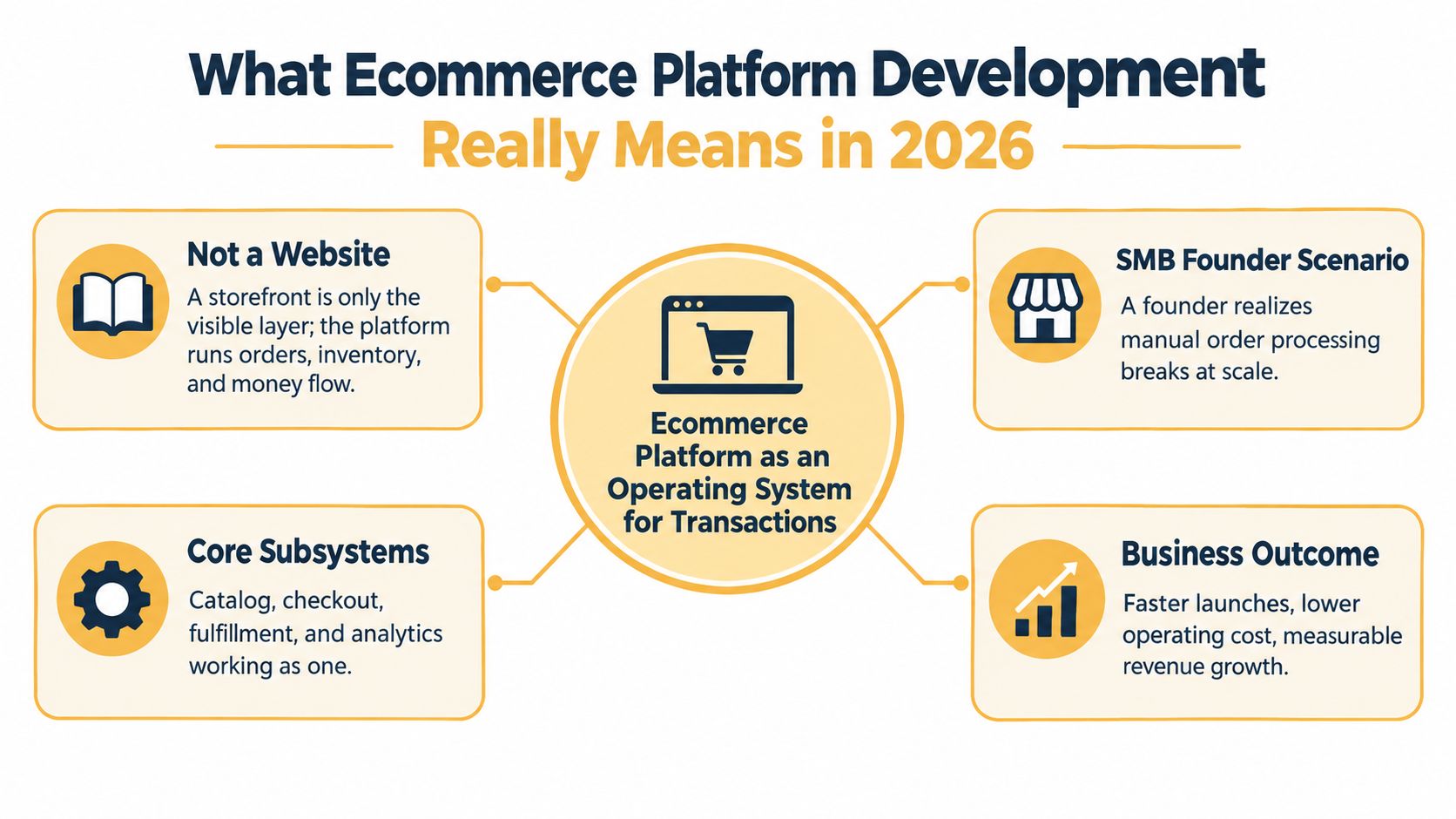
That's why ecommerce platform development isn't a website project. It's an operating-system decision for your transactions, customer data, product information, fulfillment, finance, and growth channels.
What Ecommerce Platform Development Really Means in 2026
A storefront is only the visible layer. The platform underneath must connect product data to pricing, inventory to order fulfillment, checkout to payment authorization, and customer behavior to reporting. If those systems don't agree, staff members compensate with spreadsheets, manual exports, and support tickets.
The scope has expanded because online commerce itself has expanded. In 2019, global ecommerce sales reached an estimated $26.7 trillion, with B2B transactions accounting for $21.8 trillion, or 82%, while cross-border B2C ecommerce reached approximately $440 billion. UN Trade and Development's ecommerce overview shows why a platform can't be designed only around a basic consumer cart. B2B purchasing workflows, international taxes, currencies, shipping rules, electronic data interchange, subscriptions, and marketplace feeds may all become part of the operating model.
Start with the transaction model
Before choosing technology, write down how money and goods move through the business.
- Customer types: Decide whether you serve consumers, businesses, or both. Organizational buyers may need account approval, purchase orders, negotiated pricing, tax exemptions, and repeat ordering.
- Product complexity: Record variants, bundles, subscriptions, kits, configurable products, digital goods, and products with regional restrictions.
- Operational ownership: Identify who owns catalog updates, inventory accuracy, refunds, promotions, customer accounts, and fulfillment exceptions.
- Growth channels: List the storefronts, marketplaces, mobile experiences, wholesale portals, social channels, and future AI shopping surfaces that may consume your product data.
The distinction matters. Marketing pages attract demand, but the transactional core converts that demand into accurate orders and manageable operations. A content management system can publish a campaign page. It can't, by itself, reserve inventory, calculate customer-specific pricing, route a return, or reconcile a refund with an accounting system.
Practical rule: Define the operational system before you define the visual system.
Your first scoping questions should be blunt. Which rules must be unique to your business? Which workflows are currently manual? Which system is the source of truth for products, stock, customers, and orders? What must happen if a payment succeeds but inventory synchronization fails? If a vendor can't answer those questions, it's selling you a design exercise rather than platform development.
Custom, Headless, or SaaS, Which Model Fits You
A retailer can lose months and budget by choosing architecture before defining its operating constraints. Treat ecommerce platform development as an operating-system decision for commerce, not as a website redesign. The right model determines who controls releases, payment scripts, returns, accessibility, integrations, and ongoing maintenance.
SaaS platforms such as Shopify and BigCommerce handle much of the hosting, maintenance, security tooling, and core commerce functionality. They are usually the strongest choice for a standard DTC retailer that needs to launch quickly and focus on merchandising, marketing, and fulfillment. The trade-off is dependence on platform conventions, app quality, data access, and the vendor's roadmap. Confirm how the platform supports accessible templates, return workflows, and PCI-related script control before committing.
Headless commerce separates the customer-facing frontend from the commerce backend. It gives a team more control over experience design and supports multiple channels through shared commerce services. That control carries a price: more integration work, deployment responsibility, testing, monitoring, and dependence on engineers who understand APIs, caching, observability, and data consistency. Headless is justified when those capabilities affect revenue, not because the architecture sounds advanced.
Custom development makes sense when your workflows are unusual, your existing systems require deep integration, or your commercial model cannot fit a mature platform without constant workarounds. It gives you control, but control creates responsibility. You own architecture, security, upgrades, incident response, accessibility fixes, payment-script governance, and the cost of every custom decision.
A useful primer on choosing an online selling platform helps nontechnical stakeholders frame the initial choice. For a closer examination of engineering trade-offs, review custom ecommerce development before requesting agency proposals.
| Model | Control | Time-to-Launch | Typical Cost | Best Fit |
|---|---|---|---|---|
| SaaS | Moderate, within platform rules | Fast | Subscription, apps, implementation, and transaction-related costs | Standard DTC and smaller retail teams |
| Headless | High frontend control, shared backend services | Moderate to slow | Platform, development, integrations, hosting, and ongoing engineering | Funded brands with differentiated experiences |
| Custom | Highest control | Slowest | Highest ongoing ownership burden | Complex B2B, unusual workflows, or integrated operations |
Match the model to the team
A solo founder should usually start with SaaS. A funded DTC brand should choose headless only when the storefront experience or channel strategy justifies the added operational burden. A B2B wholesaler may need custom workflows for accounts, contracts, catalogs, and purchase orders, while still using a proven commerce engine for commodity capabilities.
Agencies delivering ecommerce at scale should standardize around a small number of platforms. Reusing tested architecture, deployment processes, and component systems costs less and creates fewer operational risks than promising every client an entirely bespoke stack.
Core Features Every Ecommerce Platform Needs Before Launch
A credible platform must do more than display products and accept card details. It needs a coherent data model and dependable handoffs between customer actions and internal operations.
Build the commercial core first
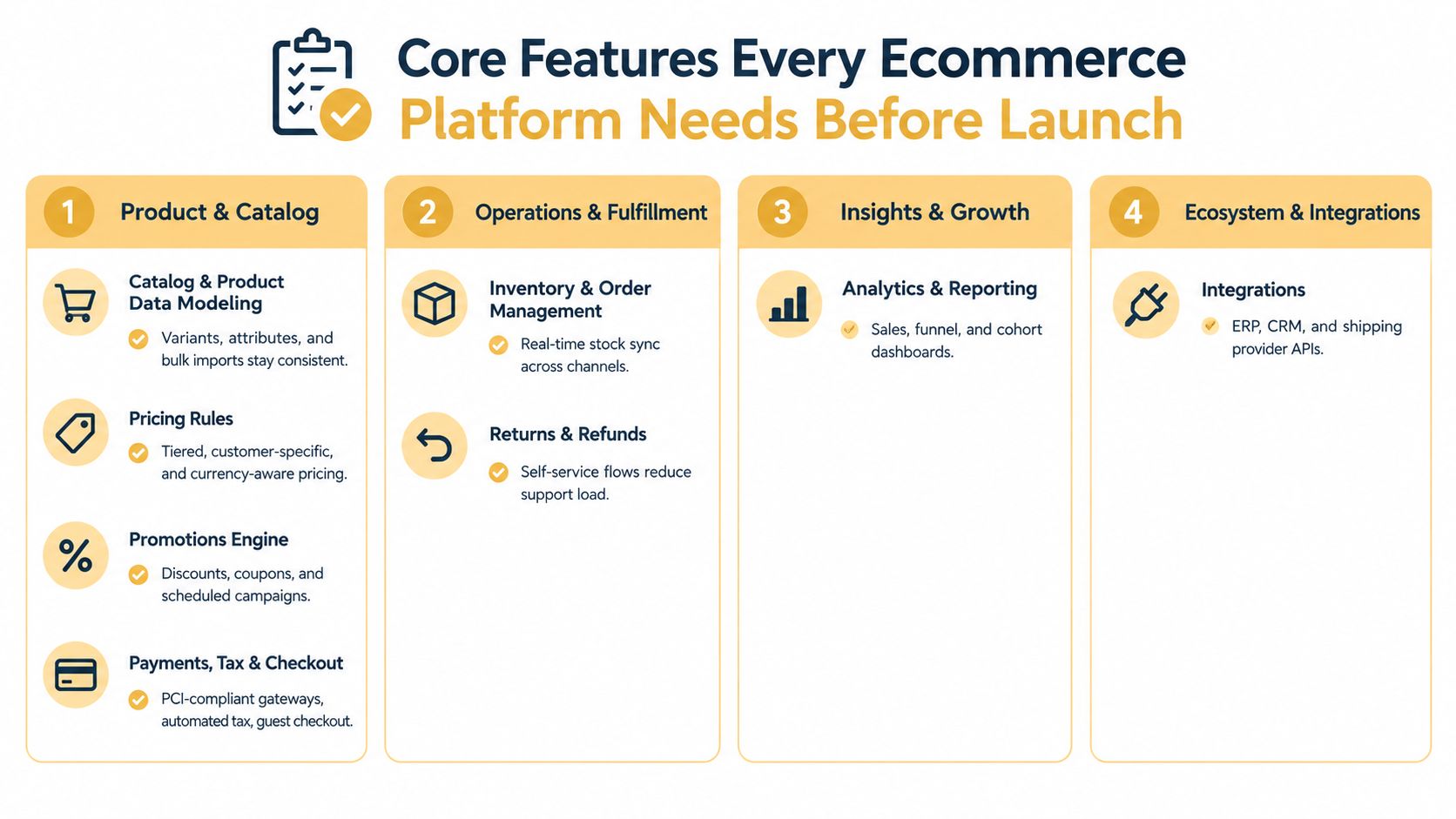
Start with the catalog. Model products, variants, attributes, media, bundles, availability, and relationships so the same information can power the storefront, feeds, search, customer service, and fulfillment. A product title and an image aren't enough when customers need to select size, material, compatibility, region, or subscription terms.
Pricing deserves its own service or rules layer. Support customer groups, volume tiers, regional currencies, sale windows, tax treatment, and promotion eligibility without hard-coding every exception into the frontend. Promotions should be testable before launch and should explain why a discount was applied or rejected.
Checkout must support guest purchase, saved customer details where appropriate, modern wallets, shipping selection, tax calculation, fraud controls, and clear error recovery. Payment success, order creation, inventory reservation, and confirmation messaging need idempotent workflows so retries don't create duplicate orders.
Treat operations as a launch feature
Search and merchandising aren't decorative features. Buyers need autocomplete, filtering, synonyms, ranking rules, out-of-stock handling, and useful category navigation. If a product exists in the database but customers can't find it, the catalog is operationally present and commercially invisible.
Your minimum operational layer should include:
- Inventory synchronization: Keep stock aligned across warehouses, channels, and order states.
- Order management: Track payment, allocation, picking, shipping, cancellation, refund, and exception statuses.
- Customer accounts: Store addresses, order history, preferences, subscriptions, and self-service actions with appropriate privacy controls.
- Returns and refunds: Give staff and customers a consistent process instead of forcing every request through email.
- Analytics: Capture product views, searches, add-to-cart events, checkout steps, payment outcomes, refunds, and repeat purchases.
- Integrations: Connect ERP, CRM, tax, shipping, support, email, and marketing systems through documented APIs or reliable events.
Teams that sell specialized products should also validate their catalog assumptions early. For example, JewelryBuyDirect's wholesale sourcing tips illustrate why product attributes, sourcing details, and merchandising information need to be structured before a store expands its assortment.
Don't build AI recommendations before product data, search, inventory, and event tracking work reliably. Personalization layered on broken fundamentals produces personalized confusion.
Tech Stacks That Power Modern Ecommerce Platforms
A modern stack should be boring in the right places. You want flexible presentation, dependable commerce logic, observable integrations, and infrastructure that can absorb traffic without turning every promotion into an emergency.
Use layers, not a pile of fashionable tools
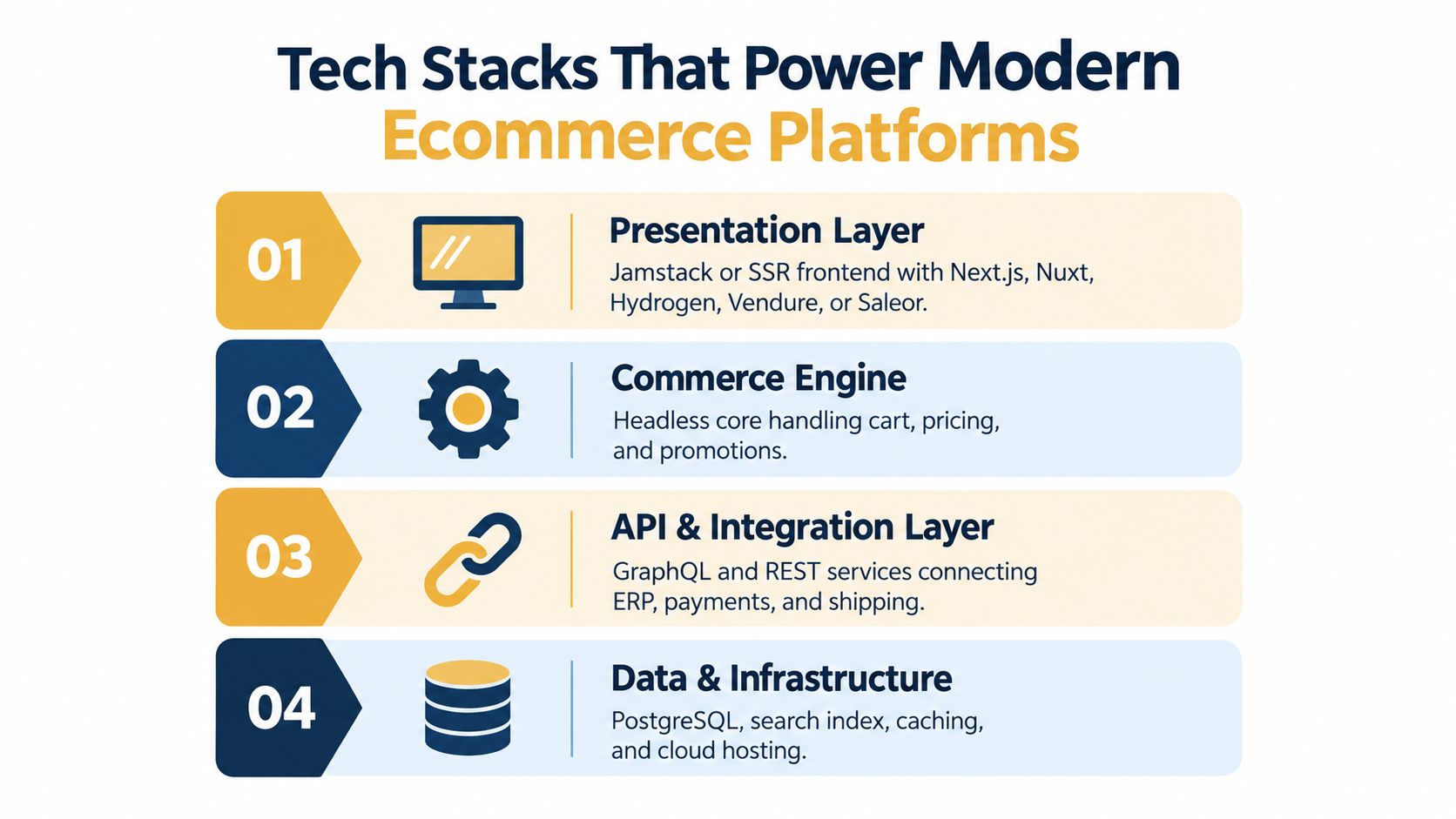
The presentation layer can use server-side rendering or a carefully designed Jamstack approach. Next.js and Nuxt are practical choices for teams that need strong SEO control and application flexibility. Shopify Hydrogen, Vendure, and Saleor can support more specialized headless implementations when the commerce backend fits the business.
The commerce engine should own carts, pricing, promotions, customers, orders, and core business rules. Don't scatter those rules across frontend components, tag-manager scripts, and one-off middleware. That architecture becomes impossible to audit when a promotion behaves differently on the product page, cart, checkout, and customer service screen.
The API and integration layer connects the commerce engine to ERP, CRM, payments, tax, shipping, search, and fulfillment. Use REST or GraphQL where they fit, but prioritize clear contracts, authentication, retries, idempotency, webhook handling, and error visibility over protocol preferences.
Spend on reliability before microservices
PostgreSQL is a sensible transactional database for many retailers. A dedicated search index handles catalog discovery more effectively than forcing every query through the primary database. Redis or an equivalent cache can reduce repeated reads, while a CDN should serve static assets and cache safe content close to users.
The infrastructure baseline should include:
- Queue processing: Move order events, email notifications, inventory updates, and fulfillment messages out of the critical request path.
- Observability: Track application errors, API latency, failed payments, inventory mismatches, queue backlogs, and checkout completion by device.
- Deployment controls: Use automated tests, staging environments, migrations, backups, rollback procedures, and permission boundaries.
- Security boundaries: Separate storefront, administrative tools, payment services, analytics, and sensitive data flows where practical.
U.S. retail ecommerce sales reached an estimated $1.2337 trillion in 2025, representing 16.4% of all U.S. retail sales, while fourth-quarter ecommerce sales reached $316.1 billion, up 5.3% year over year, according to the U.S. Census Bureau's fourth-quarter retail ecommerce report. The scale of the market makes resilience a commercial requirement, even for a smaller retailer. A failed checkout during a campaign is lost revenue, not merely a technical incident.
For an Omaha-based retailer, a realistic architecture might be a Next.js frontend, a proven commerce engine, PostgreSQL, managed search, a payment provider with tokenized fields, a shipping integration, queue-backed order events, CDN delivery, centralized logs, and dashboards for the purchase funnel. That's enough architecture to grow without building a distributed-systems research project. A focused guide to ecommerce web application development can help translate this blueprint into a delivery plan.
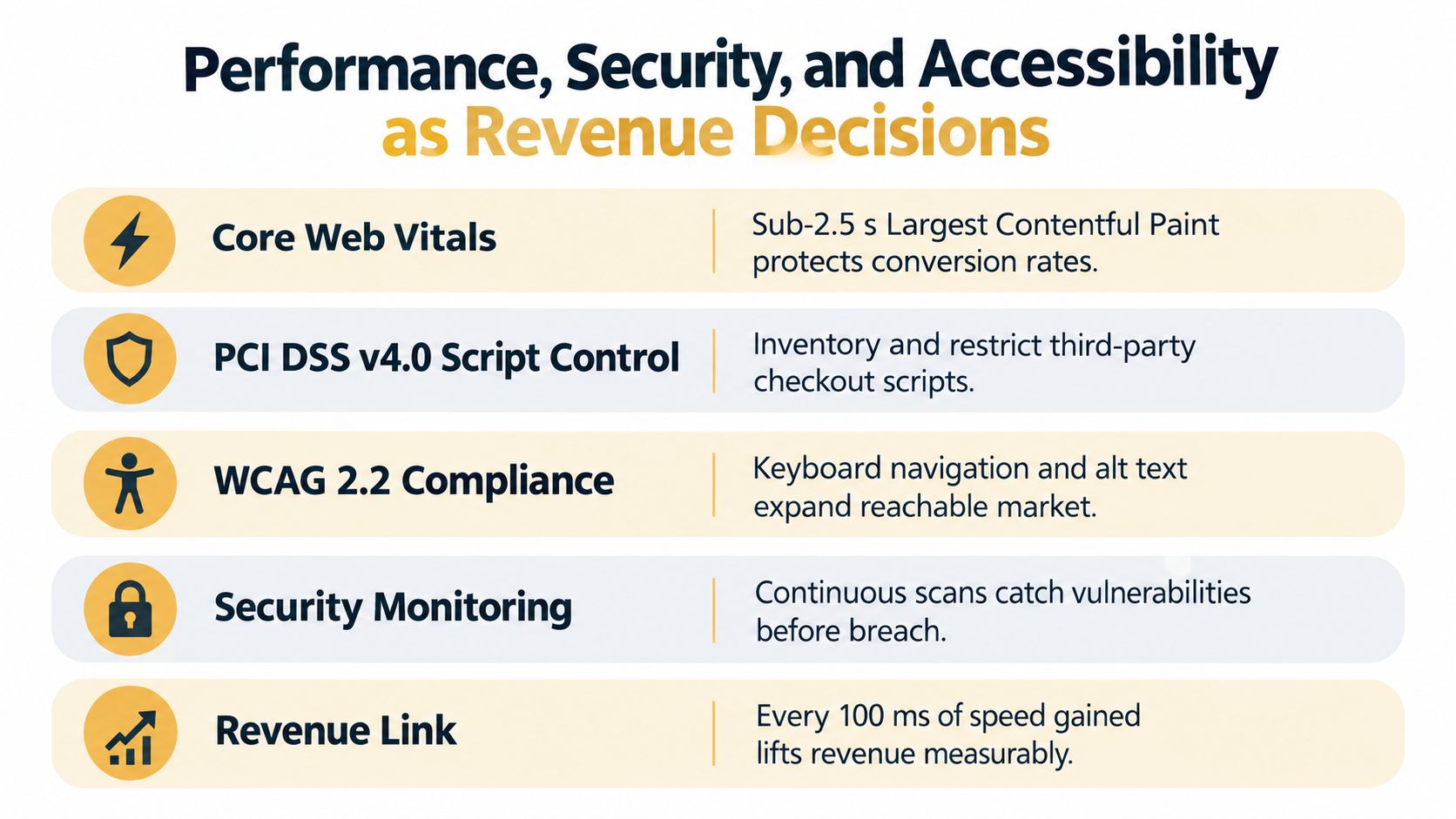
Performance, Security, and Accessibility as Revenue Decisions
Performance, payment security, and accessibility belong in the architecture backlog from the first sprint. Treating them as launch polish guarantees expensive rework and leaves revenue exposed while the team argues about ownership.
Instrument the entire funnel
The HTTP Archive ecommerce analysis defines a good real-user experience at the 75th percentile as LCP at or below 2.5 seconds, INP below 200 milliseconds, and CLS below 0.1. Those metrics must be tracked on category pages, product pages, cart templates, and checkout, not only on the homepage.
Each metric points to a different failure:
- LCP: Slow rendering delays product discovery and meaningful content.
- INP: Delayed interaction makes filtering, variant selection, cart updates, and checkout feel broken.
- CLS: Shifting images, banners, or payment widgets create mis-clicks and distrust.
Use responsive images, reserve media dimensions, defer noncritical JavaScript, limit third-party tags, and monitor field data by device, country, and funnel step. Synthetic tests are useful for diagnosis, but they don't replace evidence from real customers.
Lock down payment pages
PCI DSS v4.0 turns payment-page integrity into a design concern. Scripts running on checkout, including analytics, chat, personalization, tag management, and fraud tools, need to be inventoried, authorized, checked for integrity, and monitored for tampering. The PCI Security Standards Council's ecommerce guidance explains the control direction clearly.
Keep third-party JavaScript off payment pages unless it has a documented purpose and controlled deployment path. Prefer hosted fields or tokenized provider integrations where appropriate, apply a restrictive content-security policy, log script changes, separate merchandising permissions from deployment permissions, and document where cardholder data can travel.
Make accessibility part of the component system
Accessibility affects product discovery, variant selection, cart updates, form errors, and checkout completion. Build semantic controls, keyboard navigation, visible focus states, meaningful labels, usable validation messages, correct heading structures, and descriptive alternative text into reusable components.
Do not buy an overlay widget and call the problem solved. Automated checks can catch certain defects, but keyboard testing, screen-reader testing, and human review still expose interaction failures that automated tooling misses. Accessibility should be measured alongside completed checkouts, support contacts, error recovery, and abandonment.
Engineering standard: If a keyboard user can't select a variant, recover from a validation error, or complete payment, the platform isn't finished.
Scaling, Returns, and SEO Migration Without Breaking Revenue
Growth exposes weak operational design in three places: traffic spikes, reverse logistics, and platform migrations. Teams often solve each separately. They should design them together because all three depend on reliable events, accurate data, and controlled releases.
Traffic spikes require more than larger servers. Cache safe content, queue noncritical work, protect payment and inventory services from retry storms, and test the complete checkout path under realistic load. A platform that serves product pages quickly but fails during order creation still loses the sale.
Returns deserve equal architectural attention. Retailers expected $849.9 billion in merchandise to be returned in 2025, equal to 15.8% of annual sales, while online purchases had an estimated 19.3% return rate, according to the National Retail Federation's 2025 returns data.
Build the reverse-logistics workflow
A return should create structured events, not a support-team scavenger hunt.
- Request: Capture the order line, reason, customer identity, condition, location, and eligibility rule.
- Decision: Apply policy by product, customer risk, geography, condition, and exchange-versus-refund preference.
- Movement: Generate the appropriate label or instruction and track the item through transit.
- Disposition: Route items to restock, inspection, refurbishment, liquidation, or disposal.
- Financial outcome: Reconcile refunds, shipping costs, fees, inventory adjustments, and margin impact.
Measure contribution after reverse-logistics costs, not just the initial conversion rate. A generous policy can help acquisition and retention, but unmanaged returns create inaccurate stock, margin leakage, and abuse.
Migration adds another failure mode. Preserve URL mappings, metadata, canonical rules, structured data, internal links, XML sitemaps, analytics events, and redirect behavior. Test old URLs, new URLs, product availability, faceted navigation, and checkout before switching traffic. Launch in a controlled window with rollback procedures, rather than treating the cutover as a branding event.
The technical SEO guidance for ecommerce is useful here because migration quality depends on more than redirecting a few top pages. Search engines and customers both need stable paths to products, categories, content, and transactional actions.
Run the first year as an operating discipline
Review failed orders, payment declines, inventory mismatches, return reasons, search queries with no results, accessibility defects, and funnel performance continuously. The goal isn't to avoid every incident. It's to make incidents visible, recoverable, and economically understandable.
Your Hiring and Vendor Decision Checklist
Use the next working session to make the decision concrete.
Choose SaaS first if your product model is standard, your team lacks engineering capacity, and your priority is selling rather than owning infrastructure. Choose an agency when integrations, migration, custom workflows, or performance requirements exceed your internal capability. Hire in-house when commerce is a core product and you need permanent ownership of architecture, data, and release decisions. A hybrid model often works well for SMBs.
Ask every vendor:
- References: Can you show comparable implementations and explain what went wrong?
- Architecture: Which system owns catalog, inventory, orders, customers, and pricing?
- Security: Who owns PCI scope, script inventory, access controls, logging, and incident response?
- Accessibility: How do you test keyboard navigation, assistive technology, forms, cart, and checkout?
- Operations: What are the post-launch support terms, response commitments, backup procedures, and rollback process?
- Economics: What is included in the retainer, and which integrations or changes create additional fees?
Use a simple rollout. In the first phase, document workflows and model data. In the second, build the transactional core and test critical journeys. In the third, launch with observability, migration safeguards, and a prioritized improvement backlog.
Judge the investment through operational and commercial evidence: completed checkouts, payment success, inventory accuracy, search engagement, return cost, support volume, page experience, and organic visibility. Don't approve a platform because it looks polished. Approve it because it makes the business easier to run.
Up North Media helps businesses plan and build custom ecommerce platforms, web applications, integrations, and SEO systems around real operating requirements. If you need a practical architecture review or a migration plan, visit Up North Media and discuss the transaction workflows your next platform must support.