
You're running an Omaha retail business, your checkout finally has traffic, and the first real payment problem arrives at the worst possible time. A customer says the payment went through, your order system says it didn't, the gateway dashboard shows a pending transaction, and nobody knows whether to ship the package or refund the buyer. Meanwhile, your developer is staring at a webhook error that never appeared in testing.
That's payment gateway integration in the real world. The code matters, but the operational details matter just as much. Credentials expire, callbacks fail, test environments behave differently from production, and settlement reports rarely line up with your order database automatically. A sound integration protects checkout conversion, order fulfillment, refunds, fraud controls, and cash-flow visibility in one connected system.
The market's direction reinforces the point. One industry forecast estimates that the payment gateway market will grow from USD 44.55 billion in 2025 to USD 53.0 billion in 2026, then reach USD 104.72 billion by 2030, while another projects the digital payment gateways segment will grow from USD 34.83 billion in 2025 to USD 42.08 billion in 2026 and reach USD 88.96 billion by 2030. Those are projections, not guarantees, but they show why gateway integration has become core commerce infrastructure rather than a minor backend feature. (Research and Markets payment gateways market report)
Why Payment Gateway Integration Is a Business Decision
An Omaha retailer can choose a gateway because its advertised rate looks cheap, then discover that customers distrust the redirect, payment failures create support tickets, and chargebacks consume staff time. The gateway sits at the point where buying intent either becomes revenue or disappears. That makes it part of your customer experience and conversion strategy, not just a developer task.
A checkout that feels unfamiliar, loads slowly, or sends buyers to an unexpected domain creates friction. Customers don't care whether the failure came from your storefront, the processor, or a misconfigured return URL. They see one business, one checkout, and one reason not to finish the purchase.
Practical rule: If the payment experience feels separate from your brand, customers will treat it as a risk signal.
Gateway selection also affects what happens after authorization. A clean integration gives your team reliable payment status, clear refund controls, usable dispute information, and settlement records that finance can reconcile. A weak integration leaves the frontend celebrating a successful redirect while the backend never receives the event needed to release inventory or start fulfillment.
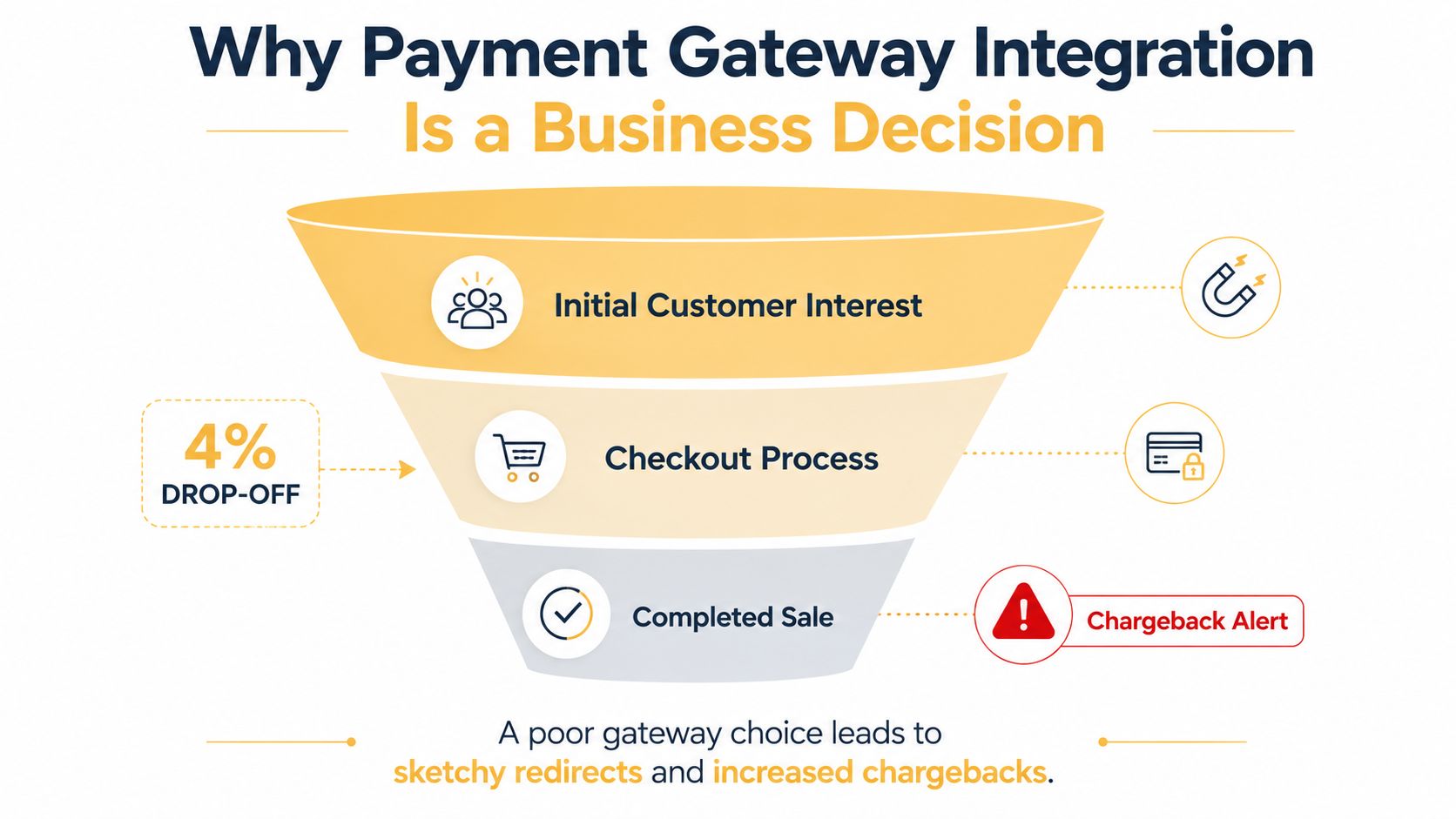
A poor gateway choice leads to sketchy redirects and increased chargebacks.
The costs show up in several departments
Marketing may send qualified shoppers to the site, but checkout determines whether that demand produces cash. Customer service handles the fallout when a buyer sees a pending charge but no confirmation. Operations waits for trustworthy payment state before shipping. Finance needs settlement data that explains why the bank deposit doesn't equal the day's gross order total.
That's why SMB owners often fix the same integration twice. The first repair happens at launch, when the team discovers missing error handling. The second arrives after transaction volume exposes duplicate webhooks, refund gaps, or confusing dispute workflows.
The payment gateway market forecast describes expansion across the infrastructure supporting merchants, processors, wallets, and banks. For a small business, the practical takeaway is simpler: your gateway decision shapes how easily you can accept payments, recover from failures, and expand payment methods later.
Put the decision in the same conversation as pricing, marketing, inventory, and customer experience. Don't bury it in a sprint document where the cheapest API wins by default. Choose the checkout pattern, provider, and security posture based on how your business sells and how your team will operate the system after launch.
Hosted Checkout vs Direct API vs Embedded SDK
There are three practical integration patterns for most SMBs. They differ less in marketing language than in who owns the sensitive work, how much control your team has, and how many failure modes you must maintain.
| Pattern | PCI Scope | Time to Launch | Best For |
|---|---|---|---|
| Hosted checkout | Lowest practical scope when configured correctly | Fastest | Owners who want a dependable launch without building payment UI |
| Direct API with tokenization | Larger engineering and compliance responsibility | Slowest | Teams with strong backend and payments expertise |
| Embedded SDK | Reduced card-data exposure with branded checkout | Moderate | Most SMBs seeking a balanced default |
Hosted checkout
A hosted flow sends the customer to a provider-managed payment page, such as Stripe Checkout or a Braintree redirect. The provider handles the card-entry interface, much of the browser-side security burden, and the payment experience's core mechanics.
Choose this when you want to launch quickly and your business doesn't need a highly customized checkout. The trade-off is obvious: your branding and interaction design stop at the redirect. A familiar provider domain can build trust, but an awkward transition can make the purchase feel less connected to your store.
Direct API with tokenization
A direct API integration keeps the payment flow inside your application. Your server creates the transaction, receives a token rather than raw card data when the flow is designed correctly, and coordinates authorization, capture, refunds, and customer records.
That control comes with real responsibility. Your team must handle token lifecycles, authentication changes, three-domain secure authentication challenges, timeout behavior, retries, and provider-specific edge cases. Most Omaha SMBs should skip this path until they have a payments-capable engineer available to maintain it. You don't need maximum flexibility if your team can't operate it safely.
For background on the parties involved in card acceptance, Sambapay's explanation of the ISO acquirer definition helps clarify where an independent sales organization fits within the broader processing chain.
Embedded SDKs
Embedded tools such as Stripe Elements sit between the two extremes. The card fields appear within your checkout, while the provider's client-side components help keep raw card details away from your server. You retain the visual design and page flow without taking on the entire burden of card handling.
For most SMBs, this is the sensible default. If you need help evaluating the engineering effort behind an SDK or API implementation, API integration services can help you compare the build against the ongoing maintenance cost.
How to Choose the Right Gateway for Your Business
Don't begin with a provider's feature page. Begin with the money and workflow your business needs to support.
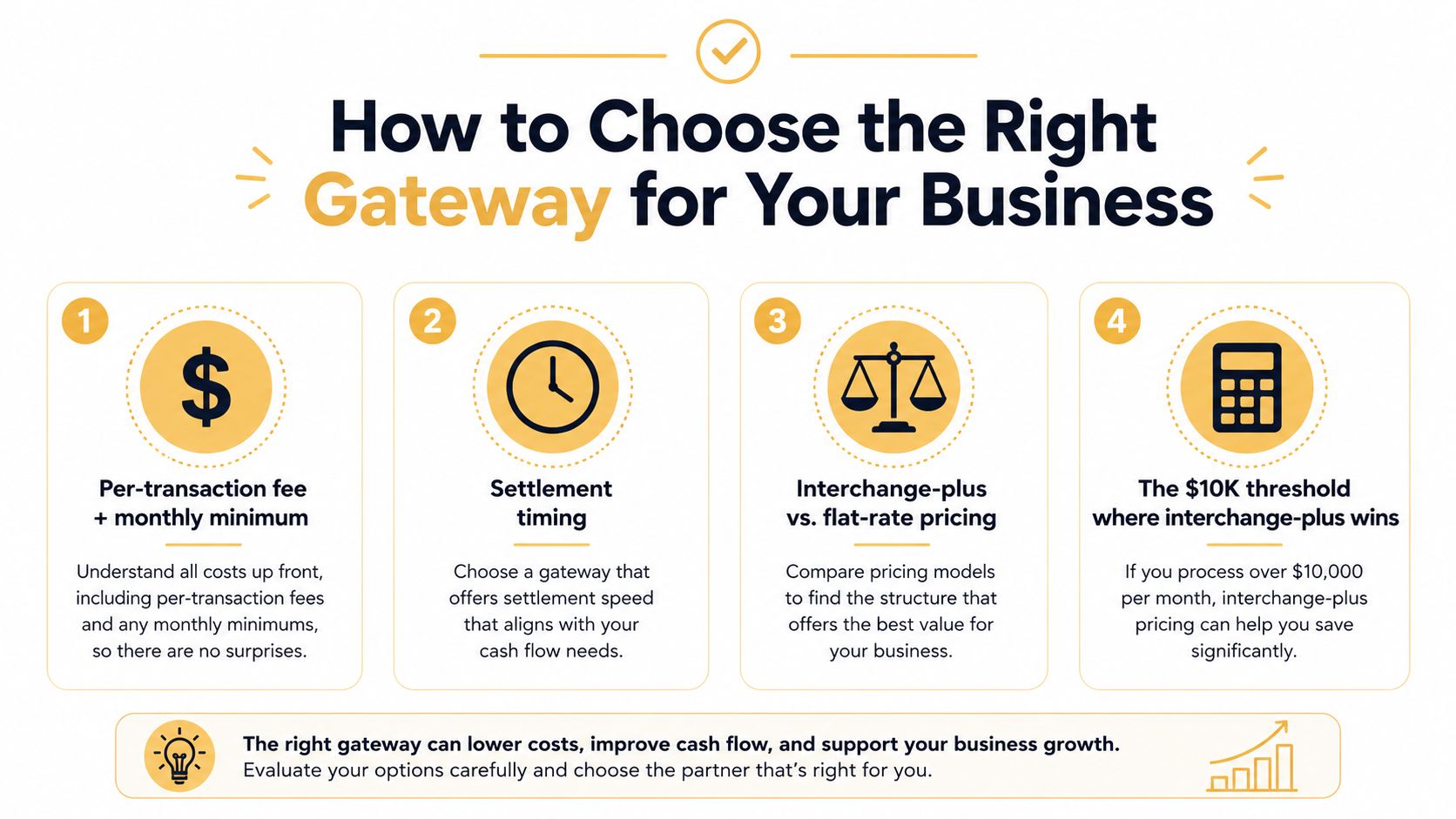
First, document the complete commercial model. Include per-transaction charges, monthly minimums, gateway fees, chargeback costs, refund treatment, currency conversion, and settlement timing. A headline rate tells you very little if the provider's settlement schedule creates a cash-flow problem or its dispute process consumes hours of staff time.
Test the provider before you commit
Use the sandbox as a product test, not a box to check. Sign up without asking sales to guide you, create a test order, process a payment, trigger a decline, inspect the webhook payload, and attempt a refund. If the documentation makes those actions difficult, production won't feel easier.
Ask these questions in order:
- Pricing model: Does the fee structure match your current sales pattern, or is it designed for a larger merchant?
- Settlement timing: When do authorized funds become available, and what happens on weekends or holidays?
- Payment methods: Do you need cards only, or should the gateway support ACH, SEPA, wallets, or real-time payment rails?
- Webhook design: Can you verify signatures, replay events safely, and retrieve an event after delivery fails?
- Support access: Can a small business reach a knowledgeable person during an incident?
- Account controls: Can a nontechnical owner manage users, credentials, refunds, and reporting without granting excessive access?
Test support with a concrete pre-sales question outside normal business hours. The quality and speed of the answer tells you more than a sales deck about launch-week support.
Match the rails to Omaha buyers
An Omaha B2B seller may care more about ACH for invoices than about adding another digital wallet. A retailer may need surcharge support, while a business with tight cash flow may prioritize faster settlement over a small difference in processing cost. Cross-border sellers should examine supported currencies, foreign-exchange settlement, localized payment methods, and reporting clarity rather than assuming that card acceptance equals international readiness.
Industry coverage also points to alternative rails, cross-border settlement, real-time payments, surcharge support, and Level III data as important gateway considerations for specialized use cases. (Payment gateway API trends from TSG Payments)
For a broader starting point, Zaro's guide to best small business payment options can help you build an initial provider shortlist. Your final decision should still come from testing the actual workflow.
Pricing rarely decides the outcome by itself. Webhook reliability, documentation clarity, settlement visibility, and support quality usually matter more once real orders start moving.
Building the Integration the Right Way
Build the integration in an order that protects your internal ledger first. The customer can see a success page, but your database must remain the authority for whether an order is paid, fulfilled, refunded, or disputed.
Start on the server
When your application receives a checkout request, create an internal order ID on the server. Calculate the price from trusted product and inventory data, validate the currency, write the order with a pending status, and only then create the provider checkout session.
Never accept the browser's total as truth. A customer can modify client-side values, send an old price, or replay a request. OWASP specifically recommends backend validation of the amount, currency, and order ID, trusting server-to-server callbacks, and processing an order only once when callbacks are duplicated. (OWASP third-party payment gateway integration guidance)
A Stripe-flavored flow might look conceptually like this:
- The server creates
order_123with apendingstate. - The server calculates the authoritative total.
- The server creates a checkout session tied to
order_123. - The client redirects the buyer to the provider.
- The success route displays a status page, but doesn't fulfill the order.
- The webhook confirms the authoritative payment event.
- The server stores the event and changes the order exactly once.
Don't fulfill from the success redirect. Treat it as a customer-facing status route, not proof of settlement.
Verify and record the webhook
Read the raw request body before JSON middleware changes it. Compute the HMAC signature using the gateway's shared secret, reject a mismatch, validate the event type and merchant context, and use the provider event ID as an idempotency key. Store the event before performing fulfillment, then return a successful response quickly, even when slower work moves to a queue.
Stripe commonly signs webhook payloads for verification. Authorize.Net may use a different signature scheme and event structure. Braintree's notifications and Adyen's event codes also diverge, so don't build an abstraction that assumes every provider speaks Stripe.
| Step | Server Action | Client or Redirect Action | Webhook Action | Common Failure |
|---|---|---|---|---|
| Create order | Validate price, currency, inventory, and internal ID | Submit checkout request | None | Client total is trusted |
| Create session | Send server-calculated line items | Wait for redirect response | None | Secret key exposed in browser |
| Complete payment | Keep order pending | Show success or cancellation state | Confirm payment status | Success page triggers fulfillment |
| Receive event | Verify raw payload and signature | No action required | Store event and update order once | Middleware alters the payload |
| Refund | Record full or partial refund request | Display refund status | Confirm refund event | Refund recorded twice |
| Dispute | Attach payment and order evidence | Notify customer when appropriate | Mark chargeback state | Fulfillment ledger stays unchanged |
Refunds need their own state machine. Record requested, submitted, succeeded, and failed outcomes. Partial refunds must reference the original payment and preserve the remaining captured amount. Chargeback events should update the order ledger and create a task for evidence collection, not just overwrite the original payment status.
Security and PCI Compliance Without the Overhead
Small businesses often treat PCI compliance as a giant paperwork problem. The more useful framing is architectural: keep raw card data out of your systems whenever possible.
Hosted checkout and client-side tokenization can reduce the payment data your application handles. That can simplify the applicable self-assessment, but it doesn't remove your responsibility for secure pages, access control, accurate documentation, and correct integration behavior. Confirm the scope with your acquiring bank or qualified security professional rather than assuming an SDK automatically makes you compliant.
Validate what the gateway can't know
Your server knows facts the gateway may not know. It knows whether the cart total matches your catalog, whether the order ID already exists, whether the currency fits the customer's account, and whether the same buyer is generating suspicious activity.
Apply controls for:
- Amount tampering: Recalculate totals from server-side product data.
- Currency mismatch: Compare the requested currency with the order and merchant configuration.
- Duplicate orders: Reject or safely reuse repeated internal order IDs.
- Velocity anomalies: Flag repeated attempts, rapid retries, and unusual patterns for review.
- Authorization context: Confirm that callbacks belong to your merchant account and expected environment.
Use TLS for every payment and callback path. Keep secrets out of source control, especially .env files that accidentally reach a public repository. Redact payment identifiers and never allow CVVs or full primary account numbers into application logs, analytics tools, support tickets, or error traces.
Make credential management routine
Rotate API keys and webhook secrets on a documented schedule. A 90-day minimum rotation cadence is a practical baseline from the implementation brief, but the provider's policy, your risk profile, and incident procedures should determine the final schedule. Separate sandbox and production credentials, restrict dashboard roles, and give the owner a safe way to revoke access without calling a developer.
For a broader application-security checklist, review these website security best practices alongside your gateway's PCI documentation.
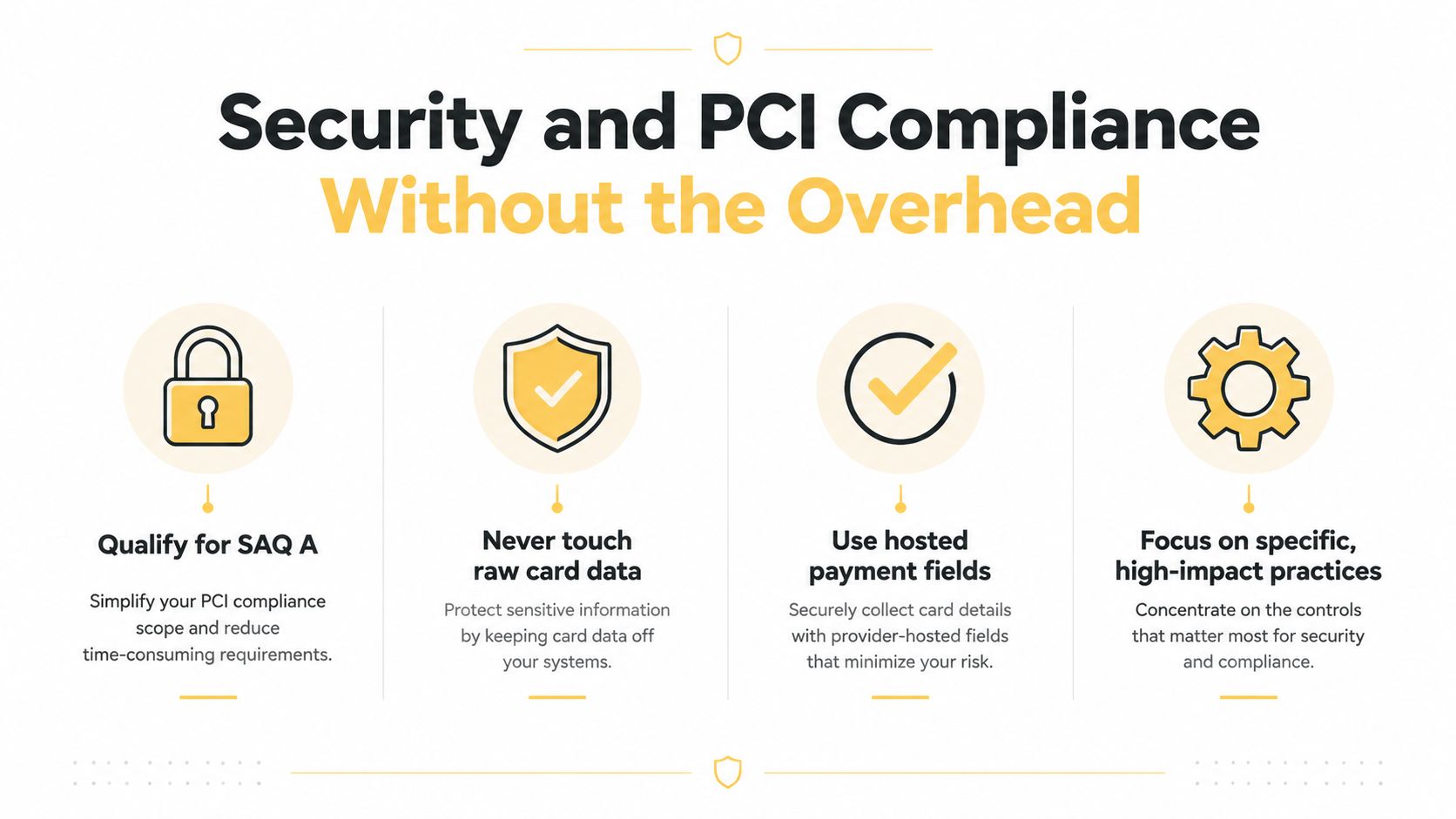
A sensible scope-reduction checklist is short:
- Tokenize everywhere: Use hosted fields or provider tokens instead of handling raw card data.
- Redact logs: Mask payment identifiers and remove sensitive request bodies.
- Restrict dashboard access: Use individual accounts, least privilege, and network controls where available.
- Enable native fraud rules: Start with the gateway's built-in controls before adding another risk platform.
- Review callbacks: Verify signatures and reject unexpected events.
Testing, Launch, and the Failures Nobody Warns You About
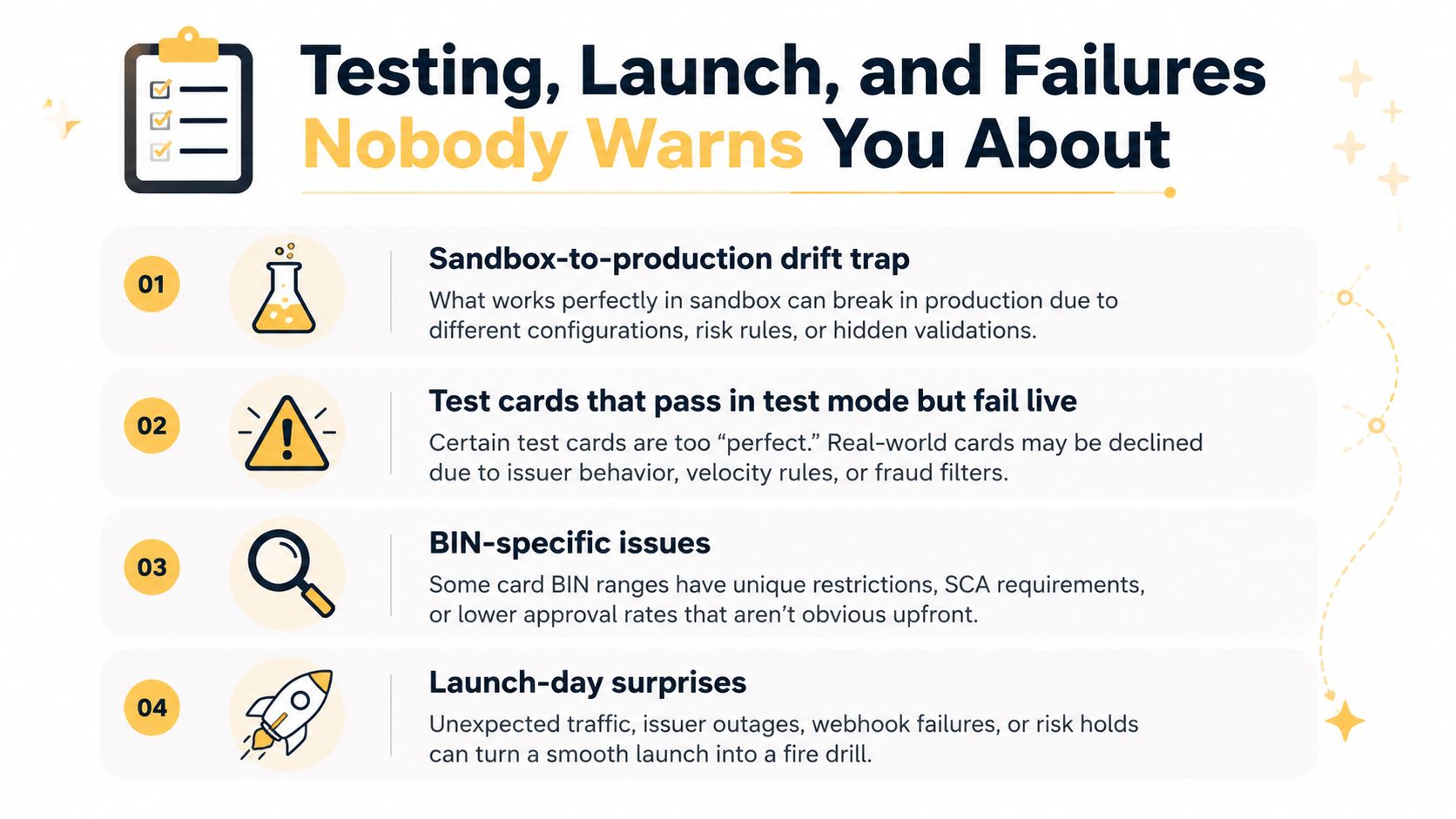
Sandbox success creates false confidence. A test card can pass in test mode while a live payment fails because issuer behavior, address verification rules, three-domain secure authentication, or card-range restrictions differ in production. Treat sandbox testing as a rehearsal of system behavior, not a prediction that every live card will authorize.
The webhook signature failure is especially common. An Express application may parse the request body before the verification library reads it. The application then calculates a signature against a re-serialized JSON payload, rejects every legitimate event, and leaves orders pending while the checkout page tells customers to expect confirmation.
Build a failure matrix
Test the whole transaction lifecycle, including the states nobody wants to see:
- Successful payment: Confirm the order moves from pending to paid only after the verified event.
- Declined payment: Show a useful message and preserve a retry-safe order state.
- Timeout: Prevent the browser from creating multiple orders while the provider response is unknown.
- Duplicate webhook: Deliver the same event repeatedly and confirm that fulfillment runs once.
- Invalid signature: Reject the event and record enough diagnostic context without storing sensitive data.
- Refund: Test full and partial refunds, including repeated refund requests.
- Capture and void: Confirm that authorization, capture, and void states remain distinct.
- Chargeback: Verify that the order ledger records the dispute and alerts the responsible person.
Stop retry storms before they duplicate money
When a webhook endpoint returns an error, gateways may retry delivery. If your handler creates fulfillment without an idempotency check, the same order can ship more than once. A second dangerous variation occurs when a refund request times out. Your system assumes it failed, submits another request, and creates an incorrect refund or a provider rejection.
Use the gateway event ID, internal order ID, and provider transaction ID as separate identifiers. Store each event's processing state. Return a fast acknowledgment after durable receipt, then process inventory, email, and fulfillment asynchronously.
Reconciliation drift has a quieter cause. The gateway, processor, and bank may report transactions at different stages, while refunds, chargeback reversals, and currency rounding alter the final figures. Before launch, prepare a reconciliation script and run it against live data on the first operating day. Don't wait for the first month-end close to discover that your ledger can't explain the deposit.
Reconciliation, Analytics, and Scaling Past Your First 10,000 Orders
A gateway integration isn't finished when the first payment succeeds. It's finished when your team can explain every material difference between the order ledger, gateway settlement report, processor statement, and bank deposit.
Start with a daily reconciliation routine. Match internal order IDs to provider transaction IDs, then classify exceptions instead of forcing totals to balance. The usual trouble spots include refund netting, chargeback reversals, interchange adjustments, settlement timing, and currency conversion rounding.
Track operational signals, not vanity metrics
Your webhook event log should be the source of truth for payment state. The checkout page is useful for customer messaging, but it can't prove that your backend received and processed the provider's event.
Useful analytics include:
- Authorization rate by BIN: Identify issuer or card-range patterns behind declines.
- Decline clusters: Group reasons to separate customer errors, fraud controls, configuration issues, and provider outages.
- Chargeback trend: Watch direction and reason categories rather than isolated disputes.
- Webhook health: Track missing, delayed, rejected, and replayed events.
- Settlement variance: Compare expected deposits with actual bank activity and document each exception.
A spreadsheet can work while transaction volume and product complexity remain manageable. Move to automation when manual matching consumes recurring staff time, exceptions are difficult to trace, or multiple currencies and payment rails make the ledger unreliable. The right trigger isn't an arbitrary order count. It's the point where an error costs more than the automation required to prevent it.
For a practical overview of the process, use this 2026 payment reconciliation guide as a reference while designing your own exception workflow.
Scale only when the operating evidence supports it
A single merchant account and API key is appropriate for many small businesses. Consider multi-merchant routing when separate brands, legal entities, geographies, or settlement requirements make one account difficult to manage. Add a second gateway for failover only when you can reconcile both providers and decide which failures justify rerouting. A second gateway without unified order and event records creates two problems instead of solving one.
Omaha businesses should also plan capacity around local demand patterns, including the College World Series and Berkshire Hathaway weekend. The practical preparation is operational, not speculative: confirm provider limits, test queues, monitor webhook latency, and make sure support coverage matches expected demand.
A manageable 90-day maturity path
During the first phase, select the provider, choose hosted checkout or an embedded SDK, document credentials, and build the pending-order model. Next, implement signed webhook verification, idempotent writes, refunds, disputes, logging, and reconciliation. In the final phase, review decline clusters, settlement exceptions, access permissions, and support procedures, then decide whether additional rails or a second provider are justified.
If the storefront or backend needs broader engineering work, ecommerce web application development can support the payment layer as part of the larger commerce system. The goal isn't a clever integration. It's a payment operation your two-person team can understand, monitor, and repair without guesswork.
Up North Media helps Omaha businesses design and build web applications with payment processing, checkout, authorization, capture, refunds, and fraud-control workflows included in the broader ecommerce architecture. Visit Up North Media to discuss your gateway integration, reconciliation needs, and a practical launch plan.