
A basic fitness app MVP costs $10,000 to $30,000 and takes 2 to 3 months to deliver. Add wearable synchronization and health-data handling and the same app moves to $50,000 to $150,000.
The gap between those two numbers is where most budget conversations go wrong. It isn't a difference in craftsmanship or hourly rates. It's scope, and scope is the only line item a founder controls. What published estimates handle badly is everything that sits behind the feature list: the cost of holding sensitive health data lawfully, and the cost of running and learning from the product after release. Treat the app as a staged roadmap with a funding gate between each stage and the numbers stop being frightening.
Fitness App Development Cost Ranges at a Glance
The reference points behind most 2026 budgets come from a mobile app cost-estimation benchmark that puts a basic application with user authentication and push notifications at approximately $10,000–$30,000, with a typical delivery period of 2–3 months. Fitness trackers move up a tier: core activity tracking, health-data handling and device integration land at $50,000–$150,000. An advanced health platform with telemedicine-style video consultations, medical-record integration, prescription management and extensive regulatory controls reaches $200,000–$500,000 or more.
Laid end to end, those brackets describe a ladder, not a single price.
| App tier | Typical scope | Budget range |
|---|---|---|
| Basic MVP | Manual workout logging, user authentication, push notifications, basic analytics | $10,000–$30,000 |
| Basic tracker | Activity tracking with a focused feature set | $18,000–$35,000 |
| Mid-complexity app | Social features, subscriptions, personalized plans | $40,000–$90,000 |
| Tracker with wearables and health data | Device integration, health-data handling, core activity tracking | $50,000–$150,000 |
| AI or marketplace product | AI features, marketplace functions, complex personalization | $100,000–$250,000+ |
| Advanced health platform | Video consultations, medical-record integration, extensive security and regulatory controls | $200,000–$500,000+ |
A name is not a scope
Two products both called "a fitness app" can sit six figures apart and neither vendor is exaggerating. Manual workout logging, profiles, notifications and basic analytics fit comfortably in the bottom band. Synchronization with wearables, real-time data processing, subscriptions, social features, personalized recommendations and privacy controls push engineering, testing, infrastructure and maintenance into a different league. The label on the app store listing tells you nothing about which row you belong in.
A practical reading of the ladder: your row is set by integrations and data types, not by how many screens the designer draws.
How to use the table
Find the row whose scope matches the features you need, then read the next two sections to see what pushes you up one. If you're comparing quotes, this is also the cheapest way to catch a bid that's too low: a proposal priced near the MVP band that includes wearable sync and a subscription engine is missing work, not saving you money. For a broader view of what sits inside those brackets line by line, our own breakdown of mobile app development cost walks through the same phases from discovery to launch.
Which Features Push the Budget Up or Down
Every item on your feature list belongs to one of four cost pillars, and each prices in a different way. Sort the list before you request quotes, and you'll know which part of the range you're heading for and which items can wait for a later stage.
Core features are the predictable spend: logging, profiles, notifications and basic analytics. They reuse patterns shipped dozens of times, test cleanly on a single device, and don't depend on a third party's release schedule. If your whole launch sits here, your estimate will be accurate to within a normal margin.
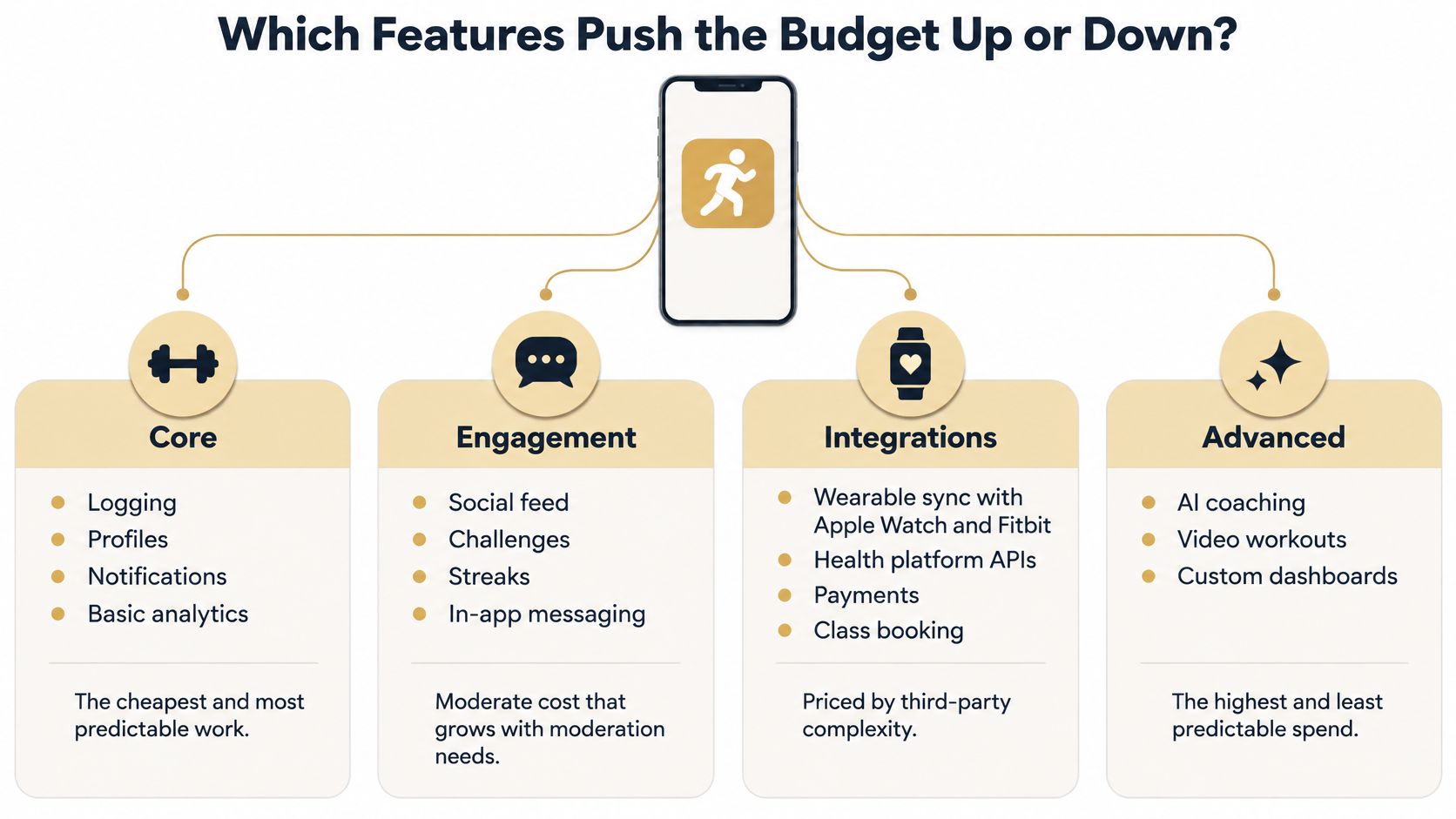
Connected features are where quotes start drifting. Wearable synchronization and real-time data processing add work that never appears on a wireframe:
- Device-specific edge cases: missing heart-rate samples, permissions revoked mid-session, phones that kill background tracking to save battery.
- Integration testing: pairing against real hardware, not just a simulator, across at least two generations of watch and phone.
- Ongoing API maintenance: every vendor SDK update arrives with a testing cycle attached, forever.
Engagement features carry their own multiplier. Social feeds, challenges and leaderboards need moderation tooling and abuse handling. Subscriptions and in-app payments need their own permission flows, restore logic, receipt validation and store policy compliance, and a rejection at review costs you a release cycle.
Intelligence sits at the top. Personalized recommendations and AI coaching need a data pipeline, model evaluation, guardrails for bad advice, and inference spend that recurs every month rather than once.
Scoring a feature list in ten minutes
Take the same app twice. Version one offers manual workout logging, a profile, push reminders and a weekly summary chart. Version two adds Apple Health and Google Health Connect sync, a live heart-rate display during sessions, and a recommendation engine that suggests tomorrow's workout. Version two doesn't add three features to version one; it adds an integration layer, a real-time data path and a modelling pipeline, plus the QA time to test all three together on real devices.
Mark each planned feature as core, connected, engagement or intelligence. The count of items outside core is the fastest signal of where the budget will rise.
Consumers can already see this split in finished products. Trim's guide to weight apps ranks tools largely on how little manual input they demand and how much data they pull automatically, which is exactly the core-versus-connected boundary that decides a build budget.
How Platform Choice and Integrations Change the Bill
The platform decision moves the number more than any single feature. Native iOS in Swift or native Android in Kotlin means one codebase and one set of store rules. Building both natively means writing the interface and the test suite roughly twice, even when the backend is shared. A cross-platform framework such as Flutter or React Native shares most of that code, at the cost of device-level testing for sensors and background tracking. A responsive web app keeps the starting spend lowest but gives up access to phone sensors and reliable background tracking, which makes it a validation tool rather than a released product.
Web app development, meaning custom web applications that include e-commerce platforms and business tools, is a real option for the first stage. It just isn't the same product as a store-listed tracker.
| Approach | How it is built | Budget effect | Best fit |
|---|---|---|---|
| Native iOS only | Swift app for Apple devices | Lower initial build than two native apps | Audiences concentrated on iPhone |
| Native Android only | Kotlin app for Android devices | Lower initial build than two native apps | Audiences concentrated on Android |
| Native iOS and Android | Two separate codebases | Roughly doubles UI and testing work | Apps that need full device features on both platforms |
| Cross-platform framework | One shared codebase for Flutter or React Native | Shares most code, adds device-level testing | Most MVPs that need both platforms |
| Responsive web app | Browser-based app that works on phones | Lowest starting spend, limited sensor access | Early validation without app-store release |
Here's a walkthrough of how the platform layer and integrations get priced in practice.
Where integrations add a second bill
Each integration you add carries three costs, not one: the initial connection, the sandbox and device testing to prove it works, and an update cycle every time the vendor changes its API. Apple HealthKit and Google Health Connect for wearable data, a payment gateway for subscriptions, a messaging service for reminders, an analytics platform, and a backend with an admin dashboard so your team can answer support questions without a developer.
If your app also has to talk to club software for class spots, bookings and memberships, the integration budget grows with the number of systems rather than the number of screens. Tools like Sports Club App show what that connected layer looks like from the member's side, and every one of those functions has to be wired to something.
Decide in this order: list every platform and integration, price the most expensive one first, then split the list into launch and stage two.
Where an integration is custom, it's worth reading how API integration services are scoped before you accept a single line item for "integrations" with no breakdown behind it.
Privacy, Health Data and Compliance Costs Most Estimates Miss
A small MVP does not automatically carry a small compliance bill. Published estimates commonly span roughly $15,000–$250,000+, and as an analysis of fitness app cost estimates shows, that range prices features, not data governance. Few published figures separate ordinary activity tracking from products handling heart rate, sleep, biometrics, clinical information or wearable data. That single distinction changes architecture, consent flows, encryption, access controls, breach procedures, auditability, legal review and vendor contracts.
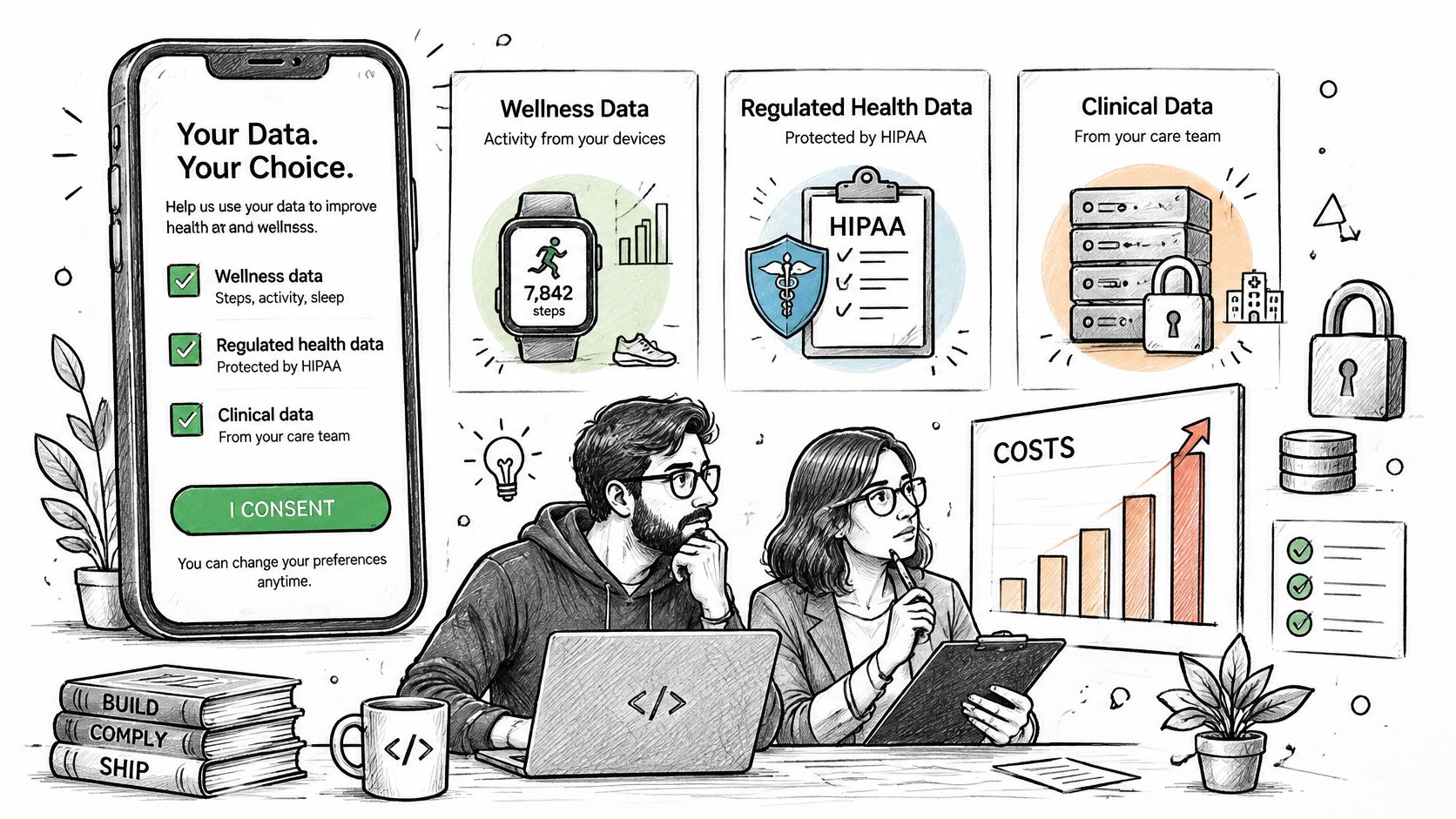
The governance bill scales with the category of data, not the size of the build. Budget the three cases separately. Consumer wellness data covers steps, workout logs and self-reported weight, and it's the cheapest to govern. Regulated health data covers heart rate, sleep, biometrics and anything clinical, and it pulls in stronger encryption, tighter access rules and documented procedures for what happens when something goes wrong. Cross-border operation brings regimes such as GDPR, HIPAA or California privacy law into scope, depending on where your users live.
One clarification saves founders weeks of unnecessary legal spend: HIPAA is not triggered merely because an app is fitness-oriented. Applicability depends on the organization, the data relationships and the use case. The question to take to a lawyer is what your app does with the data and for whom, not whether it counts as fitness software.
Cutting features does not reliably cut risk. One wearable integration or health-data workflow can cost more to operate than several visible front-end features combined.
Three decisions that cap compliance spend
- Classify every data type the app will collect, and mark which ones are regulated before a schema exists.
- List every market where users will live, not the markets you'd like to enter.
- Decide what you won't collect at launch. Skipping sleep and biometrics in stage one is a scope decision that removes a whole category of obligation, and it creates a natural funding gate: stage-two budget releases only when there's a business case for the added liability.
Compliance is a scoping decision, not a percentage bolted onto a quote after the design is signed off. A cheap MVP becomes an expensive rebuild when retention and deletion rules surface after the database is in production, so founders should check health app data retention policies before the schema is fixed, not after a deletion request forces the question.
Ongoing Costs to Budget for After Launch
The largest recurring line is maintenance, and published development estimates put annual maintenance at 15%–20% of the original build, every year. That covers bug fixes, operating system updates, dependency upgrades and small features driven by real user feedback.
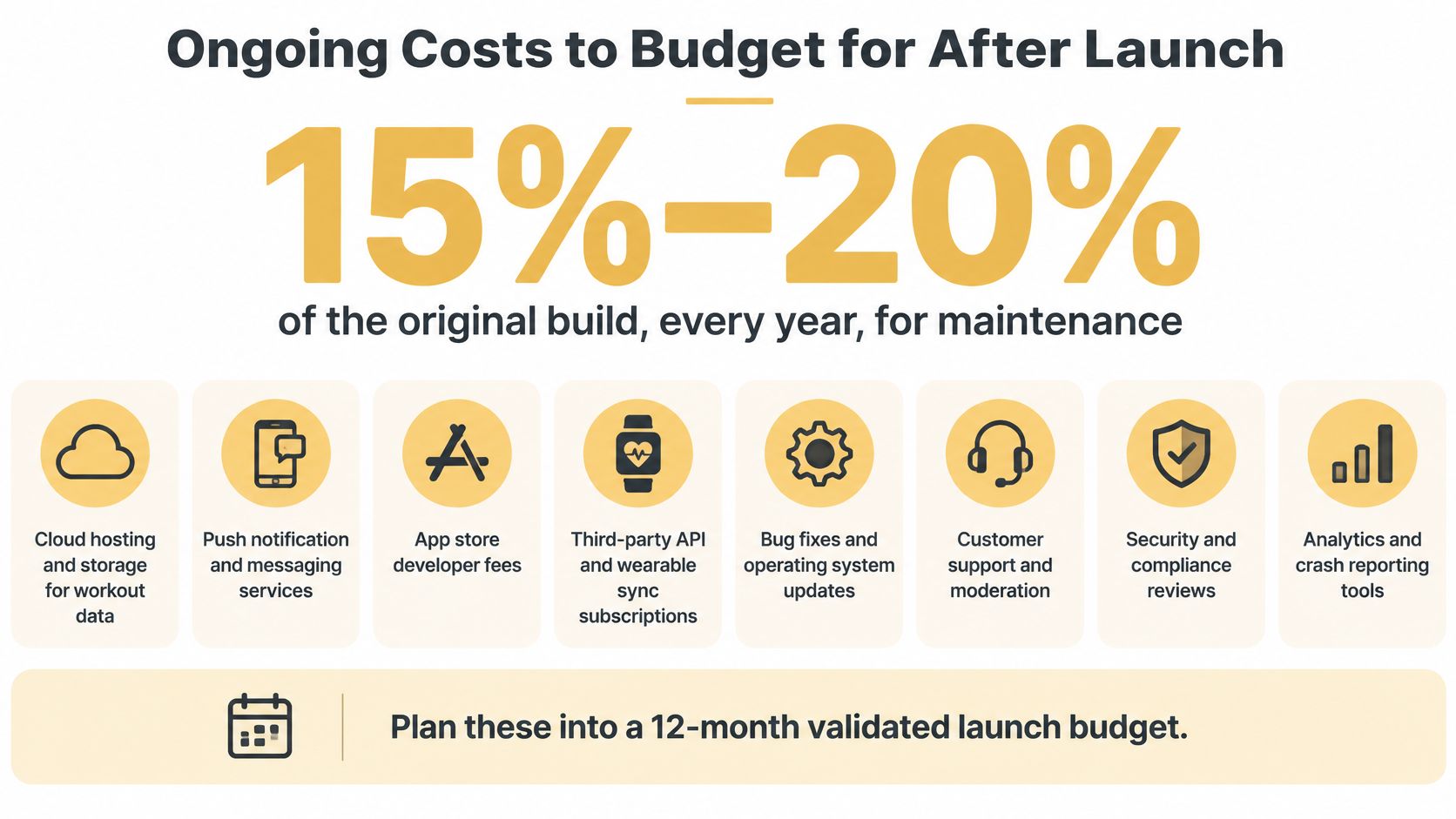
| Cost line | Type | Main driver |
|---|---|---|
| Annual maintenance | Recurring | Original build cost |
| Cloud and infrastructure | Recurring, variable | Active users, video, AI inference, wearable data volume |
| Third-party APIs | Recurring | Wearable sync, analytics, messaging services |
| App-store operations | Recurring | Developer accounts, releases, listing updates |
| Customer support | Recurring | Number of users and subscriptions |
| Lifecycle messaging and content | Recurring | Content refreshes, push and email campaigns |
| Acquisition and retention tests | Ongoing | Experiments and Day-30 retention tracking |
What the cheapest app really costs
A cheaper app can be the more expensive business. Without onboarding measurement, reliable event tracking and a Day-30 retention view, nobody can tell you why users stop exercising, so the next round of investment is a guess. A lean MVP with frictionless daily logging and clean analytics produces evidence. A larger app with weak instrumentation produces screenshots.
Fixed build cost and variable cost per active user are different animals. Text and logs cost almost nothing to serve. Video classes, AI inference and continuous wearable synchronization scale with usage, so the monthly bill rises exactly when the product starts working.
Rule for the planning spreadsheet: budget the first 12 months after launch, not just the release date.
Run the arithmetic once and the shape becomes obvious. A $30,000 build carries roughly $4,500–$6,000 a year in maintenance at that benchmark, before cloud, third-party APIs, support and acquisition tests are added. Year one is build plus maintenance plus variable costs tied to active users, never just the release invoice.
Budgeting a Staged Fitness App Launch
Take a hypothetical small fitness studio in Omaha that wants class booking and workout tracking in its own app. It has a member base, a class schedule and a budget that can't absorb a six-figure build in one go. Staging is the only sensible route, with a gate between each stage.
Stage one is a focused MVP: manual workout logging, member profiles, push notifications and basic analytics, budgeted at $10,000–$30,000 and delivered in about 2 to 3 months. Class booking is handled by whatever system already runs the front desk. The gate to stage two is evidence, not enthusiasm: members log workouts daily, and retention holds past the first month.
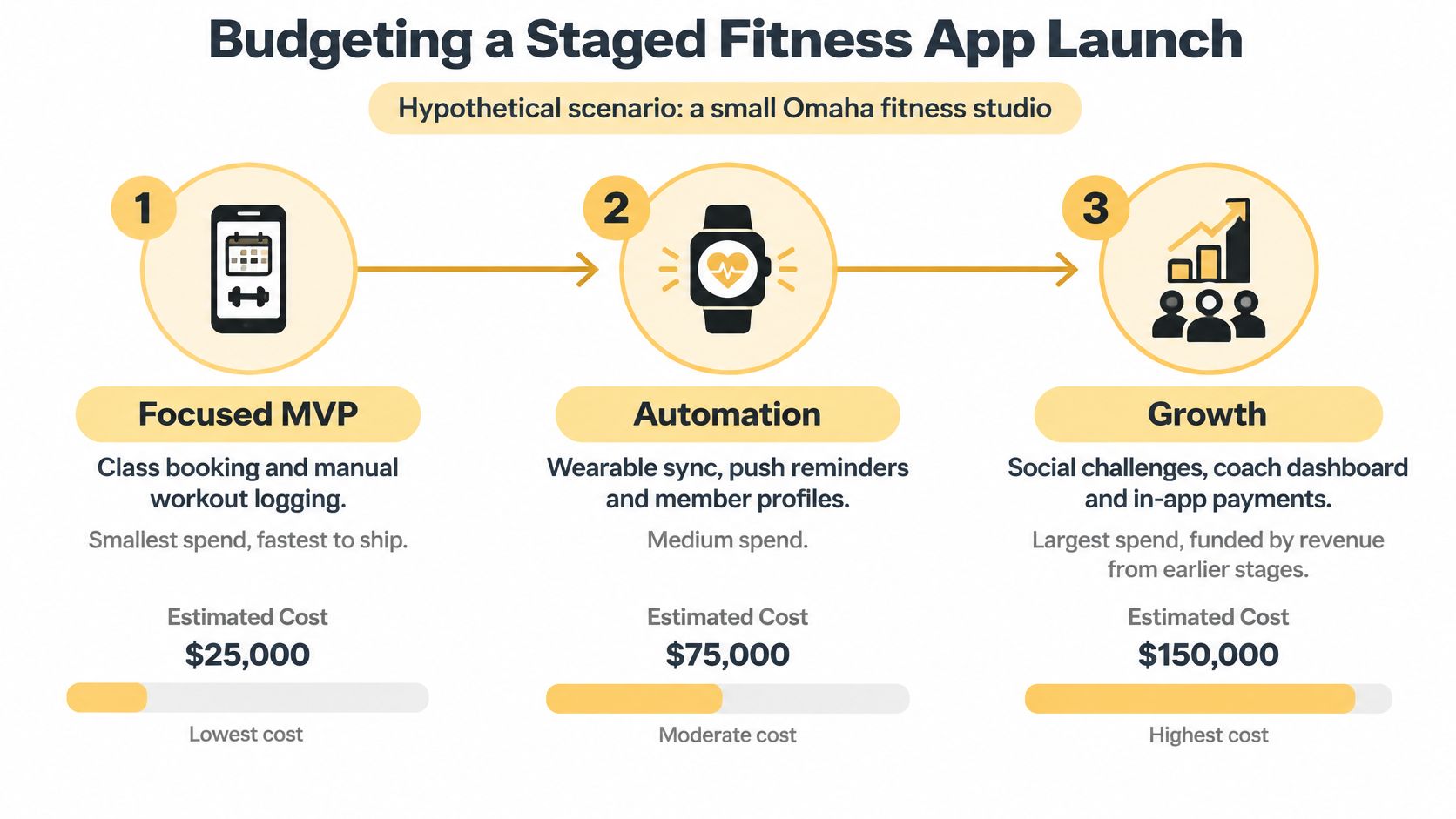
Stage two funds integrations, meaning wearable sync and device data, but only once members ask for them in numbers rather than in one loud conversation at the front desk. Stage three funds subscriptions, social challenges and personalized recommendations, once the usage data shows which features people return for.
| Stage | Scope | Budget | Gate to next stage |
|---|---|---|---|
| Stage 1 MVP | Manual logging, profiles, notifications, basic analytics | $10,000–$30,000 | Daily logging and retention past month one |
| Stage 2 Integrations | Wearable sync and device data | Fixed quote against the final integration list | Members request device data |
| Stage 3 Expansion | Subscriptions, social features, personalized recommendations | Fixed quote once retention data is in | Data shows which features drive return visits |
Gates, not phases
The distinction matters commercially. A phase rolls into the next one because the calendar says so. A gate only opens on evidence, which means stage three money is spent after the data justifies it, and the studio can stop at stage two without wasting the first two invoices. That's also the honest way to read the growth in this category: the global fitness-app market rose from about $0.68 billion in 2016 to $5.35 billion in 2021, according to fitness app market statistics, so demand for the category is real, but demand for your app still has to be proven.
For a fitness business, the website usually ships before the app does. We built a WordPress site with class integration for Downtown Fit Club, a new fitness club in downtown Omaha, in 2025, and that sequence is typical: prove the front door converts, then invest in the pocket-sized version.
If you're weighing what belongs in stage one, this guide to how to build a minimum viable product covers the scoping decisions that keep the first release small enough to fund.
Confirm Your Scope Before You Commit
The single most useful action before you request quotes is to write the MVP feature list and tag each item core, connected, engagement or intelligence. Every bidder then prices the same list, and you can compare line by line instead of comparing totals that hide different scopes.
Then work through the rest:
- State your data types and markets. What the app collects and where users live decide whether a compliance budget exists at launch or in stage two.
- Demand line-item estimates. Build, maintenance, cloud, third-party APIs and support should appear as separate lines, and the maintenance line should be checked against the 15%–20% annual benchmark.
- Set stage-two triggers in advance. Daily logging volume or a retention target agreed before launch beats a debate about feelings afterwards.
- Confirm code ownership in writing. Contract terms vary by provider, so the deliverables and custom code terms belong in the agreement rather than an email. On our projects, the client owns the final deliverables and custom code created specifically for their project once payment is complete.
A quote you can't decompose into scope, phases and maintenance is a marketing number with a date on it.
If you'd rather test your scope against an expert before committing budget, we offer a free 60-minute strategy call, with no obligation, bookable through our website. Bring the feature list and the data types, and the conversation gets specific fast.
A fitness app is a staged investment, not a single purchase, and Up North Media scopes it that way: a written feature list, a data classification, a maintenance line and clear gates between stages, the same discipline we brought to the class-integrated site we built for Downtown Fit Club in Omaha. Whether you're comparing two quotes that arrived six figures apart or starting from a blank page, book a free 60-minute strategy call and we'll pressure-test the scope before any budget is committed. Visit Up North Media to start that conversation and get a plan you can fund one stage at a time.