

The client logs in to the review dashboard you sold as your own, and another company's logo sits in the corner. Sometimes it's a footer credit. Sometimes it's the browser tab. The email arrives that afternoon with the question you don't want. Who are these people, and why are they touching my reviews?
That moment costs more than a feature. It costs the story from the pitch, the one where this was your product, your support desk, your reporting. White labeling is the difference between reselling a tool and owning a service line.
Three things decide whether a plan works. Where the branding stops matters, because a branded PDF on top of a vendor-branded login fools nobody. Where the pricing tier starts matters, because per-location and per-seat charges eat the margin you quoted. And how review requests are sent matters, because a workflow that can't show who got asked, when, and from which platform won't survive a client dispute.
The list below sorts platforms by what clients see, by the tier where white labeling begins, and by the agency type each tool fits. A review-only shop, a local SEO agency and a reseller with a wider catalog need different things from a vendor. Prices are the published ones, and every place a tool falls short gets said out loud.
1. EmbedMyReviews
The first thing to check in any white label reputation management software is whether your domain sits on the client experience or just on the export. With EmbedMyReviews, it sits on the whole thing.
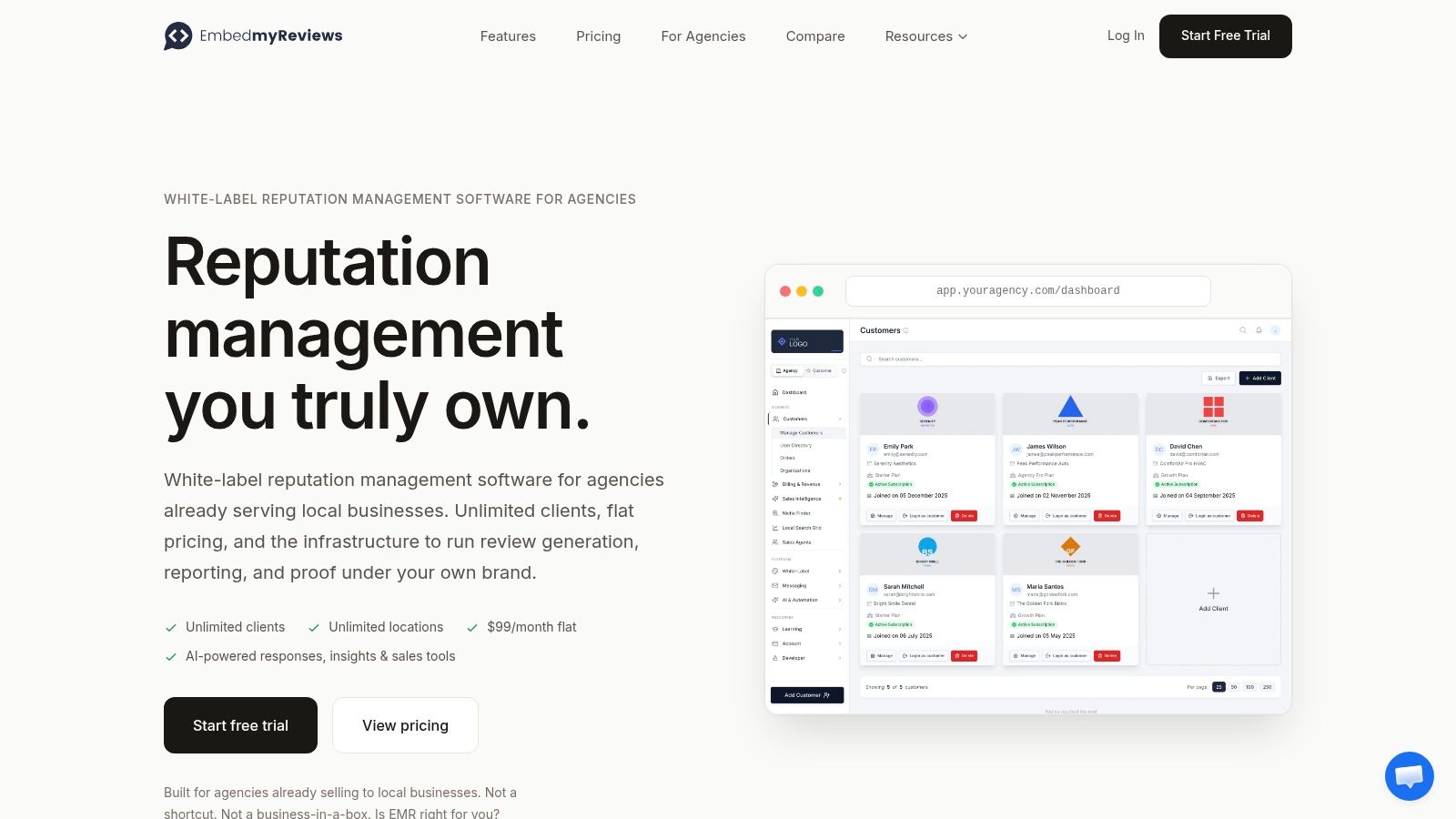
EmbedMyReviews is a white-label reputation management platform for agencies, consultants, franchises and operators serving local businesses. It centralizes review collection, response workflows, Google Business Profile posting, local rank tracking, analytics and sales intelligence under your domain and your brand. The base price is $99/month flat, and that covers unlimited clients, locations and users rather than charging per location or per seat.
What the Client Sees
A custom domain with SSL, branded UI, branded help center, API docs, page builder and 27 interface languages. Review management runs across 67+ sources, with request campaigns sent through your own email, SMS and WhatsApp keys, multi-step feedback funnels, private feedback routing, QR and NFC tracking, first-party testimonials, and widgets or embeds for client websites.
What the Agency Gets Behind It
Google Business Profile posts with client email approvals, so the client never logs in to approve an update. A Local Search Grid for geo-distributed rank tracking with white-label PDF exports. AI-powered audit reports with a Trust Score, competitor benchmarks and AI visibility testing inside major LLMs. Stripe billing with custom client plans, credit limits and add-ons, plus sales agents with territories and commission tracking. Integrations cover Zapier, HubSpot, HighLevel, Shopify, WooCommerce and a REST API with webhooks.
That scope reaches prospecting, not just post-purchase collection. An audit becomes a proposal, and the proposal becomes a plan. The white-label reputation management software built for resellers page walks through the deployment model.
Compliance deserves its own line. The FTC's rule banning fake reviews and testimonials took effect on October 21, 2024, and the Federal Register lists a maximum civil penalty of $51,744 per violation. Permission-based requests, human approval before an AI response publishes, role-based access and retained audit logs aren't nice extras. They're the evidence you'd want when a client dispute escalates.
The trade-off is the bring-your-own-key model. You supply the AI and messaging provider accounts, which keeps wholesale rates and regional provider choice in your hands but adds one setup step per client stack.
2. Reviewshake
Reviewshake's Agency plan is one of the few price points in this category you can read without a sales call. It's $199/month for 10 client accounts, 25 locations and 15 users, with additional seats billed separately.
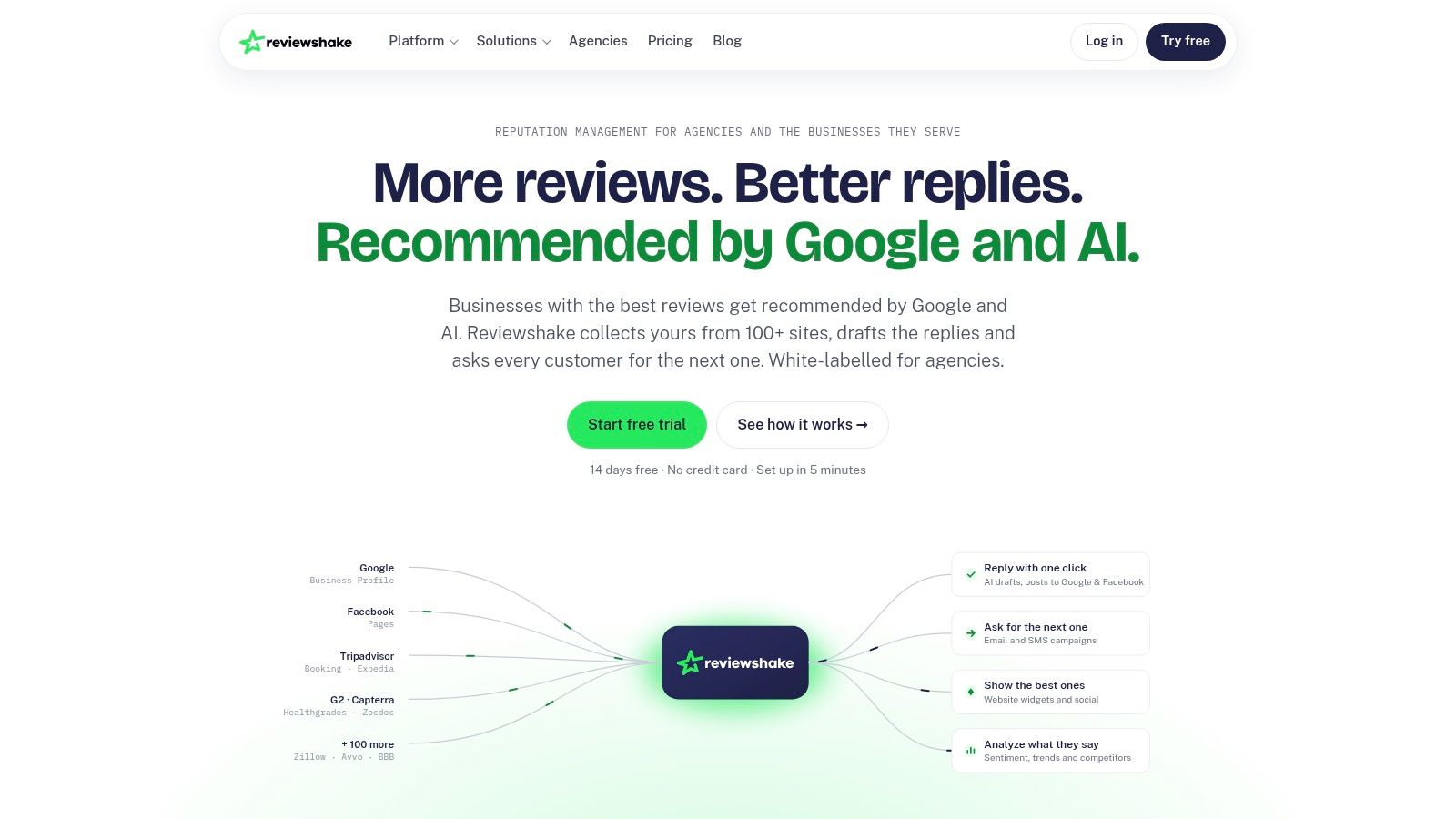
The branding goes further than most competitors. Dashboards, reports, the domain, the logo and sender emails all carry your name, so a client moving from onboarding to monthly reporting never leaves your brand. The platform covers a centralized review inbox, monitoring and reporting, automated requests by email and SMS, AI-assisted replies, widgets and review funnels, plus client roles and permissions.
The inbox behind that dashboard keeps filling whether you're ready or not. Yelp added 21 million new user reviews in 2024, bringing its platform total past 308 million, according to Search Engine Land's review-platform data.
Where it falls short. The Agency plan caps included locations and invitations, so a 40-location client costs more than the headline suggests. Review updates can take 12 to 24 hours depending on the source. Direct replies work for Google and Facebook, while other sites usually mean replying in that site's own interface. A 14-day trial is listed with no setup fee or long-term contract. Reviewshake suits the agency that wants reviews handled properly and nothing else attached.
3. Grade.us
Grade.us splits white labeling into two products, and buyers regularly miss the difference. Branded review funnels, custom funnel URLs, branded notifications and reports are included at no extra charge. The full branded client dashboard costs extra.
Pricing comes in three shapes. $99/month for one location, $60/month per location on multi-location plans, and agency plans from $400/month for 10 or more seats. A 14-day trial is listed.
That agency floor is the number to weigh. With six clients you're paying for a ten-seat plan. With twenty, the economics swing your way fast, and the per-location rate becomes the better deal.
Practical rule: ask for a screen share of the client login, not the report. Branding usually disappears at the login.
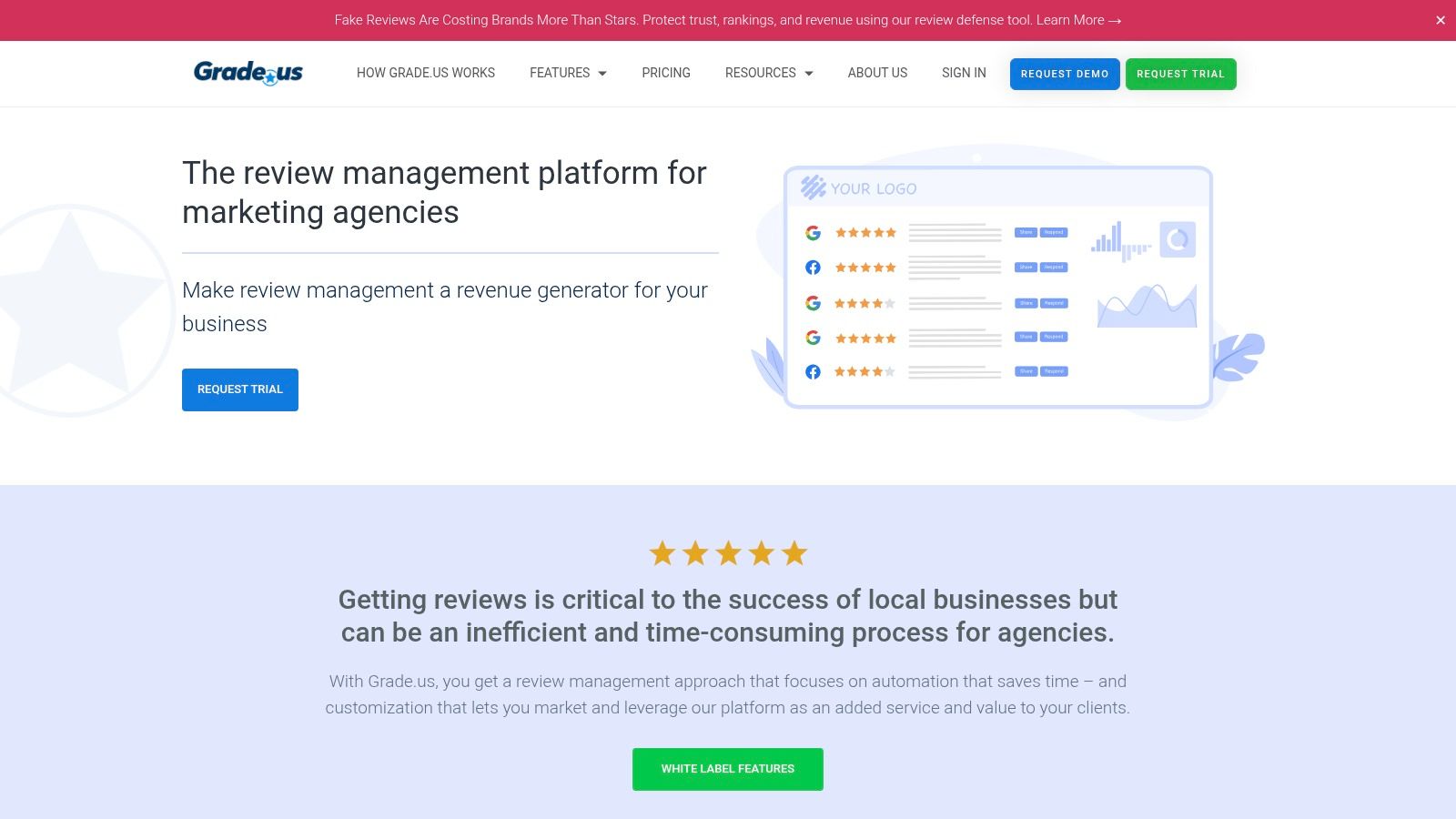
The workflow is deliberately narrow. Review monitoring, review-generation funnels, custom funnel URLs per client, client reporting and branded notifications. You won't find listings management or a content calendar here, which keeps the product focused but means a second subscription the moment a client asks for more. Grade.us fits review-only shops whose roster is big enough to justify the seat minimum.
4. GatherUp
A clinic manager opens the client login and looks for their own domain, not GatherUp's. Price that difference before you send a proposal.
Agency pricing is quote-based, which slows the buying decision. The vendor's FAQ breaks white-label fees into two tiers. Basic white labeling is free. Premium custom-domain white labeling, the version clients see on their own domain, is an annual fee plus a one-time setup charge. You cannot model margin until that call is done.
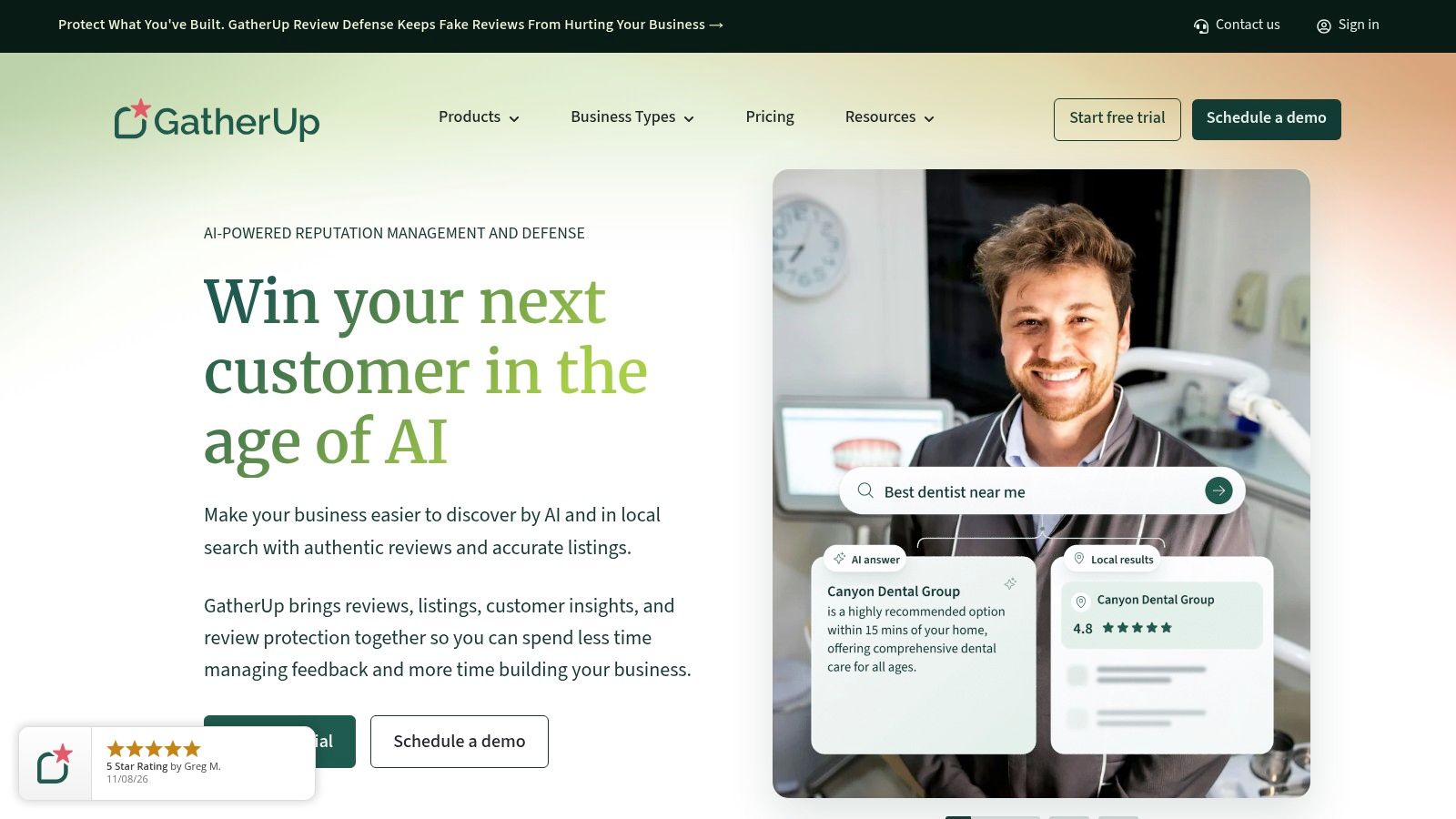
Review monitoring covers a wide set of sites, and requests go out by email, SMS and QR code. Surveys and NPS sit beside public reviews, so a mediocre visit can be captured in private instead of on a public profile. GatherUp's 2025 survey of more than 1,000 U.S. consumers found 98% said they consult reviews before choosing a local business (Beyond the Stars 2025).
The limits are commercial. Quote-based plans hide margin until sales replies. The custom-domain fee renews every year even when it looks small next to the plan. Listings management and Review Defense are separate products, so resellers with a wider catalog still buy a second subscription. Review-focused local agencies serving clinics, dental practices and home services are the better fit, because feedback volume is high and private recovery matters. Pair the tool with a written process for responding to negative reviews so private feedback gets a reply. GatherUp matches that narrower roster.
5. BrightLocal
A review-only shop and a local SEO agency should not price BrightLocal the same way. Reviews sit inside a local SEO platform, so the bill covers more than replies and requests. Published plans are Track, Manage and Grow. Entry monthly rates shift with location count and billing period. The sticker figure is not the invoice.
Clients see white-label reports and customizable review materials. Requests go out by email, SMS and in-store campaigns, and display widgets sit on the site. The same plan also covers review monitoring across a wide set of sites, local rank tracking, audits and listings tools. Reporting is the standard white-label piece. Check the client login and notification emails on your plan, because those can still show the vendor.
BrightLocal's 2025 Local Consumer Review Survey found that 96% of consumers read online business reviews at least occasionally, while the share who trusted reviews as much as personal recommendations from friends and family fell from 79% in 2020 to 42% in 2025 (BrightLocal). A report that only tallies new reviews misses that drop. Clients need context next to the count.
What to Confirm Before You Buy
Which elements are white-labeled: reporting is standard. Confirm the client login and the notification emails before you tell a client those screens are branded too. Location math: entry prices move once you add locations. Price the roster you expect in twelve months. Overlap: rank tracking you already pay for elsewhere makes part of this subscription a duplicate bill. Review-only shops and resellers with a wider catalog pay for local SEO features they may never open.
Breadth is the trade-off. The review module rides inside a larger product instead of driving it. BrightLocal fits local SEO agencies that want rank tracking, listings and reviews on one invoice.
6. Synup
Synup bundles reviews with listings, social publishing and local search tools, and the published pricing tells you where white labeling begins. Solo is $49/month. Premium is $299/month and includes up to 10 locations plus white labeling on your own domain. A 14-day trial is listed.
That gap between tiers is steep, and it's the honest trade-off. With three clients you're paying Premium rates for a three-location roster.
The case for the platform is that review software alone doesn't answer the trust question. Pew Research's survey of online reviews found 82% of U.S. adults read online ratings or reviews at least sometimes before buying a product for the first time, and 48% of review readers said it's often difficult to determine whether reviews are truthful and unbiased (Pew Research Center). Listing consistency and a complete profile address part of that doubt, and Synup handles both next to reviews.
Where it falls short. White labeling isn't on the lowest tier, so the branded dashboard upsells a plan that may be oversized for a small roster. The starting cost sits above lighter review tools. The breadth goes unused if all you need is monitoring and replies. Before selling the review module, optimize the Google Business Profile it points at, because a broken profile wastes every request you send. Synup fits multi-location agencies already managing listings and social for the same clients.
7. Vendasta
A client opens the portal and either sees your brand alone or sees your name next to Vendasta's. That split decides whether the platform is usable for the account.
Vendasta is a channel-partner platform. The catalog is the product: reputation, listings, websites, and the other services you resell under one vendor relationship. Published minimums step up by tier. Starter stays co-branded, so the client sees both names. The white-label client portal begins at Professional. Premium is the top published tier, with a higher monthly floor. Those minimums count toward eligible products in the catalog, not toward a single review module.
The market behind that catalog explains the model. Growth Market Reports valued the reputation management platform market at USD 5.4 billion in 2024 (Growth Market Reports). Vendors want a share of the reselling layer, not just a subscription.
On a five-client roster the floor is hard to spend. You pay it whether the extra products get sold or not. Co-branding on Starter defeats the point if the client was promised a fully branded dashboard. For an agency building a productized bundle, wholesale pricing and a portal in your brand at Professional can justify the commitment. I would not put a review-only shop here. The unused catalog is the cost.
Vendasta fits resellers with a wider catalog and a plan to grow into it.
8. LocalImpact
LocalImpact sells a branded workspace without pushing you into a broader marketplace. Branding covers a custom domain, logo, colors and favicon, plus client and location management and role-based access for clients and team members.
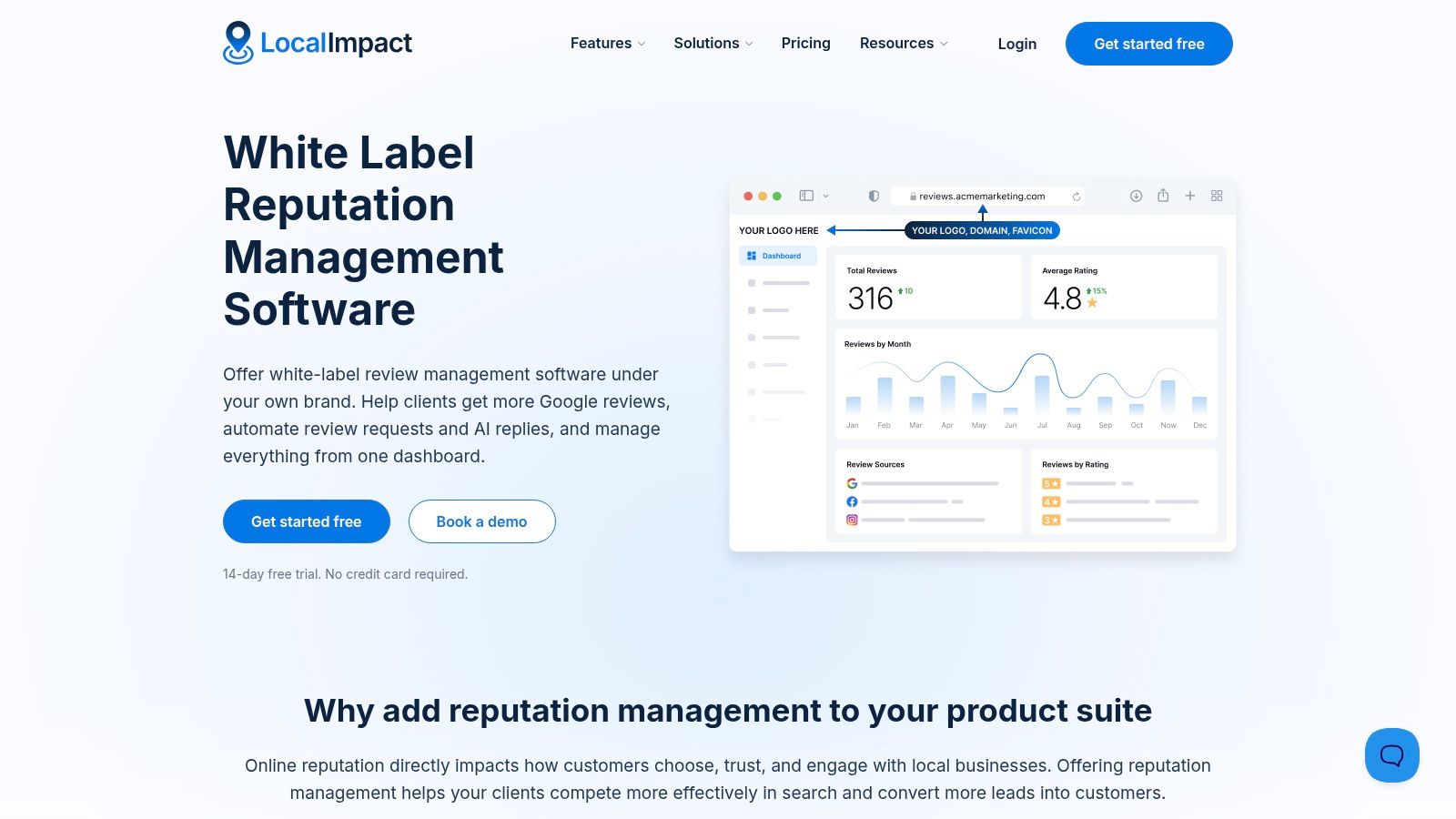
The Agency plan starts at $149/month for up to five locations, with additional locations costing extra. Review monitoring and reporting are included, and a free trial is offered.
Five locations is the number that decides your margin. At ten clients you're on a larger plan or paying per additional location, and that changes the price you quoted in the proposal.
Start the trial with a real client, real review sources and one deliberately awkward request. Slow support shows up during onboarding, not during the first demo day.
Where it falls short. The advertised entry price covers a limited location count, so estimate the full total before you sell. Support quality and product depth are best judged inside the trial. LocalImpact fits agencies that want a branded multi-client workspace without a full local search marketing suite attached to it.
9. More Good Reviews
A $99/month agency plan with five locations included, a seven-day trial and no credit card, and no annual contract listed. That's a low-risk way to find out whether your clients will log in.
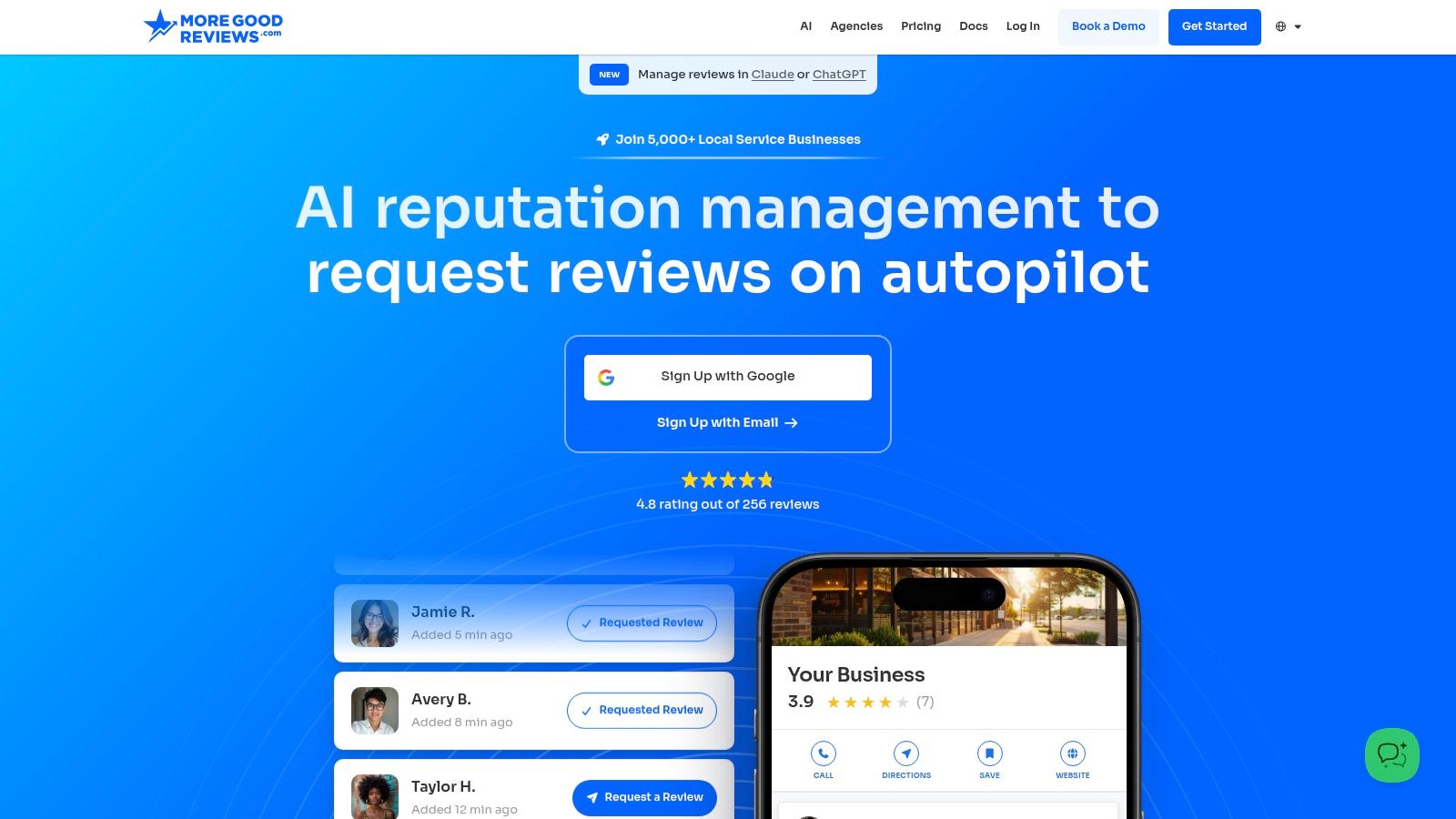
The white-label piece is a branded client portal on a custom agency domain, with client invitations and access controls. Review requests go out as branded email and SMS, and project-level configuration options let you vary the setup per client.
Where it falls short. Five included locations are a starting roster, not a book of business, so check additional-location pricing before promising anyone a flat rate. It isn't built for reselling a broad suite of local marketing products, which is fine if reviews are the service you sell and a problem if you're assembling one. The company also says the service isn't designed for handling protected health information, so medical and dental clients need a different conversation before the demo rather than after the contract.
More Good Reviews fits consultants and small agencies that want monthly pricing, a short commitment and a portal that carries their name while they test the service line.
10. Cloutly
Cloutly treats reviews as one part of customer engagement rather than the whole product. Requests go out by SMS, email and QR code, AI-assisted replies handle the first draft, and unified messaging and lead capture sit beside the review inbox.
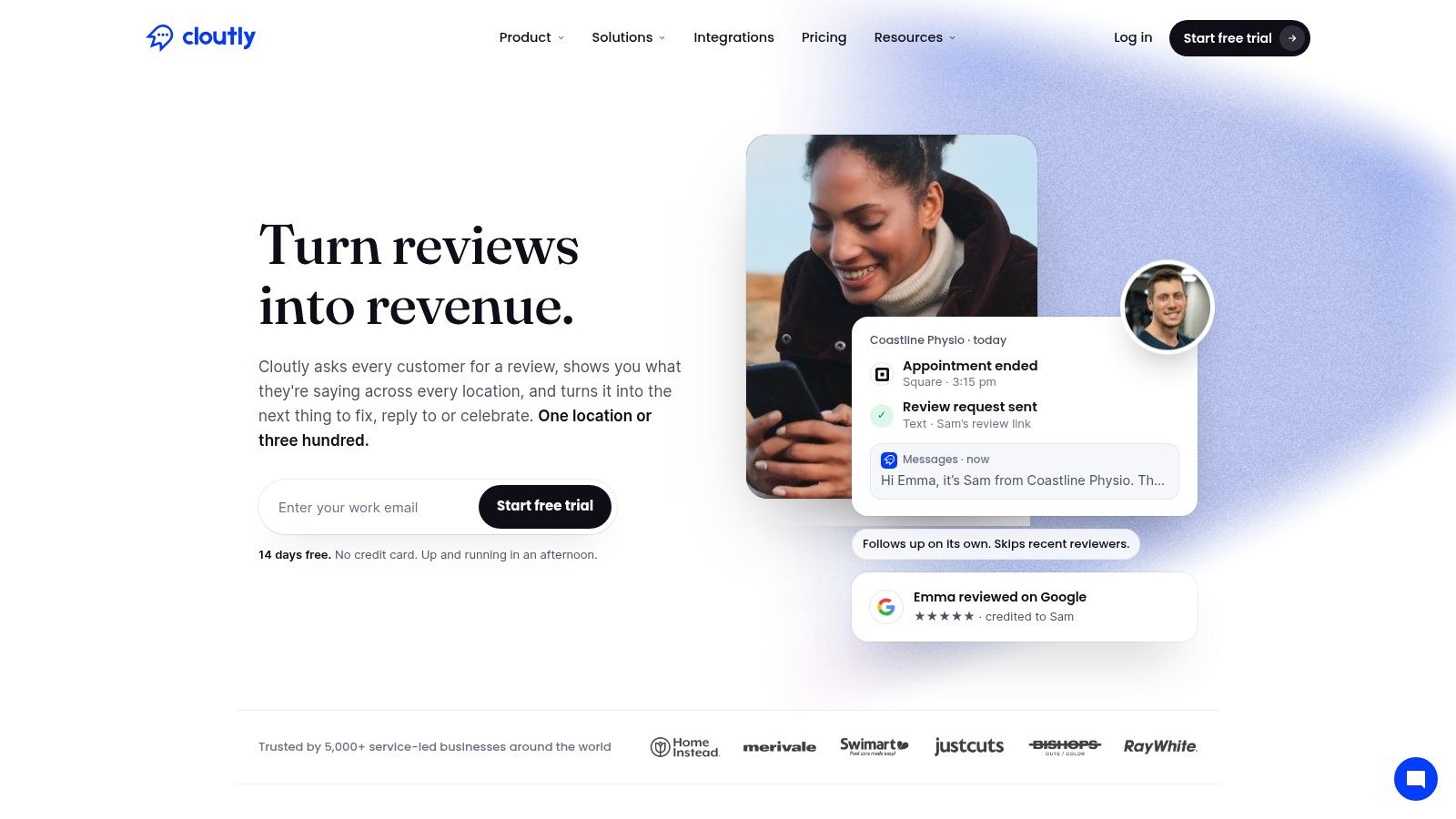
White-label partnership pricing starts at $299/month for up to 20 client locations, with additional locations billed separately. You get a partner workspace, separate client workspaces and brand customization. The listed 14-day trial covers the standard platform rather than the partner program, so ask what a partner trial looks like.
Twenty locations at that price is a more generous starting allowance than most plans offer, and it changes the math for a mid-sized roster.
Where it falls short. The starting price sits above lighter agency tools, and usage plus additional-location costs move the total in ways the headline hides. Partners are responsible for matters including client contact data and communications, so read the terms before loading client lists into the workspace.
The review platforms are also getting better at enforcement. Google reported it blocked or removed more than 292 million policy-violating reviews during 2025, alongside more than 13 million fake business profiles and restrictions on over 782,000 accounts (customer trust statistics). Clean request workflows matter more than clever ones. Cloutly fits agencies that want reviews and inbound messaging in a single workspace.
11. Repuso
A reseller with three clients this month and twelve next month feels a per-client bill differently than a flat agency seat. Repuso's agency and reseller plan uses a low published entry price, billed annually, with monthly billing higher and a charge for each client on top. That per-client model is what decides whether a cheap start stays cheap.

Clients can see a branded domain and dashboard, review widgets on their sites, and the requests you send in their name. You also get client sub-accounts, review aggregation and reporting, according to the vendor. You set client pricing yourself, so the markup is yours.
What they see on the site still has to look earned. A 2022 systematic review of 69 empirical studies on review credibility found credibility depends on source trustworthiness and content characteristics, and multiple of those studies reported that negative reviews can be perceived as more credible than positive ones (Review of Managerial Science). A wall of unbroken five-star quotes reads as manufactured.
Where it falls short. Confirm which plan includes response workflows, SMS and white-label branding before you build a service around it. The tiers do not all carry the same pieces, so a low entry price can still leave the branded dashboard on a higher plan. Per-client charges add up as the roster grows, and the annual billing discount only pays off if you keep the platform. There is less established public reputation data on Repuso than on the longer-running agency tools in this list, so pressure-test support and onboarding during the first month. Repuso fits resellers who want a cheap start and full control of client pricing, not a review-only shop that needs every workflow on the first invoice.
How the leading white label reputation tools compare on price, branding depth and fit
| Item | Published Starting Price | White-Label Scope | Best For |
|---|---|---|---|
| EmbedMyReviews | $99/month; unlimited clients, locations, and users | Full white-label platform on a custom domain, with branded UI, billing, and client experience | Agencies wanting unlimited scale, broad reputation tools, and full platform ownership |
| Reviewshake | $199/month; includes 10 client accounts and 25 locations | Branded dashboards, reports, domain, logo, and sender emails | Agencies managing multiple clients that want a branded review workflow |
| Grade.us | $99/month for one location; agency plans from $400/month | Basic white labeling included; premium dashboard branding costs extra | Review-focused agencies needing funnels and monitoring |
| GatherUp | Quote-based; custom-domain branding costs $440/year plus $250 setup | Basic branding available; paid custom-domain option for dashboards and communications | Agencies combining public reviews with surveys and private feedback |
| BrightLocal | $31/month | White-label reports and customizable review communications | Agencies pairing reputation management with local SEO tools |
| Synup | $49/month; white labeling on Premium at $299/month | Branded dashboard on eligible plans | Agencies seeking reviews, listings, social publishing, and local SEO together |
| Vendasta | $99/month; white-label portal from $499/month | Starter is co-branded; Professional and higher include a white-label portal | Agencies reselling a broad catalog of local-business services |
| LocalImpact | $149/month; includes up to five locations | Custom domain, logo, colors, and favicon | Agencies wanting a branded multi-client workspace without a reseller marketplace |
| More Good Reviews | $99/month; includes five locations | Branded client portal, custom domain, and review-request communications | Smaller agencies and consultants starting with a modest client roster |
| Cloutly | $299/month for up to 20 client locations | Branded partner and client workspaces | Agencies wanting review management plus messaging and lead capture |
| Repuso | $19/month when billed annually, plus per-client charges | Branded domain and dashboard with client sub-accounts | Budget-conscious resellers focused on review aggregation and website widgets |
Match the Tool to Your Client Mix Before You Sign
Start with the client, not the feature list. A review-only agency with eight restaurant accounts needs a different vendor from a reseller pushing listings, social and websites to forty businesses. Match the platform to the mix you have, then to the mix you intend to sell next year.
What to Check Before You Sign
Cost per client location at your twelve-month roster size: price the roster you expect, not the one you have on signing day. Seat limits versus team size: count the account managers who'll need logins, not just the owners. Contract terms: a one-year commitment is fine when the platform is core to your offer and painful when it isn't. Where branding lands: the login, the notification emails, the help docs and the PDF exports.
For review-only agencies, compare per-client and per-location costs at the size you expect, then test the client-facing dashboard during the trial to confirm which elements carry your branding. Open the login screen on a phone, trigger a notification email and download a report. One vendor logo in a footer undoes the whole pitch.
Agencies reselling a wider catalog should weigh portal depth and contract terms more heavily than review features. The question isn't which tool monitors more sites. It's whether the portal you hand a client looks like something you built, and whether you can leave in a year without rebuilding the client relationship from scratch.
Before committing, audit where each client's business information already appears across review sites, directories and forums. Mismatched hours, outdated addresses and duplicate listings undercut any review program, and they're the first thing a customer notices after reading a good review.
If you'd rather hand the work off, Up North Media runs review management as part of its local SEO services, including Google Business Profile optimization and consistent NAP across platforms. Our Off-Site Footprint Review maps every place a client's information appears, finds the gaps and the contradictions, and delivers a branded report with a recorded walkthrough. Book a free 60-minute strategy call through our site to scope the work.