
You've published the posts. You've watched the backlink report climb. And your rankings, traffic, and leads have barely moved.
That's the most common version of Guest Posting for SEO I see from small and mid-sized businesses. The work got done, but it was pointed at the wrong outcome. A guest post isn't valuable because it exists on another domain. It's valuable when the right readers see it, trust it, and act on it.
Why Guest Posting Still Matters for SEO
A local services company or ecommerce brand can easily spend months chasing placements. Someone builds a spreadsheet, sorts by domain score, sends pitches, and celebrates every live link. Then reality hits. The articles sit on sites nobody reads, the anchor text looks forced, and referral traffic is close to zero.
That doesn't mean guest posting is dead. It means volume is the wrong goal.

What a Good Placement Actually Delivers
A strong contribution can deliver referral traffic from people who already care about your topic. It can build brand visibility with an audience you don't own. It can also reinforce topical authority when your name keeps appearing in credible places where your buyers learn.
Those outcomes matter even when the link itself carries a qualifying attribute. A reader who's just learned something useful from you is warmer than a cold visitor from an ad. They've seen your thinking, not just your logo.
That's especially useful for considered purchases. A homeowner comparing Omaha contractors, a retailer choosing software, or a founder evaluating agencies rarely converts on first touch. A byline becomes one credible impression among several.
The Line Google Drew in 2014
Google made this distinction public in January 2014, when Matt Cutts warned that guest blogging had become heavily associated with link acquisition. As Matt Cutts's 2014 guest blogging warning made clear, the problem wasn't experts contributing to relevant publications. The problem was low-quality networks built mainly to place followed backlinks and manipulate rankings.
That moment separated two activities that still get lumped together.
- Editorial contribution: You write something original for a real audience, on a relevant publication, because readers will value it.
- Manipulative link building: You place near-identical articles wherever they'll take you because you want ranking credit.
One of those builds a reputation. The other creates risk.
Would you still want this placement if the link transferred no ranking credit at all? If the answer is no, you're probably buying a link disguised as an article.
That's the mental model to keep. Treat Guest Posting for SEO as a distribution and credibility channel first. One article in a publication your customers read, written well enough that an editor would defend publishing it, will usually beat a pile of forgettable placements. You get readers, trust, and a relationship with the publisher. The link becomes a supporting benefit, not the entire strategy.
How to Find and Qualify Guest Post Opportunities
Don't start with a list of hundreds. Start with the publications your buyers already read, then filter hard.
Domain authority is the weakest screening tool. A domain can look strong in Ahrefs, Moz, or Ubersuggest and still have no engaged audience in your market. Metrics help you sort. They don't tell you whether an editor exists.
The supply problem is real, too. In one 2025 practitioner compilation, 85.3% of guest-post sites were classified as low quality using thresholds of domain rating below 40 and monthly traffic below 10,000, according to 2025 data on low-quality guest post sites. That's why a shortlist should be a filter, not a phone book.
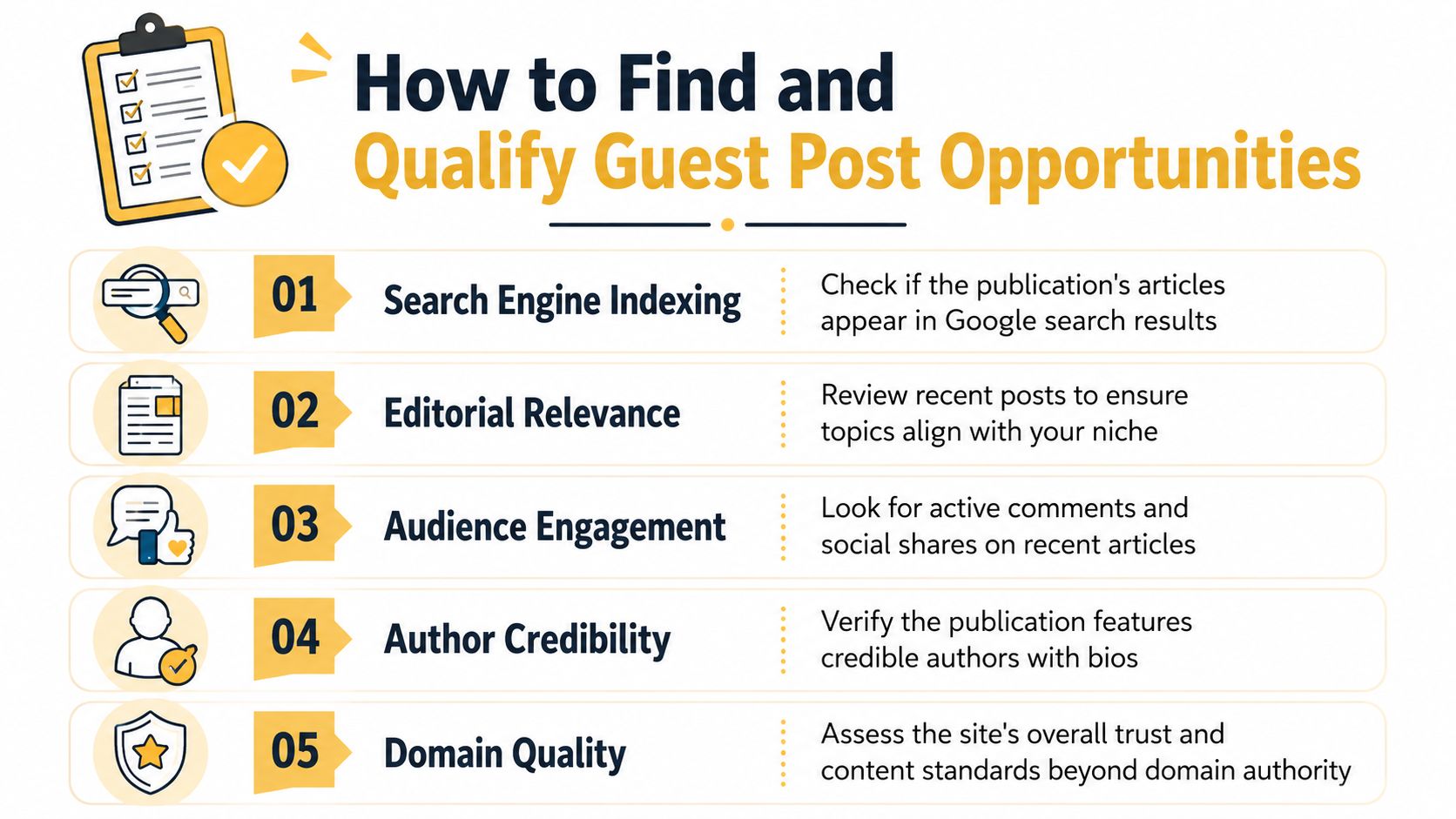
A Five Part Qualification Check
Run every prospect through these checks before you pitch.
- Check indexing first: Search for recent article titles and use site searches on Google. If new posts aren't appearing, readers from search probably aren't either.
- Read recent coverage: Scan the latest articles for consistent topical focus. A site publishing plumbing tips, crypto news, and wedding planning in the same week isn't building authority in any of them.
- Look for named people: Named editors, authors with bios, and an about page suggest accountability. Anonymous bylines and missing contact details suggest a placement marketplace.
- Verify visible readership: Look for substantive comments, social discussion, newsletter promotion, and articles that get cited elsewhere. Traffic estimates alone won't prove people care.
- Find the editorial gate: A publication that can reject you, edit you, or qualify your links is usually safer than one that guarantees publication after payment.
Match the Audience to a Buyer
Relevance isn't just sharing a keyword category. Read the comments and recent headlines, then ask who these readers are at work or at home. Would they plausibly hire you, buy from you, or recommend you?
Topic research helps here. A keyword gap analysis can show subjects competitors cover that you don't, and those gaps often make strong guest topics for publications serving the same buyers. You're looking for overlap between what the audience needs, what you can teach, and what your site should be known for.
If you need a broader starting pool before you start filtering, you can find high-quality guest posting opportunities and then run each prospect through the checks above instead of trusting the list blindly.
Aim for a working shortlist of suitable targets, not hundreds of maybes. Then weigh opportunity cost. Track response rate, writing time, any placement cost, expected referral sessions, and likely brand mentions. If a weak site takes the same effort as a credible one, drop the weak site and put that time into partnerships, expert commentary, or original research.
Outreach Templates That Get Responses
Editors don't ignore pitches because they're rude. They ignore pitches because most of them could have been sent to anyone.
Your email has one job. It needs to prove, quickly, that you've read the publication and that you're offering something its readers will use.
Build the Pitch Around Their Readers
Start with the editor's name and a specific reference. Mention a recent article, a recurring column, or a gap in their coverage. Then propose two or three topics that fit formats they've already published.
A workable structure looks like this:
Subject: Idea for your readers on reducing cart abandonment
Hi Maya, your March piece on post-purchase emails got me thinking about the checkout step before it. I run content for a small ecommerce brand, and I'd like to pitch an original article for your readers.
Two angles I could write: a teardown of checkout friction points we've tested, or a guide to recovery emails that don't rely on discounting. Here's a recent piece of mine so you can judge the fit. Open to either?
Notice what's missing. There's no flattery about their amazing blog. There's no promise of a high-quality, SEO-optimized article. There's no request for a dofollow link in the first email.
Lead with usefulness. The link conversation comes later, after they've decided your idea belongs there.
Subject Lines and Opening Sentences
Keep subject lines plain and specific. "Guest post submission" sounds like bulk mail. "Pitch: What local retailers get wrong about Google reviews" tells an editor exactly what's inside.
Your opening sentence should do the same work. Reference a real takeaway, a question their article raised, or a reader problem you've seen in their comments. If you can't write that sentence, you haven't read enough of the site to pitch it yet.
For teams sending more than a handful of pitches, it helps to plan the follow-up cadence before the first email goes out. The Cold Email Sequence Structure from MailAdept is a useful reference for spacing messages and keeping each touch distinct instead of repeating the same ask louder.
Follow Up Without Pestering
Let several business days pass, then send one short nudge in the same thread. Add something small, such as a revised headline or a one-line outline. Don't resend the entire pitch as if the first email never happened.
- First follow-up: Bump the thread, restate the strongest topic in one line, and make it easy to say no.
- Second follow-up: Offer a different angle only if you have a stronger fit.
- After silence: Move on and keep the relationship intact for a future idea.
Track it all in a simple sheet or CRM. Record the publication, editor, date pitched, topics offered, status, and next action. That boring system stops you from pitching the same editor twice in a week, and it shows you which topics and publications respond.
Writing Guest Posts That Earn Editorial Approval
The fastest way to get rejected after a yes is to send an article that reads like it was written for your site and parked on theirs.
Editors publish guest posts to serve their audience. Your draft has to match their tone, depth, and formatting habits closely enough that publishing it feels easy.
The writing process starts with studying recent pieces on the host site, not with opening a blank document.

Match the House Style
Read three or four recent articles and note the patterns. How long are they? Do they use short paragraphs, screenshots, data tables, or personal anecdotes? Are headlines direct or clever?
Mirror that structure. If the publication runs practical how-to guides, don't submit a reflective essay. If it favors opinion with a strong point of view, don't send a neutral list of tips anyone could write.
Strong on-page basics still matter inside someone else's article. Write a clear headline, use subheadings readers can scan, and keep paragraphs tight. If you want a refresher on structure and readability, these SEO content writing tips cover the habits that make a draft easier for both editors and readers to get through.
Bring Something Only You Can Bring
Original insight is what separates a contribution from filler. That might be a lesson from a client project, a process your team uses, a mistake you made, or data from your own operations that you're allowed to share.
You don't need a research department. A concrete example works. Explain what you tried, what happened, and what you'd do differently. Specificity builds trust faster than broad advice.
The video below is worth watching for a practical look at how experienced writers approach structure and clarity before they worry about optimization.
Place Your Link Like a Guest, Not a Sales Rep
One natural, contextual link is usually enough. Put it where it helps the reader go deeper, such as linking to a detailed guide, tool, or example you've referenced. Don't force your homepage or a service page into an unrelated sentence.
Use branded or natural anchor text. Your company name or a descriptive phrase reads like a citation. Exact-match keyword anchors read like a ranking attempt, and editors know the difference.
Your author bio does the rest. Keep it short, state who you are and what you do, and link to a relevant page. If you repurpose an idea across publications, change the angle, examples, and structure for each audience. The topic can travel. The article shouldn't.
Safe Link Practices and Google's Rules
Guest Posting for SEO stops being a content question and becomes a compliance question.
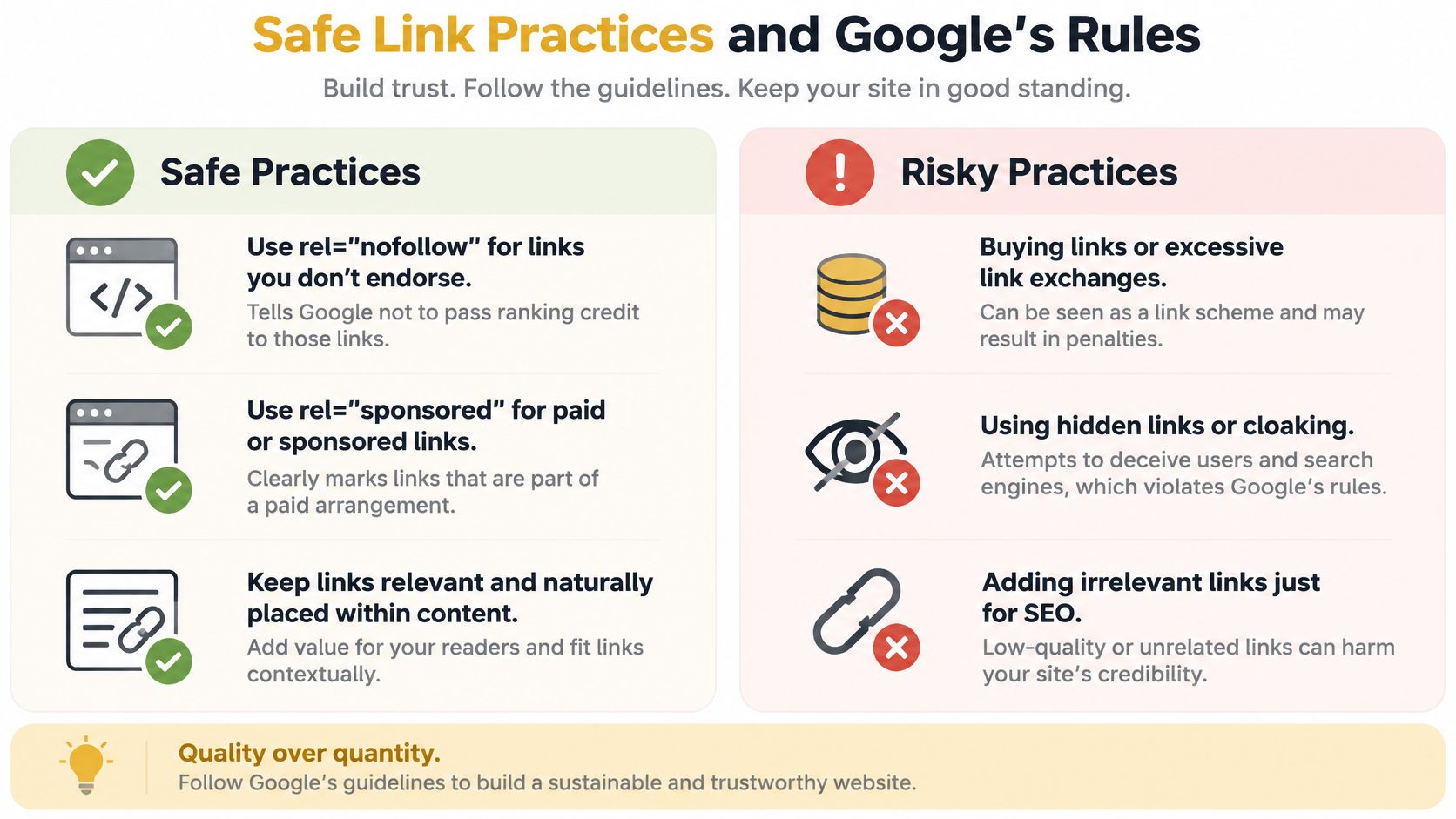
Google doesn't ban guest contributions. It targets guest posts used to pass ranking credit at scale, especially when money, optimized anchor text, and low editorial value are involved.
What Google Said in 2021
In its July 26, 2021 reminder, Google warned that excessive guest posting without appropriate link qualifications could lead to algorithmic or manual actions, as explained in Google's 2021 guidance on link tagging and link spam. It recommended rel="nofollow" and rel="sponsored" when links might be intended to influence rankings.
That guidance moved the conversation from broad caution to a practical tagging rule. If the placement is commercial, qualify the link. If you paid for it, qualify the link. If the link exists mainly to influence rankings, don't pretend it's a pure editorial endorsement.
Where the Spam Line Sits
Google's broader policy lists paid articles, advertorials, native advertising, guest posts, and press releases containing links that pass ranking credit, especially with optimized anchor text, as examples of link spam under Google's spam policies on link spam.
Compare two placements.
| Editorial Contribution | Ranking Manipulation |
|---|---|
| Editorial contribution: Original expertise for a known audience | Ranking manipulation: Thin article placed mainly to carry a link |
| Editorial contribution: Natural or branded anchor text | Ranking manipulation: Keyword-rich anchor repeated across sites |
| Editorial contribution: Commercial ties disclosed | Ranking manipulation: Payment hidden, link left followed |
| Editorial contribution: Host can edit, reject, or qualify links | Ranking manipulation: Publication and followed link guaranteed upfront |
The difference isn't subtle. One would still make sense with a nofollow attribute. The other falls apart without ranking credit.
Practical Safeguards for Every Placement
Disclose commercial relationships clearly. Accept rel="sponsored" on paid placements instead of negotiating around it. Keep anchor text natural and varied, and don't reuse the same target page and phrase across a campaign.
Practical rule: If you wouldn't defend the article, the site, and the link to a skeptical editor in public, don't publish it.
Google hasn't published a safe volume threshold, so don't look for one. There's no magic number of guest posts per month that makes a manipulative pattern acceptable. Relevance, editorial value, and honest link qualification are the safeguards you control.
Tracking ROI and the Metrics That Matter
Counting backlinks is the easiest way to measure guest posting. It's also the least useful.
A link report tells you a page exists. It doesn't tell you whether anyone read it, clicked, remembered your brand, or eventually bought from you.
Set Up Tracking Before You Publish
Add UTM parameters to the links you control, such as your author bio or an agreed in-content link. Use a consistent source for the publication, a medium like referral or guest-post, and a campaign name for the article.
Then check performance in Google Analytics 4. Filter referral sessions by the host domain and look beyond raw visits. Review engaged sessions, time on site, pages viewed, and key events such as contact form submissions, demo requests, or purchases.
In Google Search Console, watch branded queries after a placement goes live on a site with real readership. A reader who doesn't click your link may still search your company name later. That branded search lift is often the first signal that a byline reached people.
Measure Influence, Not Just Last Click
Guest posts rarely get fair credit in last-click reporting. Someone reads your article, visits your site, leaves, then returns through search two weeks later and converts. Last click gives search all the credit and your guest post none.
That's why assisted conversions matter. If you're trying to connect awareness touches to revenue without overstating them, this guide to proving ROI with attribution is a helpful primer on giving earlier touchpoints appropriate credit. For the broader reporting framework, this breakdown of how to measure SEO ROI helps you tie referral and organic gains back to business outcomes.
Track these signals per placement:
- Referral sessions: How many readers arrived from the host site
- Engagement quality: Whether those visitors read, explored, or bounced immediately
- Assisted conversions: Whether the visit contributed to a later lead or sale
- Brand mentions: Whether the article led to citations, shares, or invitations elsewhere
Count the True Cost
Be honest about inputs. Add outreach time, writing and editing time, internal review, and any placement fee. A free guest post that took your founder two days isn't free.
Then compare placements against each other. A modest article that sends a steady trickle of qualified visitors and produces one good lead can beat a high-traffic placement that sends curious readers who never fit your offer.
A guest post that drives fewer visitors but the right ones will outperform a louder placement every budget review.
Decide in advance what earns a repeat pitch. If a publication sends engaged readers and the editor wants you back, scale that relationship. If several placements produce links and nothing else, adjust your targets or stop. Don't keep funding a reporting metric.
Final Checklist and Alternatives to Consider
Guest posting works best when it's selective. Before you launch your next round, run through this checklist and be willing to kill weak opportunities early.
Pre Launch Checklist
- Define the goal first: Decide whether you're chasing referral traffic, credibility, audience access, or authority, because each points to different publications.
- Qualify the site: Confirm indexing, topical consistency, named editors, visible readers, and a real editorial gate.
- Personalize the pitch: Reference recent coverage and propose topics built for their audience, not your keyword list.
- Write something original: Bring experience, examples, or data that a generic writer couldn't produce.
- Handle links transparently: Disclose commercial ties, accept the right rel attributes, and keep anchors natural.
- Track what matters: Tag links, watch referral quality and branded search, and record the true cost per placement.
That process will produce fewer live articles than a mass outreach blast. That's the point. A smaller portfolio is easier to audit, easier to defend, and more likely to reach people who can buy from you.
When Another Channel Is a Better Bet
Guest posting isn't always the right tool. In the same 2025 survey compilation cited above, only about 12% of SEOs considered guest posting their most effective link-building approach, while digital PR ranked ahead at 20%. That gap should make you compare options instead of defaulting to guest posts.
Digital PR fits when you have a story, data, or expert commentary journalists and publishers already want. Original research fits when you can publish findings others will cite. Partnerships fit when suppliers, associations, or complementary brands can co-create content for shared audiences. Expert commentary fits when speed matters and you can offer a quotable, specific point of view.
Choose based on what you can credibly produce. If your team has strong opinions and customer insight but little time for long articles, commentary and partnerships may return more. If you have proprietary data, research and digital PR may travel further than a byline.
Google's direction has been consistent for years. Editorial value survives policy updates. Scaled link schemes don't. Build the version of Guest Posting for SEO that still makes sense when the link is qualified, the editor is picky, and the reader is the prize. That's the version worth keeping.
If you're spending time on guest posts that produce links but not customers, Up North Media can help you rebuild the program around credible placements, qualified traffic, and measurable ROI. Our Omaha team pairs data-driven SEO with content and outreach strategy built for small and mid-sized businesses, ecommerce brands, and publishers. Visit Up North Media to talk through what a selective, compliant guest posting plan would look like for your market.