
“Publish more content” is the most expensive default advice in SaaS SEO. If your existing pages don't help the right buyers evaluate the product, another batch of articles won't fix the problem. You'll have more URLs to maintain, not a clearer path to revenue.
SEO for SaaS companies is a portfolio prioritization problem. Decide which pages deserve investment, which need consolidation, and which shouldn't exist. In an AI-search environment, that decision also means separating exposure that may never generate a click from content buyers need to visit before they can act.
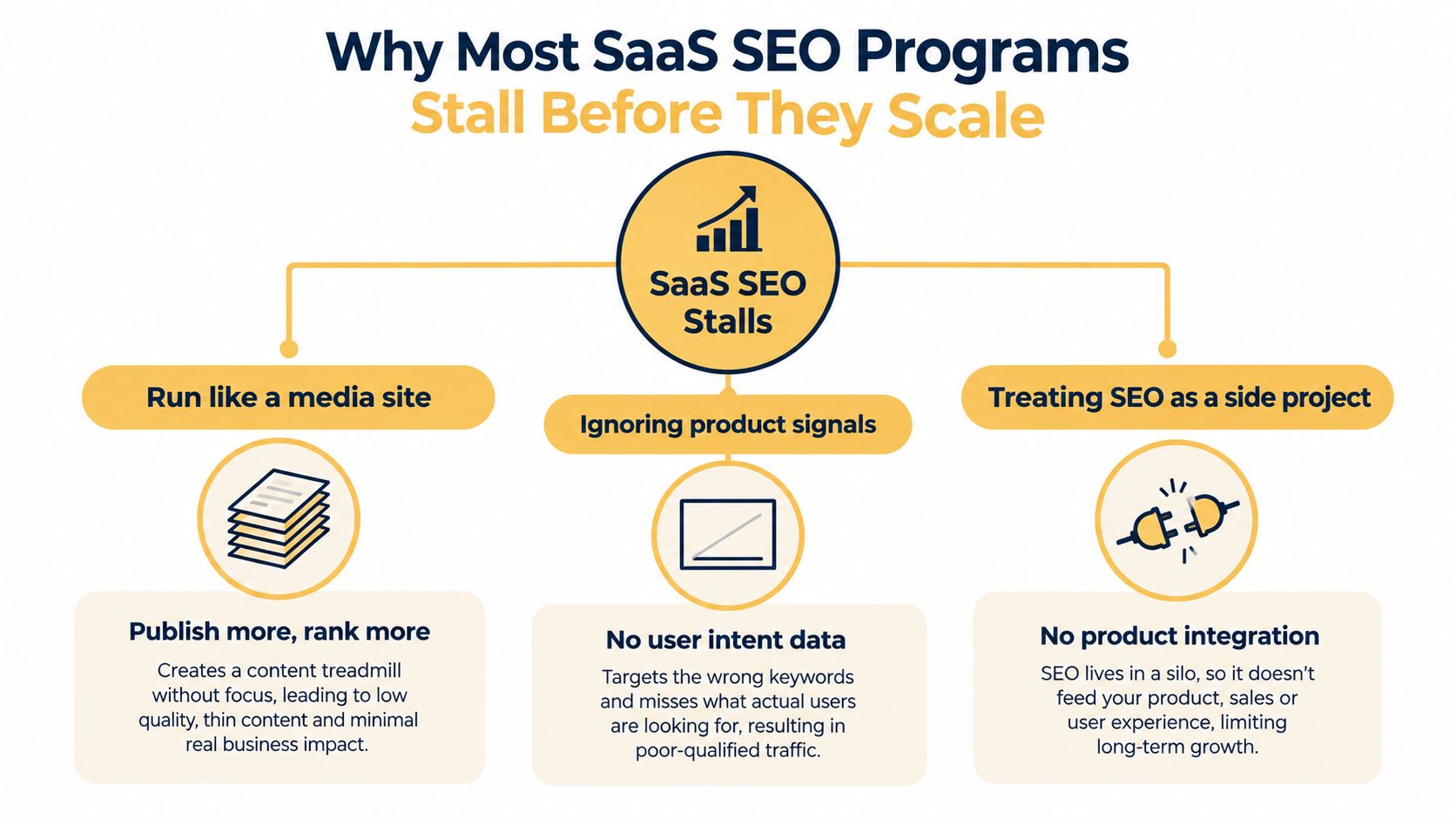
Why Most SaaS SEO Programs Stall Before They Scale
A publishing calendar isn't a growth strategy. Start with a different question: Which buyer decision should this page help someone make? If the answer is unclear, pause the brief.
The failure modes are organizational as much as editorial.
Stop treating traffic as the product
A SaaS business doesn't sell pageviews. An educational article can be useful without producing immediate signups, but the team should know what role it serves: introducing a relevant problem, supporting evaluation, earning citations, or helping someone implement the product.
Don't treat those roles as interchangeable. A glossary visit isn't equivalent to a pricing-qualified demo request, and reporting them together conceals whether the program attracts potential customers.
Rankings still matter. A study covering 4 million Google results found average CTR of 27.6% for the first organic result versus 15.8% for the second, approximately 74.7% higher CTR for the leading position. Those are averages, not forecasts for your site, because intent, device, advertisements, and search features affect actual behavior.
The practical implication isn't to chase every keyword. It's to concentrate effort on commercially meaningful pages where better visibility would matter.
Portfolio rule: A page deserves investment because of the job it performs for the business, not because someone found a keyword with attractive volume.
Build the product-and-funnel map first
Before keyword research, document what the product does today. Separate shipped capabilities from roadmap promises, identify the customers it serves, and list the implementation constraints sales teams repeatedly explain.
Then inventory the public journey.
| Public surface | What to capture | Buyer decision |
|---|---|---|
| Product and feature pages | Supported workflows, limitations, proof | Does this solve my problem? |
| Pricing | Plan boundaries, usage rules, qualification requirements | Is this commercially suitable? |
| Comparisons | Named alternatives and meaningful trade-offs | Why choose this approach? |
| Integrations | Prerequisites, supported actions, setup guidance | Will it fit my stack? |
| Trial, signup, and demo flows | Entry points, friction, next steps | Can I evaluate it? |
| Changelog and documentation | Current capabilities and implementation detail | Can I trust and deploy it? |
Match each page to an intent: problem-aware, solution-aware, comparison, integration, or pricing-qualified. Record its next action and owner. A guide without an appropriate next step is unfinished, even if the writing is strong.
For teams deciding where agency support fits, ContentBuck's overview of what SaaS SEO agencies actually do is a useful scope discussion alongside this internal map. Keep accountability for product accuracy inside the business.
Audit before adding inventory
Establish a lightweight technical baseline: review the sitemap, robots directives, canonical patterns, and the boundary between the public site and authenticated application. Use that review to identify questions for engineering rather than launching a wholesale rebuild.
Next, give every existing page a disposition:
- Invest: Strong product fit, a valuable buyer decision, and a defensible reason to visit.
- Improve: Relevant intent, but weak evidence, unclear positioning, or a broken conversion path.
- Consolidate: Overlapping pages that should become a more useful destination.
- Retire or restrict: Obsolete, unsupported, or unsuitable public URLs, after checking dependencies and existing value.
Keep the output on a working sheet, not in a presentation nobody updates. You're allocating editorial time, engineering capacity, and promotion effort across a finite portfolio. Publishing should follow those decisions, not substitute for them.
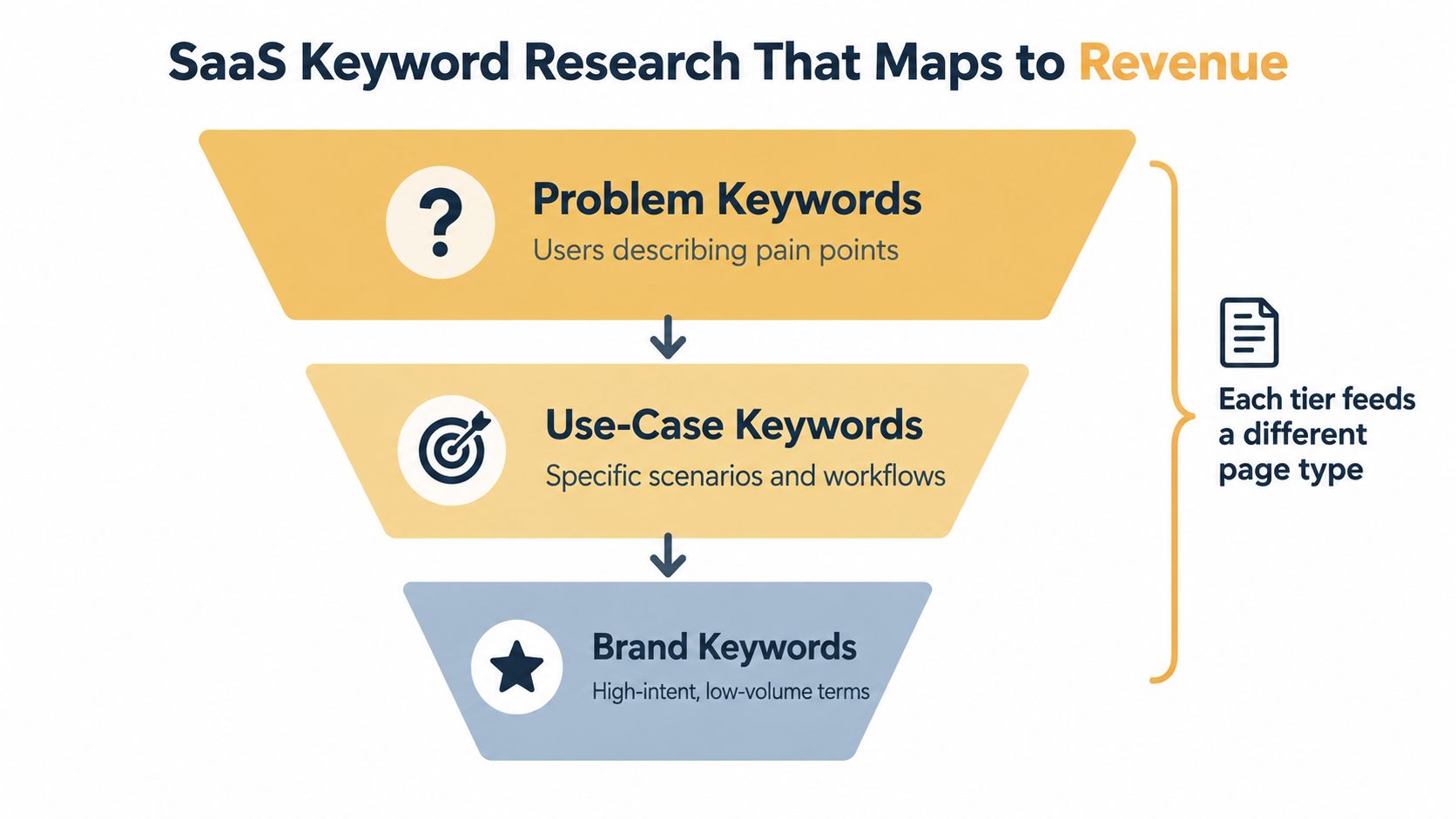
SaaS Keyword Research That Maps to Revenue
“Reduce manual invoice reconciliation” and “invoice software pricing” describe different buying moments. Don't place them in the same keyword bucket because both mention invoicing.
Use the funnel as a page-assignment tool, not an assumption that every visitor follows a linear journey.
Research from product fit outward
Begin with problems and workflows the product supports. For a hypothetical approval platform, "automate purchase approvals" could justify a use-case page; "approval software alternatives" requires a comparison; an ecosystem query needs a real integration, not a speculative landing page.
Build the working list in this order:
- Problems and use cases: Capture the language buyers use to describe work they need done.
- Comparisons and alternatives: Target evaluations where you can explain meaningful differences clearly.
- Integrations: Include supported connections and specific tasks users can perform.
- Education: Add foundational topics when they support a relevant commercial cluster.
Use search intent analysis to check the expected page type before commissioning content. For another research reference, consult SubmitMySaas SaaS SEO tips, then validate candidates against your product map rather than importing a generic list.
Score the need for a click
Add AI-answerability to your prioritization sheet: can someone fully resolve this query inside a search answer, or do they need your workflow, documentation, template, or product evidence?
An analysis of more than 200,000 keywords across 30 sites found position-one CTR fell from 28% to 19% year over year as AI Overviews and product features expanded. That observation isn't a forecast for every SaaS query, but it makes ranking alone an inadequate selection criterion.
Use qualitative ratings for commercial intent, differentiation, AI-answerability, attainable visibility, and production effort. Avoid a precise-looking weighted score if the inputs are guesses.
For a companion walkthrough, use the video below while reviewing your candidate list.
Group queries by shared intent, assign a primary destination, and identify supporting pages. Defer clusters where you lack a credible product connection or realistic route to leading visibility within your planning horizon.
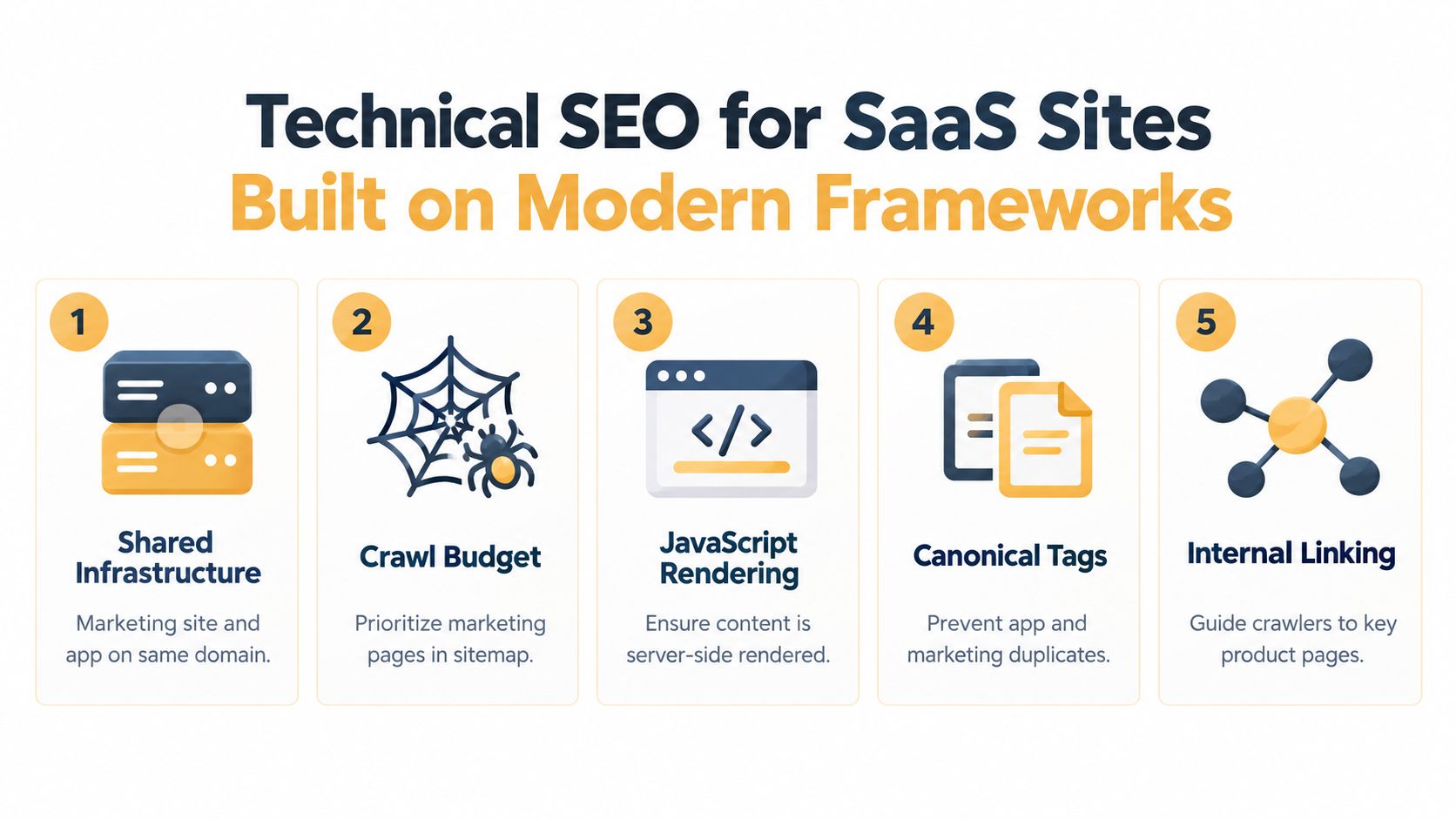
Technical SEO for SaaS Sites Built on Modern Frameworks
Your dashboard and pricing page shouldn't have identical performance requirements. The dashboard supports authenticated work; the pricing page must communicate value before a visitor has committed to anything.
When both share infrastructure, explicitly protect the public acquisition experience.
Validate the acquisition templates
For important marketing, pricing, integration, and documentation pages, deliver meaningful server-rendered or statically generated HTML. Don't accept a browser screenshot as proof that search engines can discover the intended content.
Use a crawl-to-index release checklist:
- Inspect responses: Confirm appropriate status codes, unique titles, meta descriptions, intended canonicals, and indexable content.
- Control URL variants: Review filters, tracking parameters, tenant paths, and trailing-slash patterns. Keep internal links consistent with the intended public URLs.
- Check representative pages: Inspect deployed examples in Google Search Console before expanding a template.
- Review after release: Watch indexing coverage and organic landing-page performance for unexpected changes.
Keep authenticated screens and thin generated pages out of the public acquisition inventory unless there's a deliberate reason to expose them. Canonical decisions aren't a substitute for deciding which page types should exist.
Use the SEO for web applications guide to frame the development conversation. Grou's discussion of technical fixes that boost rankings can serve as an additional checklist, but turn each proposed fix into a testable ticket rather than accepting the title as a guarantee.
Optimize real-user performance
Google's Core Web Vitals guidance identifies good experience targets of Largest Contentful Paint at 2.5 seconds or less, Interaction to Next Paint below 200 milliseconds, and Cumulative Layout Shift below 0.1. Evaluate field data by template and device, rather than celebrating a synthetic Lighthouse score.
Prioritize public pages with valuable conversion paths. Reserve image and video dimensions, reduce unnecessary JavaScript, delay nonessential widgets, and investigate long main-thread tasks.
A faster logged-in dashboard doesn't resolve a slow public comparison page. Assign performance work to the journey you're trying to improve.
Treat Core Web Vitals as experience metrics, not a promised ranking lift. Judge the work alongside landing-page engagement, signup starts, and qualified opportunities.
Product-Led Content and Developer SEO Working Together
A feature page that says “powerful automation” gives a buyer little to evaluate. A page showing the trigger, supported actions, permissions, failure conditions, and setup process gives them something concrete.
Product-led content should expose useful product truth, not insert a sales pitch into an unrelated article.

Write for evaluation, not applause
Build comparisons around the buyer's decision criteria. Name alternatives, explain where each approach fits, and acknowledge when another product is more suitable.
Don't manufacture current pricing details. Have a product owner verify plan information before publication, explain the conditions that affect the comparison, and assign responsibility for updates.
| Asset | Evidence to include | Editorial mistake to avoid |
|---|---|---|
| Comparison | Workflow differences, constraints, verified pricing context | Declaring your product the winner everywhere |
| Integration page | Supported actions, prerequisites, setup path | Repeating partner names without implementation detail |
| Feature page | Actual behavior, screenshots, limitations | Replacing explanation with adjectives |
| Developer tutorial | Working example, expected output, error handling | Hiding essential instructions inside interactive widgets |
An integration page should tell someone what they can connect and what happens next. If the connection requires middleware, a particular plan, or manual setup, say so.
Give documentation a distinct job
Treat API references, implementation tutorials, and marketing pages as complementary assets. Marketing explains suitability; documentation explains execution. Don't make each surface repeat the same introductory copy.
Google describes crawling, rendering, and indexing as separate JavaScript processing stages and warns that JavaScript-generated canonicals should match those in the original HTML. Apply that guidance to documentation templates as carefully as marketing templates.
Make essential code examples available in HTML. For versioned documentation, deliberately distinguish different versions from duplicate presentations; don't automatically canonicalize every older reference to a current page that no longer answers the same question.
Use contextual navigation between relevant surfaces:
- From marketing to docs: Link technical claims to implementation detail.
- From docs to evaluation: Offer relevant product, integration, or plan context without interrupting the task.
- Across versions: Clearly identify the supported version and appropriate migration guidance.
The result should be a coherent public product library, not competing explanations maintained by disconnected teams.
Earning Backlinks a SaaS Site Can Actually Win
Before sending outreach, answer a blunt question: why would an editor, partner, or practitioner reference this asset?
“Please link to our software” isn't a compelling answer. A useful benchmark, implementation resource, or narrowly focused tool gives the recipient something they can use.
Choose the asset before the outreach list
Start with a public artifact that connects to the commercial cluster you've chosen to support. A migration checklist may fit better than a broad industry report if implementation risk dominates the sales conversation.
Consider the maintenance cost before commissioning it:
- Original research: Publish only findings you can substantiate. Explain the method, sample limitations, and relevant privacy safeguards.
- Free tools or calculators: Solve a specific task and disclose assumptions. Assign an owner for accuracy and upkeep.
- Integration resources: Coordinate useful launch material with the partner, including a public destination that explains the connection.
- Comparison resources: Create a fair reference someone could cite without endorsing your entire sales argument.
Research needs credible inputs; tools need engineering support. If neither is available, a detailed practitioner resource is preferable to a thin “industry study” with questionable methodology.
Outreach test: Would the recipient still find this resource useful if you removed your request for a backlink?
Distribute where buyers already pay attention
Build a selective list of relevant publications, newsletters, ecosystem partners, and practitioner communities. Pitch the finding or practical utility, not the fact that your company published something.
Partner directories, accurate software listings, podcast appearances, and conference resources are also reasonable opportunities to evaluate. Don't assume they include links, and don't judge them solely by a domain score.
The commercial rationale is visibility, not collecting badges. A historical analysis from 2014 covering approximately 465,000 keywords across 5,000 websites found 71.33% of searches produced an organic click on the first results page, while pages beyond it received substantially less attention; this predates today's search features and isn't a current CTR benchmark.
Track relevant referring domains, referral engagement, and changes in the supported commercial cluster. Record other changes, such as content updates, so you don't credit every ranking movement to outreach.
A link report should help decide where to invest next. A spreadsheet full of unrelated placements doesn't do that.
Measuring SaaS SEO When Clicks Are No Longer the Win
A Pew Research Center analysis reported by The Indian Express examined nearly 69,000 searches from about 900 U.S. adults and found traditional-result clicks in 8% of searches with an AI Overview, compared with 15% without one. Those observed behaviors make traffic-only reporting incomplete, not obsolete.
Keep click-based measurement, but separate it from exposure and commercial outcomes.
Report distinct layers
| Layer | What to track | What it doesn't prove |
|---|---|---|
| Search acquisition | Query visibility, landing-page clicks, engagement | That visitors are qualified |
| AI-search exposure | Observed mentions, cited pages, branded-search changes | That a mention caused a sale |
| Commercial outcomes | Qualified demos, trial activation, opportunities, revenue | That a single touch deserves all credit |
Maintain a repeatable sample of priority queries for AI-search checks. Record the query, market, device, date, observed mention, and cited destination. Label these observations clearly rather than presenting them as exhaustive visibility data.
Connect touches without pretending attribution is perfect
Use Search Console for query and landing-page analysis, analytics for on-site actions, and the CRM for qualification and opportunity outcomes. Preserve landing-page and acquisition details through signup or demo flows where your consent setup permits.
- Define meaningful events: Separate a trial account from an activated trial, and a submitted form from an accepted opportunity.
- Keep CRM fields usable: Record original acquisition, known content touches, and the buyer's self-reported discovery source.
- Separate attribution views: Report sourced opportunities and assisted opportunities independently rather than adding them together.
Use a consistent SEO ROI measurement approach and disclose missing data. Branded-search growth can support a hypothesis about increased awareness, but it doesn't establish that AI citations caused it.
Track indexation of intended cluster pages, time to meaningful visibility, and observed citations as leading indicators, not guaranteed pipeline predictors. Reallocate when stronger commercial evidence becomes available.
Governance, OKRs, and a 90-Day Rollout
SEO work needs a place in product and engineering planning. Otherwise, the marketing team can identify a rendering problem while nobody has the capacity to fix it.
Assign an accountable program owner and establish a small decision group covering marketing, product, engineering, and sales or revenue operations. Give each discipline a concrete responsibility, including product verification, release approval, and lead-quality feedback.
Set objectives around business decisions
Use qualified organic pipeline as the commercial objective, supported by stage-appropriate measures such as accepted demos or activated trials. Set targets from your own baseline and sales economics, not an agency benchmark borrowed from another business.
Keep delivery commitments separate from outcomes:
- Commercial commitments: Define what counts as qualified and how opportunities will be attributed.
- Delivery commitments: Name the technical fixes, page improvements, and distribution experiments the team will ship.
- Decision commitments: Specify when the team will expand, revise, consolidate, or stop work.
A publishing quota can be a capacity measure. It shouldn't be the primary definition of success.
Use the rollout as an operating proposal
The following is a proposed 90-day rollout, not a promise of results within that period.
| Working period | Main work | Required output |
|---|---|---|
| Weeks one through four | Product map, portfolio audit, tracking review, priority technical fixes | Ranked backlog and documented baseline |
| Weeks five through eight | Improve the selected cluster and launch a useful public asset | Validated pages and a distribution plan |
| Weeks nine through twelve | Review acquisition and qualification evidence, resolve ownership gaps | Reallocation decisions and the next roadmap |
Start governance immediately; use the final review to formalize what worked. For a manageable experimental cadence, propose a technical test, a content test, and a link-earning test each month, adjusting to actual capacity.
Document briefs, template acceptance criteria, product-review requirements, and measurement definitions. Give every experiment an owner, hypothesis, and decision date.
The objective isn't “good SEO.” It's a repeatable process for putting scarce resources behind the pages and activities most likely to produce qualified pipeline.
Up North Media offers SEO audits, keyword research, technical optimization, content strategy, and implementation support for businesses evaluating where organic search can contribute to growth. Visit Up North Media to discuss a SaaS portfolio audit and a prioritized roadmap that connects your public pages, acquisition experience, and pipeline measurement.