SEO typically takes 6–12 months to show meaningful results, with first movements sometimes appearing in 3–6 months. Strong strategies often need 12–24 months to produce their full effect, especially in competitive markets.
You may be asking because you published several pages, fixed obvious website issues, and watched the analytics dashboard stay almost flat. That experience is common, but it doesn't mean the work has failed. SEO has two different clocks: the clock that measures how quickly your team can make changes, and the clock that measures how quickly search engines discover, evaluate, and trust those changes.
A page can be written in an afternoon. Ranking it for a valuable search query is a longer process. The difference between those two timelines explains why SEO rewards consistent execution rather than short bursts of activity.
Why SEO Takes Longer Than Most Businesses Expect
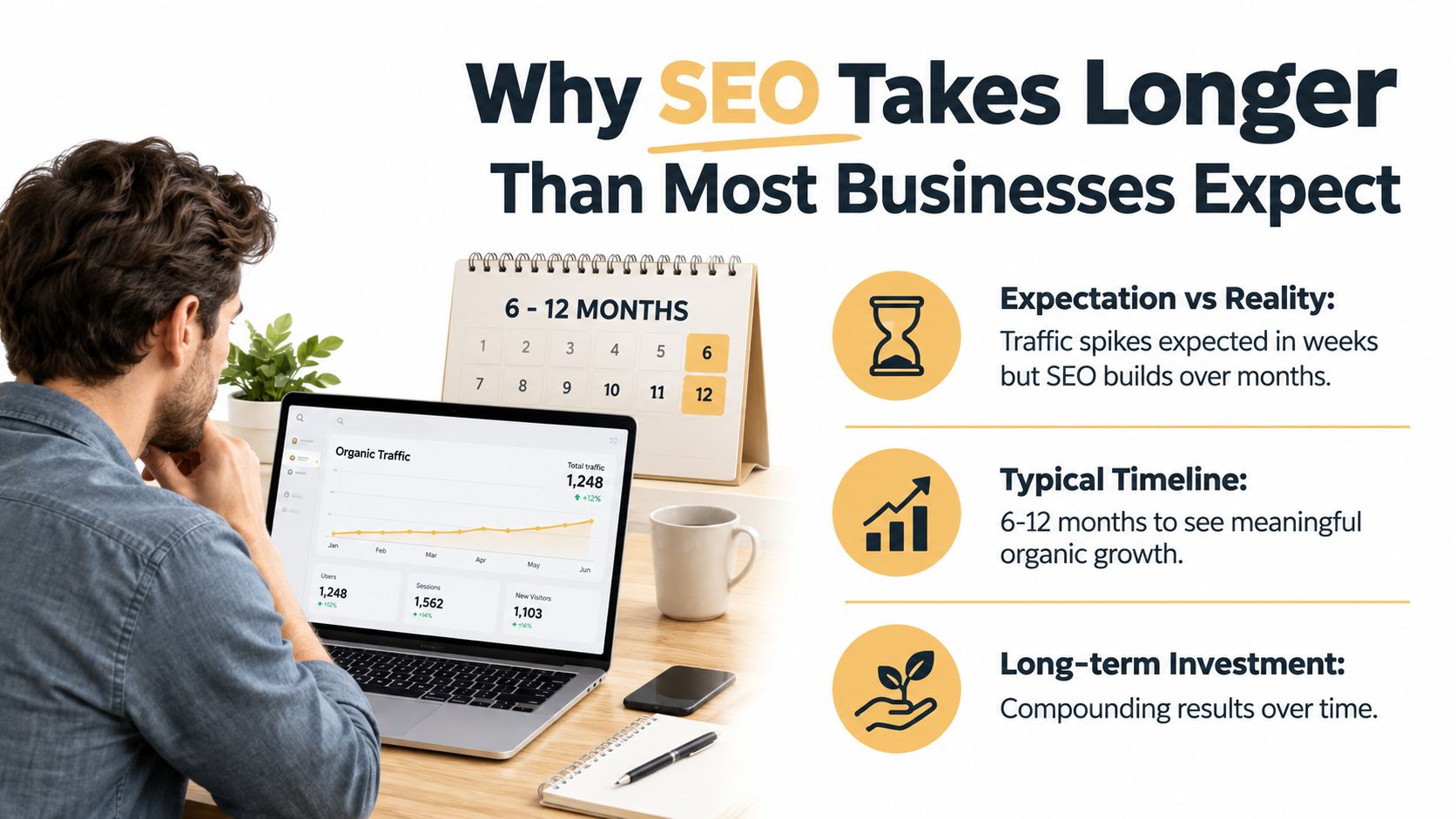
A small business owner might hire an SEO consultant on Monday, publish new service pages by Friday, and expect a traffic spike the following week. When the dashboard remains quiet, the investment can feel wasted. The more realistic expectation is that early movement may appear between months 3 and 6, while meaningful organic traction commonly requires 6–12 months, as documented in industry timeline research from New Media.
The work itself can move quickly. Your team can rewrite a title, repair an internal link, improve a page's structure, or publish an article in a matter of hours. Ranking speed is different. Google must discover the change, process the page, compare it with competing results, and gather enough evidence to decide whether the page deserves a stronger position.
Execution speed is not ranking speed
Think about SEO like joining a gym. Your first workout improves your routine, but it doesn't visibly change your body overnight. Progress comes from repeating the right exercises, recovering properly, and giving the process enough time to compound.
SEO works similarly. A single page may make a useful contribution, but a broader result usually depends on connected improvements:
- Technical foundations: Search engines need to reach, understand, and index important pages.
- Relevant content: Your site needs to answer the questions your audience searches.
- Authority signals: Other credible websites and users need reasons to trust your expertise.
- Iteration: You need to improve pages after observing impressions, rankings, clicks, and conversions.
A useful planning resource for companies selling to other businesses is this B2B SEO pipeline guide 2026, particularly if organic visibility needs to support a longer sales cycle.
Practical rule: Treat the first months as the foundation and evidence-gathering phase, not as a final verdict on the campaign.
Patience isn't passive. It gives your team enough runway to distinguish a temporary ranking fluctuation from a durable trend. Businesses that keep publishing, refining, and measuring can build an asset that continues working after the initial implementation period.
How Search Engines Actually Decide What Ranks
Search visibility makes more sense when you treat Google like a large library. Your page is a new book, and search engines must complete several jobs before a reader can find it.
First, search engines crawl the page
Googlebot discovers new and updated URLs by following links and using other discovery systems. A page that isn't connected to the rest of your website may take longer to find, and a page blocked by technical settings may not be crawled as intended.
Internal linking matters here. Links from relevant, already-discovered pages help search engines understand that a new page exists and how it relates to the rest of your site. A clear architecture also makes it easier for people to move between related topics.
Next, search engines index what they can understand
After discovery, Google processes the page. It analyzes the text, structure, media, links, and other available signals before deciding whether to store the page in its index. Indexing isn't guaranteed. Technical errors, duplicate content, weak page value, or unclear topical purpose can prevent a page from becoming a meaningful candidate for search results.
This is why a technical review should happen before you scale content production. A technical SEO audit checklist can help you identify crawlability, indexation, architecture, and on-page issues that might otherwise make later work less effective.
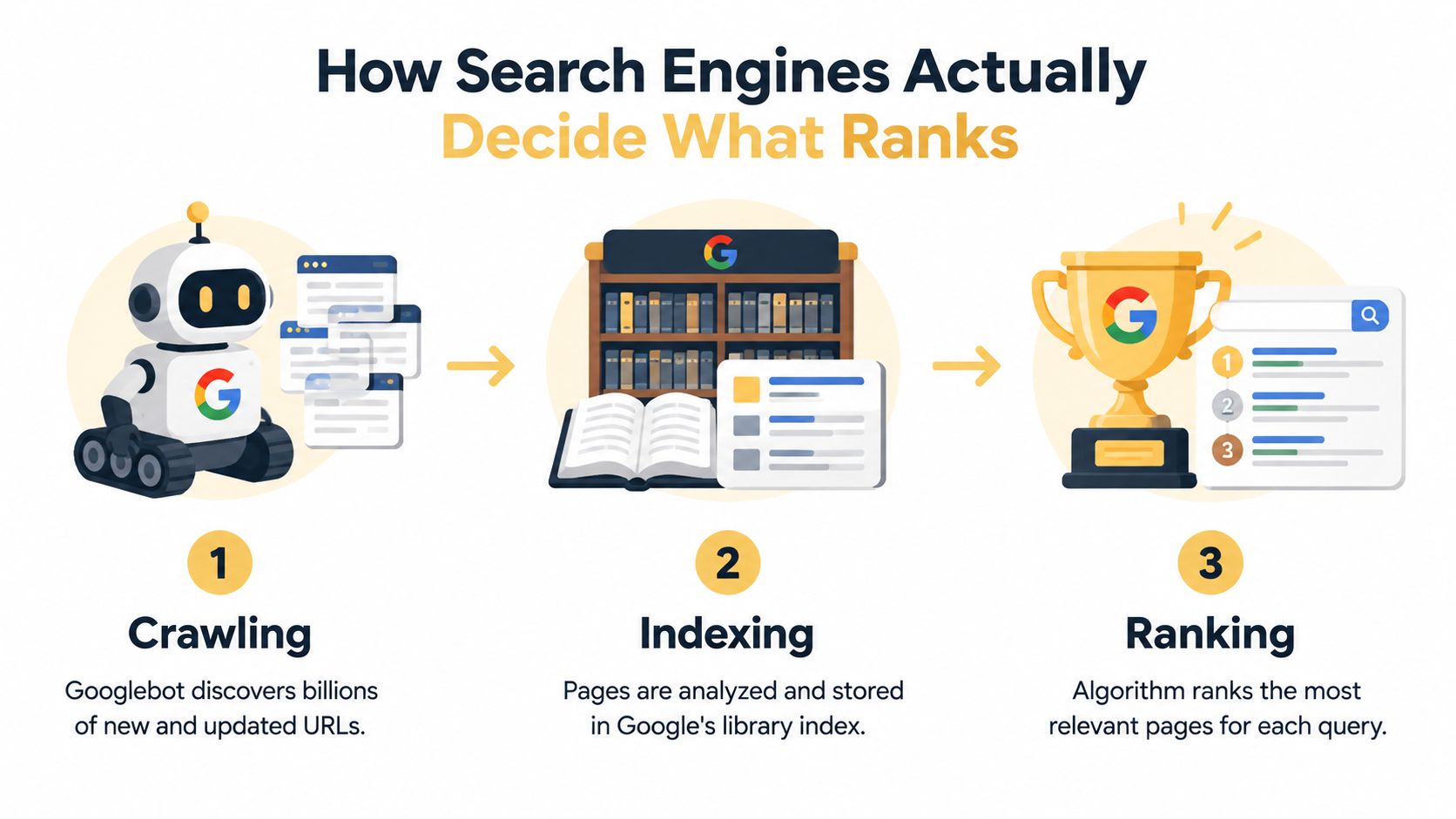
Finally, Google ranks the indexed candidates
When someone searches, Google evaluates the indexed pages against the query and orders the results. Relevance, content quality, site context, authority, freshness, and the likely usefulness of each result all affect that decision.
A page published today usually can't demonstrate a long history of usefulness. Its position may change as Google tests it, competitors update their pages, and new signals accumulate. That evaluation cycle is the practical reason SEO rarely behaves like paid advertising.
Watch the following video for a visual explanation of how search engines process and organize web pages.
Key Factors That Influence How Fast SEO Works
No single timeline applies to every website. A local company targeting a narrow service may see useful movement before a national brand competing for a broad commercial term. Your starting authority, technical condition, content quality, competition, and ability to earn relevant links all shape the path.
The main accelerators and delays
Domain history affects the starting line. An established website may already have indexed pages, internal links, topical context, and external references. A brand-new site has to establish those foundations while it creates content.
Competition changes the difficulty. Specific, low-competition queries can move sooner because fewer pages compete for the same search intent. Broad terms often involve sites with deeper content libraries and stronger authority, so reaching the first page can take much longer.
Technical health removes friction. Search engines need to crawl important pages, understand their relationships, and process the content efficiently. Broken links, poor architecture, duplicate pages, or indexing controls can stall otherwise solid work.
Content must match the searcher's job. A page that explains a process, compares options, or answers a buying question should fulfill that purpose clearly. Length alone won't make content competitive. Strong pages provide useful detail, first-hand understanding, clear organization, and a reason for the reader to continue.
Relevant links can strengthen credibility. Links from appropriate, trustworthy websites can help search engines understand that other publishers find your content useful. Quantity isn't a substitute for relevance, and link acquisition depends on producing material worth referencing.
Past problems can extend the recovery period. A site with serious technical issues, a history of low-quality publishing, or a prior search visibility decline may need diagnosis and cleanup before new content can perform consistently.
| Factor | Faster Timeline | Slower Timeline |
|---|---|---|
| Site history | Established domain with useful indexed content and external references | New domain with little indexed history or authority |
| Competition | Narrow, specific queries with clear intent | Broad commercial terms dominated by established competitors |
| Technical condition | Crawlable architecture, strong internal linking, and clean indexation | Blocked pages, duplicate URLs, broken paths, or unclear structure |
| Content | Thorough, original pages that satisfy the query | Thin pages that repeat information without adding value |
| Authority | Relevant references and a credible topic cluster | Few external signals and limited topical depth |
| Target market | Focused local or niche demand | National or highly competitive search results |
Read ranges as planning guidance
These factors interact. A new website may move earlier than expected for a precise query, while an older domain can remain invisible if its pages are poorly structured or irrelevant. The right question isn't whether a vendor can promise a particular month. It's whether the strategy addresses the reasons your site is currently losing visibility.
New Website Versus Established Domain Timelines
A new website and an established domain don't begin an SEO campaign with the same resources. The established site may have indexed content, internal link equity, relevant history, and external references that help search engines interpret new pages. The new site must earn those signals while it builds its library.
Research published by Factory Jet places a brand-new domain's first rankings commonly around 4–6 months, page-one potential around 8–12 months, and consistent organic traffic around 12–18 months. The same source describes an established domain with a history of at least 2 years as potentially seeing first movement in 6–10 weeks and page-one potential in 4–8 months. These are planning ranges, not guarantees, and query difficulty still matters. You can review the full brand-new versus established-domain timeline for the assumptions behind those ranges.
| Stage | New Domain | Established Domain |
|---|---|---|
| Discovery and indexation | Search engines learn the site's structure and initial content | Existing pages and links can help new content get discovered |
| Early visibility | Initial rankings may appear after the site has built a basic content and authority foundation | New pages may show movement sooner when they fit existing topical coverage |
| Page-one potential | Usually requires sustained content, technical, and authority work | Existing relevance and internal link equity can shorten the path |
| Consistent traffic | Takes time for several pages to rank together and attract qualified clicks | Historical performance can support a broader, steadier keyword footprint |
How a new site can improve its odds
A new domain shouldn't begin by publishing disconnected articles on every possible topic. Start with a focused subject area, map the primary service or product page, and create supporting content that answers closely related questions. Link those pages together naturally so users and search engines can understand the subject hierarchy.
Technical fixes should happen early because they prevent later content from sitting in an unclear or inaccessible structure. After that, publish consistently, improve pages based on Search Console data, and pursue relevant mentions or links. This sequence doesn't bypass the authority curve, but it avoids spending months building content on a weak foundation.
What the Data Says About SEO Results
The benchmark evidence supports a slower answer to the question, how long does SEO take to work, than many sales pitches suggest. An Ahrefs study of 2 million random pages found that only 1.74% of newly published pages reached Google's top 10 within one year, while the median age of pages already ranking in the top 10 was over 2 years. The study is summarized with its methodology and interpretation in this Ahrefs SEO timeline analysis.
That result doesn't mean a new page can't rank quickly. The same analysis found that 40.82% of top-10 pages achieved that position within 1 month. The important distinction is that fast wins often come from pages with strong existing relevance or authority. A brand-new page on a brand-new domain generally has less accumulated evidence to support an immediate competitive ranking.
Fast movement and durable visibility are different outcomes
Semrush benchmark data covering 28,000 domains found that only 7.65% maintained content in Google's top 100 for the full 13-month study period, according to the analysis from RankSpark. This helps explain why one encouraging ranking isn't enough to declare success. A page needs to remain useful and competitive while other publishers update their own content.
Long-tail queries can provide earlier evidence that your strategy is aligned with search intent. Broader head terms usually require a larger body of relevant content, stronger authority, and sustained refinement. Ranking position also matters because visibility and clicks aren't interchangeable. A page can gain impressions without generating meaningful leads if its title, intent, offer, or position doesn't match what the searcher needs.
This is why measurement should include business outcomes, not rankings alone. A practical framework for connecting organic activity to commercial results appears in this guide to measuring SEO ROI. It also helps business owners evaluate proposals carefully, including the concerns outlined in this resource on pay for performance SEO risks.
Milestones and Signals to Watch Along the Way
SEO progress usually appears in sequence: visibility first, clicks later, and qualified actions after that. Reading each signal in context helps separate faster execution from slower ranking movement, so an early change is judged fairly rather than treated as either success or failure.
Early signals show whether visibility is forming
Search Console impressions may increase before clicks. This means Google is showing a page for more searches, even if its position is still too low to attract many visits. The signal becomes stronger when impressions are followed by movement into better ranking ranges, improved click-through rates, and visits from relevant queries.
A page can gain visibility without producing leads. If impressions rise while clicks stay weak, examine whether the title and description match the searcher's need. If clicks increase but enquiries or sales do not, check the page's offer and whether it answers the intent behind the query.
Month 3 shows whether visibility is expanding
Around this stage, examine groups of related pages rather than one unusually good result. Target queries entering broader ranking ranges, alongside rising impressions across optimized pages, suggest that the site is gaining visibility. A page moving from the lower results toward the second page is stronger evidence than a temporary position for an unrelated term.
Content quality still determines whether that movement lasts. Compare the page with the results it is trying to replace. If competitors answer the query more clearly or cover important details you omit, improve the existing page before automatically publishing another one.
Months 6 and 12 measure traction and business value
At 6 months, look for stronger rankings on specific queries, a wider keyword footprint, and organic sessions from pages connected to commercial goals. At 12 months, assess whether priority pages retain their positions, traffic arrives consistently, and visitors complete meaningful actions such as enquiries, purchases, or calls.
Measure the direction of the system, not the mood of a single day.
Rankings fluctuate, so compare similar periods and separate branded from non-branded queries. Review progress across groups of pages and connect those changes to qualified visits and conversions. A growing set of useful pages can matter more than one isolated ranking jump, because durable SEO value comes from repeated relevance rather than a single spike.
Does AI Change How Long SEO Takes
AI can shorten the time your team needs to execute SEO tasks. It can help create content briefs, identify internal linking opportunities, review page structures, detect possible keyword cannibalization, and organize technical audit findings. Those efficiencies matter, especially for small teams with limited production capacity.
They don't automatically shorten the ranking process. Search engines still need to crawl, index, evaluate, and compare the resulting pages. Faster writing can even create more review work if the content lacks original experience, accurate detail, or a clear reason to exist.
The 2026 market still lacks broad independent benchmarking that proves AI-assisted SEO consistently produces faster rankings. Some recent articles claim movement within 1–4 weeks and sustained gains within 2–3 months, but those claims remain largely marketing-led rather than supported by broad independent comparison. The more established guidance continues to place meaningful results around 4–12 months, as discussed in this 2026 SEO results timeline guide.
Use AI to increase quality control and output
A sensible AI workflow treats automation as production support, not an authority shortcut. Use it to cluster queries, draft an outline, surface missing subtopics, suggest related internal links, and flag technical patterns. A human should verify facts, add first-hand insight, align the page with the business offer, and remove generic material.
The guide to using AI for SEO is useful for thinking about that division of labor. AI may help you complete more high-quality work sooner. It can't manufacture a track record of trust or force a page to outrank established competitors.
Your Month by Month SEO Timeline and Checklist
A practical SEO plan assigns each period a specific job. Execution speed depends on your site, market, and resources. Ranking speed follows later, because search engines still need evidence that your pages deserve visibility.
Month 1 establishes the working system
Complete the baseline audit described in the milestones section, then turn its findings into an action list. Fix access problems first, including blocked resources, broken redirects, missing titles, weak internal links, and priority landing pages that do not support a clear business goal. Set up Google Search Console and analytics tracking so future changes can be compared with the starting position.
Success looks like: your team has named owners, agreed priorities, defined conversion goals, and a record of the work completed. The month measures execution readiness, not ranking success.
Months 2 and 3 build focused coverage
Map search intent to service, product, category, and informational pages. Publish content for the highest-priority topics, improve existing pages when their intent already matches the offer, and connect related resources with useful internal links. Keep a change log so ranking movement can be assessed against actual work rather than memory.
Measure: indexation, impressions, query coverage, ranking distribution, and engagement on organic landing pages.
Success looks like: relevant queries begin producing impressions or broader visibility. Major commercial terms may still sit outside the first page, so early impressions are evidence of discovery, not proof of finished performance.
Months 4 through 6 refine pages and earn authority
Review pages that receive impressions but few clicks. Improve titles, introductions, headings, examples, calls to action, and internal links. Promote useful resources to relevant partners, industry publications, associations, and other websites that may reference them.
Don't chase volume: relevance and editorial fit matter more than collecting arbitrary links.
Success looks like: specific pages move closer to page one, organic sessions become more consistent, and early enquiries or purchases can be connected to search landing pages.
Months 7 through 12 scale what earns evidence
Expand topics that attract qualified impressions and conversions. Consolidate overlapping pages, refresh content that has lost relevance, improve conversion paths, and continue technical monitoring. Compare the original baseline with current ranking distribution, non-branded visibility, organic traffic quality, and completed business goals.
Keep investing when: visibility is broadening, priority pages are improving, and organic visitors take valuable actions.
Pivot when: the target query does not match the offer, content fails to satisfy intent, technical barriers remain unresolved, or disciplined work produces no meaningful leading signals. Change the target topic, improve the offer, consolidate pages, or revisit competitive assumptions.
For Omaha businesses, e-commerce teams, publishers, and technology companies that need structured support, Up North Media offers SEO audits, strategy, implementation, technical optimization, content and link-building support, plus monitoring tied to rankings, traffic, and conversions. Its team can discuss a timeline based on your site's authority, competition, and growth objectives.