
In Q4 2024, AI chatbots generated 95.7% less referral traffic than traditional Google search on average, and more than half of surveyed publishers later reported traffic declines during 2025, according to Digiday publisher research. That shift breaks the old publishing model where a business cranks out dozens of surface-level articles and expects steady organic clicks in return.
Learning how to build topical authority now requires two strategic changes. First, a narrow, evidence-backed subject boundary beats a broad content cluster every time because search engines and readers reward proof over volume. Second, your reporting has to capture visibility, citations, and brand demand even when search interfaces answer a question without sending a click.
Authority is slow to earn and surprisingly easy to dilute. One unfocused quarter of chasing loose keyword volume can blur what a site stands for, while disciplined work on a single defensible topic compounds across both traditional results and AI answers.
The Five Stages From Topic to Authority
Basic informational queries no longer guarantee a visit. In a 2025 Pew Research Center analysis of browsing activity shared by 900 U.S. adults, users who encountered a Google AI summary clicked a traditional search-result link in only 8% of visits, compared with 15% of visits when no AI summary appeared. Because that dataset measures U.S. browsing rather than global traffic, treat it as a directional signal rather than a uniform drop for every website. Even with that caveat, easily summarized definitions now carry far less traffic value than pages packed with implementation detail, original evidence, and local or operational context.
The diagram below outlines the five-stage workflow that turns a single commercial subject into recognized authority.
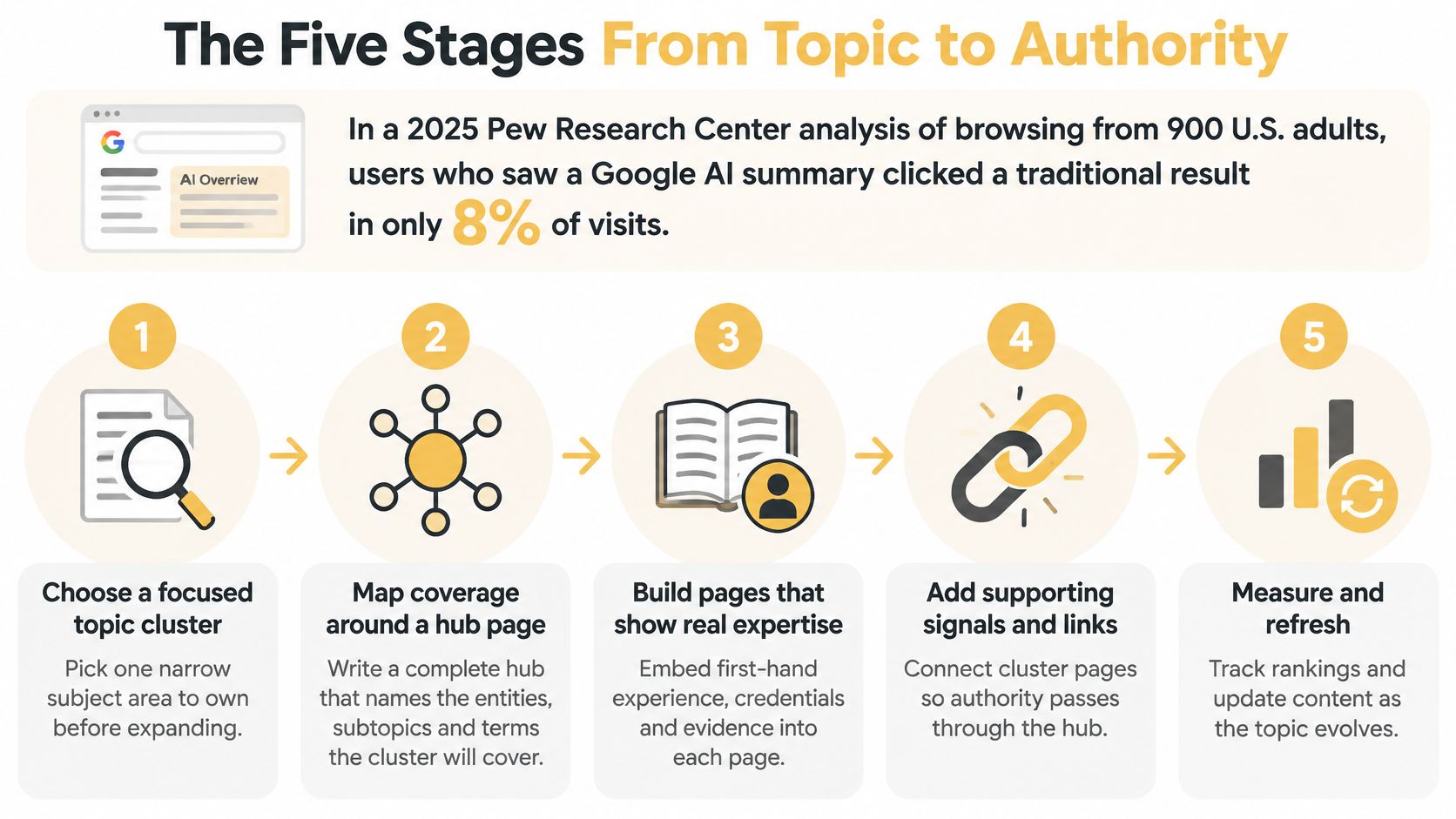
Running these stages in order stops teams from writing articles that never connect or never earn trust:
- Choose a boundary: Build a scored shortlist of three to five candidate subjects and select the single topic that clears every commercial and expertise test.
- Map the cluster: Draft one central hub brief alongside an intent map so every real audience question has a planned destination page before writing begins.
- Create supporting pages: Publish evidence-backed articles written by named practitioners, complete with primary citations, method notes for original findings, and review dates.
- Link and prune: Connect every supporting page back to the hub, remove orphan URLs, and merge duplicate pages so no two URLs chase the same intent.
- Measure by cluster: Track performance across the entire topic folder in a shared scorecard, then run a quarterly review that produces at least one concrete editorial decision.
| Stage | What you produce | Done when |
|---|---|---|
| 1. Choose a boundary | Scored list of three to five candidate topics | One topic clears every criterion |
| 2. Map the cluster | Hub page brief and intent map | Every audience intent has a planned page |
| 3. Create supporting pages | Evidence-backed articles with named authors | Each page has sources, a method note and a review date |
| 4. Link and prune | Link map and merge list | Every page is reachable from the hub and no two pages share an intent |
| 5. Measure by cluster | Scorecard for the topic folder | A quarterly review has produced at least one decision |
If you want a structured template to sequence briefs and quarterly maintenance alongside this cycle, pairing the workflow with SubmitMySaas's SEO content planning framework keeps editorial calendars tied to measurable topic gaps rather than ad hoc requests.
These five stages don't run once and finish. They operate as a quarterly loop: new buyer questions emerge, tools change, and pages go stale. Starting with the boundary decision is critical, because picking an oversized or undefendable subject wastes every hour spent writing, linking, and measuring downstream.
Choose a Topic Boundary You Can Defend
The fastest way to stall a content program is trying to own an entire industry. Say a mid-sized business decides to cover all of e-commerce or all of local marketing. After six months of publishing, it sits on dozens of shallow posts that can't outrank established trade publications, and every loosely related topic drags down the site's focus.
Depth inside a tight perimeter consistently outperforms sprawling coverage. A 2025 Search Atlas analysis of scholarly content found that specific topical authority (deep expertise in a narrow subject) was the strongest reported driver of rankings, with a statistically significant coefficient of -0.293 (p = 0.001), and showed that content depth mattered more than breadth. That finding comes from academic publishing rather than a universal ranking rule across every commercial sector, so you still need to validate any boundary against your own query logs and buyer conversations before committing budget to it.
Picture an Omaha retail company deciding where to invest its content hours. Writing generic posts about retail growth pits that company against national business outlets with massive editorial teams. Owning a narrower commercial subtopic, such as inventory forecasting for regional multi-store retailers, lets the company draw on its own reorder logs, seasonal sell-through patterns, and supplier lead times that generalist publishers can't replicate.
Score Candidate Topics Before Writing
Rather than picking a topic by gut instinct or raw keyword volume, shortlist three to five candidate boundaries and grade each one from 1 to 5 across five operational criteria.
| Criterion | Question to ask | Red flag |
|---|---|---|
| Customer value | Does this topic come before a purchase, booking or renewal decision? | Only curiosity traffic with no buying step |
| First-hand experience | Have you built, tested or measured this yourself? | You would be summarising other sites |
| Data access | Do you hold numbers, logs or customer questions nobody else has? | No proprietary data after a week of searching |
| Competition | Can you answer more follow-up questions than the top three results? | Top results already cover the edge cases well |
| Question depth | Are there enough closely related questions to fill a cluster of eight to twelve pages? | Fewer than five real questions |
I would always pick the candidate that scores highest on customer value and first-hand experience, even if third-party keyword tools report smaller monthly search volume. High search volume without proprietary proof just buys you page-three rankings. Running structured semantic keyword research against your top two candidates also shows whether a narrow territory contains enough distinct subtopics and related entities to support a real cluster instead of a single standalone guide.
The ten-question boundary test: Before locking in a subject, list ten specific customer questions your team can answer better than any general publisher using your own workflows, benchmarks, or product data. If you stall at five, narrow the angle or swap the candidate.
Map Your Cluster Around One Hub Page
A folder full of loosely tagged blog posts isn't a topic cluster. A working cluster operates as a documented parent-child coverage system with one clearly defined subject, predictable internal paths, and a direct route from educational answers to a commercial or practical next step.
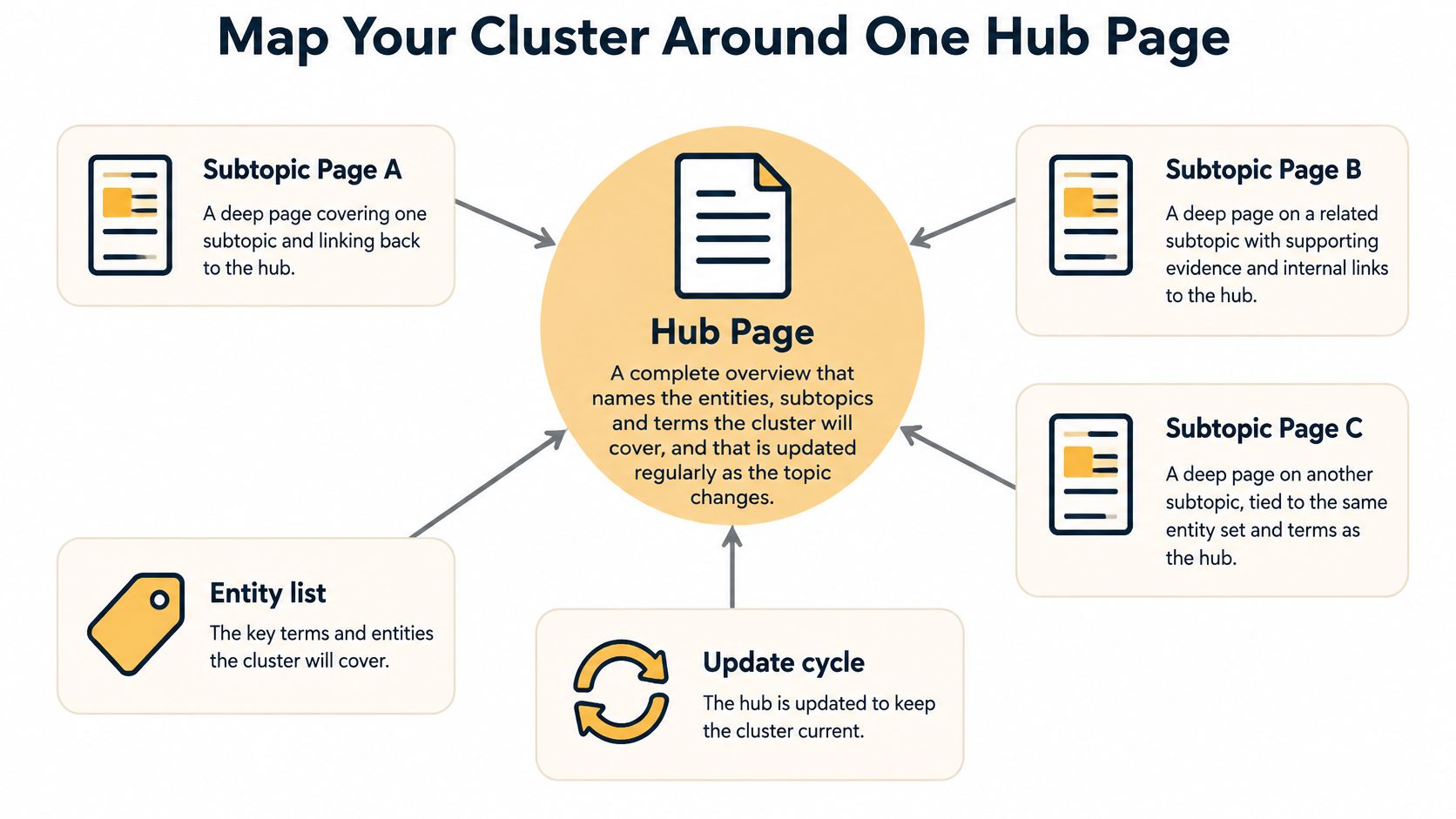
Build the hub page first. That page provides a complete, structured overview of your chosen boundary, explicitly defines the core entities, subtopics, and terminology the cluster will cover, and serves as the living index for everything beneath it. Whenever you publish a new supporting article, update a benchmark, or merge an older URL, revisit the hub so its overview and links stay accurate.
The visual below shows how a central hub anchors its supporting subtopic pages and shared entity set.
Cover All Four Audience Intents
Once the hub brief is approved, assign one dedicated supporting page to each distinct intent your buyers bring to the subject. Leaving out an entire intent layer weakens the cluster even when individual posts read well.
- Informational: Buyers starting their research want clear definitions and mechanics, such as "What is topical authority and how is it built?" Give this intent a deep explainer or make the hub overview carry the foundational explanation so supporting pages don't repeat basic definitions.
- Comparative: Decision-makers weighing options search for trade-offs, such as "Should I build topic clusters or pillar pages?" Answer these queries with side-by-side comparison articles that spell out where each approach works and where it breaks down.
- Transactional: Readers ready to hire or buy look for execution, such as "Who can run a cluster audit for my site?" Point this intent to a focused service or product page with clear deliverables, process steps, and conversion paths rather than burying offers inside blog copy.
- Troubleshooting: Teams already mid-project hit snags and search for fixes, such as "Why did rankings drop after a site restructure?" Diagnostic guides with concrete checks and remedies are usually the gap readers feel first, because most competitors stop after publishing introductory explainers.
| Intent | Example question | Page type |
|---|---|---|
| Informational | What is topical authority and how is it built? | Hub page overview |
| Comparative | Should I build topic clusters or pillar pages? | Comparison article |
| Transactional | Who can run a cluster audit for my site? | Service or product page |
| Troubleshooting | Why did rankings drop after a site restructure? | Diagnostic guide with fixes |
Keep your initial scope tight enough to ship cleanly. An eight-to-twelve-page cluster is large enough to test whether your boundary earns traction without locking your team into a year of speculative writing. If two planned subtopics overlap heavily or can't sustain independent depth, combine them into one stronger page before drafting begins.
Create Pages That Show Real Expertise
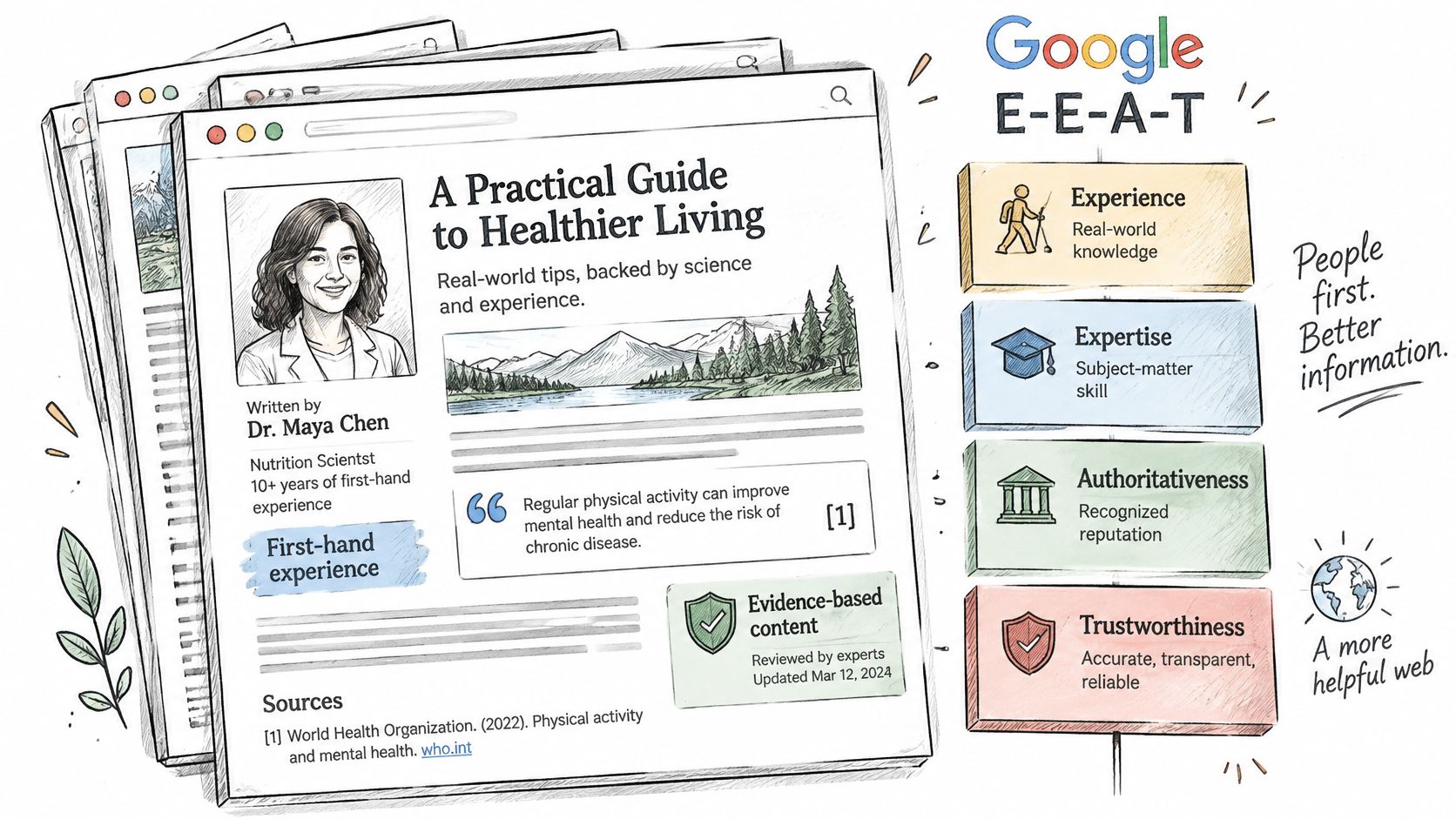
Credibility is built into the evidence inside an article, not bolted on with a generic badge in the sidebar. Google expanded its E-A-T model (expertise, authoritativeness, and trustworthiness) to E-E-A-T in December 2022 when it added first-hand experience to the Google Search Quality Evaluator Guidelines. Human quality raters use those guidelines to evaluate whether search systems return helpful results, and Google states that rater scores don't directly determine rankings.
That distinction shapes how an editorial team should operate. Treat E-E-A-T as a production standard that earns reader confidence, not a mechanical checklist or a set of buzzwords to sprinkle into paragraphs. Businesses selling to cautious buyers, including regional retailers, software companies, publishers, and local service providers, win trust when a reader can see who wrote the advice and how they tested it.
The graphic below summarizes the four pillars that guide page-level quality reviews.
Five Page-Level Standards to Enforce Before Publishing
Apply five concrete checks to every supporting page before it goes live:
- Named authorship with relevant work: Replace generic brand bylines with a real practitioner's name, and connect that byline to a biography outlining the specific work history, credentials, or hands-on projects behind their guidance.
- One first-hand example per page: Include an original test, an annotated screenshot from a working tool such as Google Search Console or Screaming Frog, or a step-by-step walkthrough from real execution instead of rephrasing what top-ranking blogs already publish.
- Primary citations for every figure: Trace every statistic, rule, or benchmark back to the original study, technical document, or official release, and link directly to that source in the same sentence.
- Transparent method notes on original data: Whenever you publish internal benchmarks or experiment outcomes, state the sample size, timeframe, collection method, and clear limitations right beside the results.
- Trigger-based review dates: Display a visible "last reviewed" date near the top of the page, and tie your next scheduled update to real events such as software updates, regulatory shifts, or new annual benchmarks.
Can a skeptical reader verify every major claim, number, and procedure on the page without opening another tab to fact-check you?
If a draft fails that editorial test, hold publication until the missing proof, citation, or hands-on example is in place.
Link Pages and Prune the Overlap
Publishing thorough articles only gets you halfway if those pages sit isolated or compete against each other for the same queries. Google's creating helpful content documentation specifically recommends pages that offer a substantial, complete, or thorough description of a topic and notes that its ranking systems evaluate signals tied to experience, expertise, authoritativeness, and trustworthiness. Clean site architecture ensures crawlers and readers can see how your in-depth pages reinforce one another.
Internal Linking Rules That Keep Authority Flowing
Structure links inside the folder deliberately rather than scattering random links wherever a keyword appears:
- Point every supporting page back to the hub: Use descriptive anchor text that names the subject, such as "regional inventory forecasting guide," never vague prompts like "click here" or "read more."
- Cross-link siblings selectively: Add sideways links between two supporting pages only when a reader needs the second page to complete an action on the first. Restraint keeps navigation clear and preserves topical focus.
- Eliminate deep click paths and orphans: Keep every cluster URL reachable within two or three clicks of the hub page, and run a monthly crawl in Screaming Frog or Ahrefs Site Audit to catch orphan pages that receive zero internal links.
Documenting parent-child paths in a repeatable internal linking strategy stops new writers from publishing disconnected posts that leak link equity away from your main hub.
Merge Duplicates and Run a Quarterly Pruning Pass
Overlapping pages split clicks, backlinks, and crawl focus. When two URLs answer the same search intent, fold the useful sections into the stronger page and set a permanent 301 redirect from the weaker URL. Reserve canonical tags for edge cases where both pages must remain live for users, such as filtered catalog views or campaign landing variants.
Once a quarter, grade every URL in the topic folder against six criteria so weak pages get repaired or retired before they drag down cluster quality.
| Criterion | Check | Action if weak |
|---|---|---|
| Intent coverage | Does the page answer one intent that no sibling answers? | Merge into the sibling that owns the intent |
| Factual freshness | Are figures and procedures current as of the last review date? | Update the page or retire it |
| Internal-link reachability | Is the page linked from the hub within two or three clicks? | Add a descriptive link from the hub |
| Unique evidence | Does it hold data, a test, a screenshot or an expert quote nobody else has? | Strengthen it first, or merge it |
| Author credentials | Is a named author with relevant work shown? | Add a bio or reassign the page |
| Conversions | Does it lead to a practical or commercial next step? | Add a clear path or prune the page |
Start your cleanup with URLs that fail on unique evidence while overlapping a sibling's intent. Those pages add maintenance cost without contributing original value.
Never keep a page live only because someone already published it.
Measure Authority Beyond Rankings
Single-keyword rank reports used to tell a clean story. Today, AI-generated summaries and chat interfaces can quote your definitions, tables, or troubleshooting steps without sending a user to your website. Judging a topic cluster solely on organic sessions hides the pages that build buyer recognition inside zero-click answers.
Google's ranking systems guide notes that its automated systems aim to prioritize original, helpful content created for people rather than material built mainly to attract search traffic, and Google doesn't publish a universal topical-authority score. Because no single platform metric confirms authority on its own, evaluate the topic folder as a unit across six complementary signals.
| Metric | What it shows | Where to read it |
|---|---|---|
| Non-brand clicks and impressions by cluster | Whether the topic earns search demand | Search Console, filtered by topic folder |
| Rankings for a fixed intent set | Whether core questions are winning | Rank tracker on a saved keyword list |
| Share of pages earning impressions | Whether new supporting pages get discovered | Search Console pages report |
| Branded searches | Whether people remember the brand after reading | Search Console branded query filter |
| Assisted conversions | Whether cluster content feeds revenue | Analytics multi-touch report |
| AI answer appearances and citations | Visibility without a click | Manual checks on a fixed query set |
Track Controlled Trends Over Two Quarters
Consistency turns raw metrics into reliable decisions. Lock a fixed list of priority queries covering all four intents in your cluster, then record traditional rankings and manual AI answer citations on the same day each month. Keeping the query set fixed ensures you're reading genuine authority gains rather than noise from shifting keyword lists.
Next, compare branded searches, brand-plus-topic queries, and direct traffic during the months after your cluster launches against your pre-launch baseline. When a buyer reads your framework inside an AI overview, remembers your name, and searches for your brand directly a week later, the cluster did its job even though the first touch produced zero clicks. Wiring these signals into a dashboard focused on how to measure content performance prevents leadership from cutting foundational guides that drive assisted revenue rather than last-click visits.
Give every new cluster enough runway before judging it. Search engines and readers take time to connect a folder of pages to a brand, so compare at least two full quarters of folder data, including branded search movement across that window, before deciding whether to expand or pivot the topic boundary.
Run Your First Cluster Audit This Quarter
Before commissioning another batch of new blog posts, audit one existing topic folder this quarter. Most active websites already contain half-finished clusters buried under overlapping articles, stale screenshots, and missing troubleshooting guides. Repairing and tightening an existing folder almost always produces stronger gains than publishing fresh posts into an unorganized archive.
Work through one priority folder in five concrete steps:
- Pull folder data: Export every live URL and its non-brand queries for that single topic folder from Google Search Console.
- Score every page: Grade each URL against the six pruning checks covering intent ownership, freshness, hub reachability, unique proof, named authorship, and conversion paths.
- Mine unanswered buyer questions: Review recent sales call notes, support tickets, and customer comments to list practical questions your current folder ignores.
- Pick three immediate actions: Choose one overlapping URL to merge, one promising page to upgrade with original evidence, and one missing supporting page to draft from scratch.
- Lock the baseline and schedule: Record your starting scorecard metrics for the folder and put your next quarterly review date on the team calendar.
Good roadmaps start with real market demand rather than generic keyword exports. At kickoff, we gather a client's real buyer queries, target competitors, and the markets that matter, then create a customized SEO roadmap aligned with those business goals and target audiences. If your internal team doesn't have the capacity to run the audit in-house, hand the exact same topic folder, baseline scorecard, and six grading criteria to any qualified outside specialist so every recommendation ties back to measurable edits.
The 90-day standard: A cluster audit only counts as finished when it ships concrete changes to at least three pages in your priority folder within ninety days.
If you're ready to turn an unfocused blog archive into a defensible topic cluster built for both traditional search and AI answers, Up North Media pairs data-driven SEO strategy, custom web development, and AI consulting to build measurable organic growth. Our team handles buyer-query research, technical cluster architecture, content execution, and transparent performance tracking aligned with your commercial goals. Explore how we structure custom SEO roadmaps at Up North Media.