
A lot of Omaha teams are trying to fix operations while still running them.
That usually looks like one of three scenes. A 12-person e-commerce brand in Elkhorn is juggling Shopify, a warehouse portal, a help desk, and a spreadsheet someone swears is temporary. A publisher in Benson is moving drafts through email, Google Docs, and a CMS with five slightly different publishing checklists. A startup founder near Aksarben is spending more to acquire customers while delivery slips, support queues grow, and nobody agrees where the bottleneck is.
The common problem isn't a lack of software. It's that more tools got layered onto workflows that were never clearly mapped in the first place. So the team works hard, the dashboard count goes up, and margin still gets squeezed.
If you're trying to figure out how to improve operational efficiency, the answer usually starts with a smaller move than people expect. Map the current state. Find the constraint. Standardize the work. Then automate the stable parts. Finally, put one owner and a few useful KPIs around it so the gains stick.
Why Operational Efficiency Feels Stuck in 2026
More software made weak handoffs harder to see
A Monday morning problem in Omaha usually does not look dramatic. An e-commerce team in Elkhorn has plenty of orders, but three people are checking three systems to confirm whether shipments left. A publisher in Benson has editors waiting on ad placements and last-minute copy changes because nobody is working from the same queue. A startup near Aksarben has a founder approving exceptions in Slack, which turns one person into an invisible checkpoint for the whole company.
That is why efficiency feels stuck. The work is moving, but it is not flowing.
In 2026, many SMBs are dealing with coordination drag more than raw capacity limits. Teams added apps, dashboards, automations, and alerts over time. The result is a process that looks modern from the outside and still burns hours on status checks, duplicate entry, and rework.
Leaders also tend to define efficiency too narrowly. They hear the word and think headcount cuts or higher output targets. On the ground, the better definition is simpler. Fewer waits. Cleaner handoffs. Clear ownership. Less rework when something changes.
Why efficiency and adaptability pull in opposite directions
Small companies need consistency, but they also need room to react. That tension shows up fast in Omaha SMBs.
A DTC brand may need a standard order flow, then a retailer sends a special packaging request that breaks the usual pick-pack-ship routine. A publisher may need a clean editorial calendar, then a sponsor changes creative two hours before release. A startup may want a tidy sales-to-delivery handoff, then one enterprise prospect asks for custom terms and everyone drops into manual mode.
Analysts at Smartsheet found that 63% of operational professionals said they struggle to balance efficiency with changing business needs, 76% relied on manual workarounds, 61% lacked full visibility, and only 8% believed they had achieved operational excellence in the Smartsheet operational excellence report. That matches what shows up in smaller teams. The core issue is often process brittleness. A workflow holds together until one exception hits it.
Practical rule: If the team needs a separate Slack thread to explain what status means, the process is not under control.
More alerts rarely solve that. A better operating model does. For SMBs, that usually means five moves:
- Current-state mapping: See where handoffs, queues, and approvals slow the work.
- Bottleneck prioritization: Fix the constraint that is capping throughput or creating the most expensive delays.
- Standardize before automation: Clean up the process before asking software to run it.
- KPI discipline: Track a few numbers tied to speed, quality, and exceptions.
- Change ownership: Assign one person to maintain the new process after rollout.
What actually improves throughput
Automation and AI can help, but only in the right spots. The OECD estimates that AI and automation could raise annual aggregate labour productivity growth by 0.4 to 0.9 percentage points in G7 economies over a 10-year horizon, with annual total-factor productivity gains of 0.25 to 0.6 percentage points in some broader scenarios, according to this OECD summary on operational efficiency.
For an SMB, that does not mean buying another tool and hoping for lift. It means using automation where the work is already repeatable and the rules are stable. In practice, that could be return authorization for an Omaha e-commerce brand, production checklists for a small publisher, or invoice follow-up for a startup with growing accounts receivable. Those are the places where process discipline pays back.
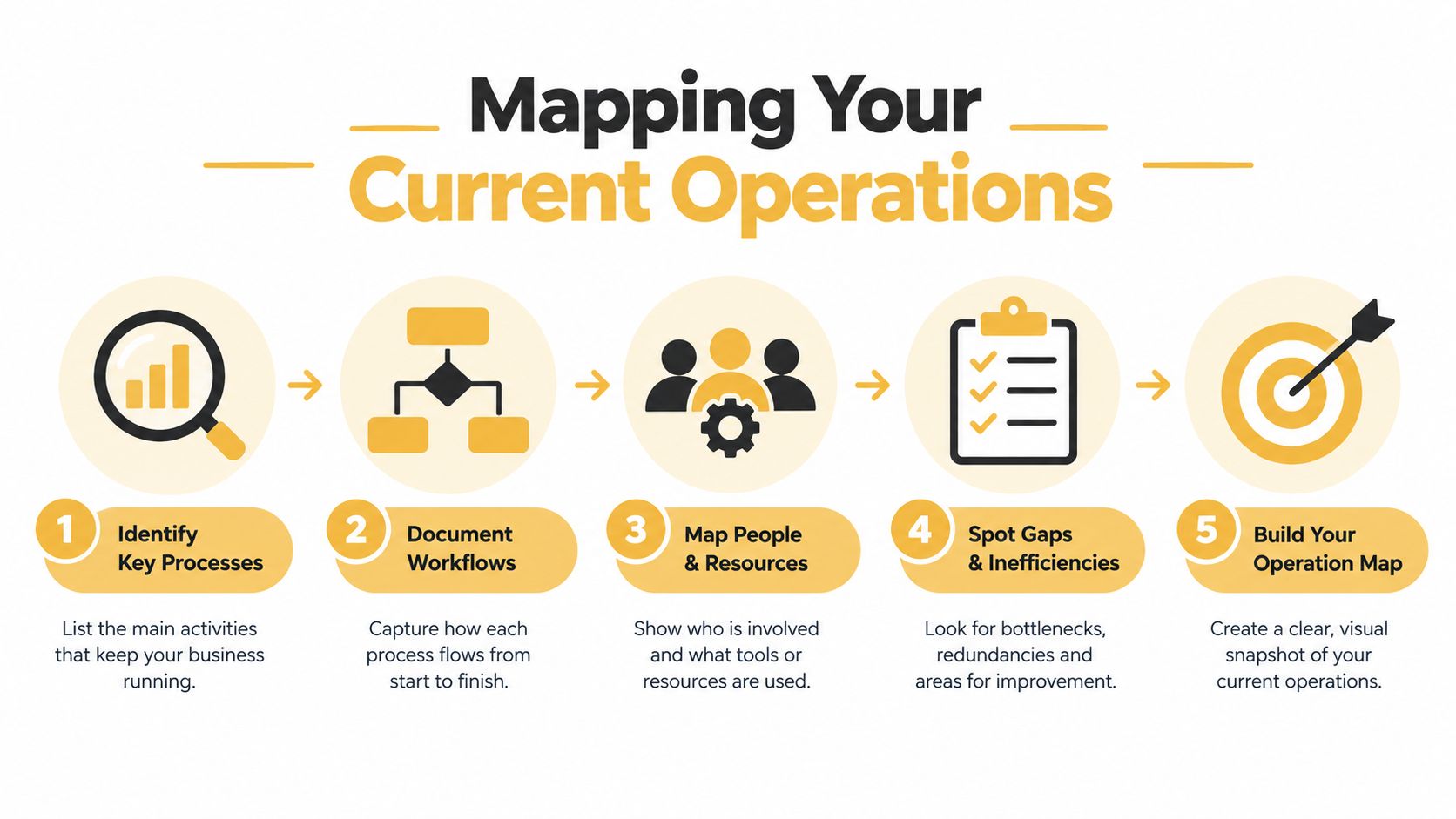
Mapping Your Current Operations
Start with one workflow, not the whole company
They make this too abstract. They hold a meeting, describe "operations" at a high level, and end up with opinions instead of a map.
Pick one workflow that matters. For an Omaha DTC apparel brand, use order to ship. For a local publisher, use draft to publish. For a startup, use lead to closed handoff or invoice to reconciliation.
Then write every step exactly as it happens today.
For a DTC workflow, the map may look like this:
- Shopify order is received.
- Picking list is printed.
- Warehouse or 3PL gets notified.
- Label is created.
- Tracking email goes out.
- Inventory updates.
- Returns get logged in Google Sheets.
- Support handles exceptions.
That doesn't sound complicated until you mark every handoff, every login, and every place someone rekeys data.
Ask the questions that expose drag
At each step, ask the same set of questions:
- Who owns it
- What triggers it
- Which system holds the source data
- Where data gets copied or re-entered
- How long the item waits before anyone touches it
- What breaks when the step fails
- Whether the step adds value, is necessary waste, or is pure waste
For a publisher, audit the web stack the same way. Log the CMS sign-in flow. Check the editorial calendar tool. Open the ad ops dashboard. Watch how many copy-paste actions happen between approved draft and published article.
A lot of editorial teams discover that "publishing" is four separate jobs hidden inside one label: formatting, image sizing, tagging, and ad placement. Once you split those out, the bottleneck usually becomes obvious.
Capture screenshots for a week. Time the waits, not just the work. In many SMB processes, the delay isn't the task itself. It's the idle time between tasks.
Build a map people can use
You don't need process mapping software to do this well. A shared doc, a spreadsheet, and a screen recording tool are enough. What matters is accuracy.
Use three labels on every step:
- Value-add: The customer would care if this disappeared.
- Necessary waste: The customer doesn't care, but the business currently needs it.
- Pure waste: Nobody benefits. It exists because the process drifted.
If you want an outside framework for this kind of audit, this guide on how to streamline business operations for SMEs is a useful companion to the mapping exercise.
The point of the map isn't documentation for its own sake. It's to stop arguing from memory. Once the current state is visible, weak spots stop hiding behind "that's just how we do it."
Finding and Prioritizing Bottlenecks
The fastest way to waste an efficiency project is to fix the most annoying problem instead of the most expensive one.
A founder usually feels the loudest issue first. That doesn't mean it's the right one to tackle. The approval chain may be irritating, but a recurring reconciliation delay or fulfillment exception loop may be costing more time and margin every week.
Use a simple scoring model
For SMBs, a three-factor model works well:
- Impact: How much money, time, or throughput this bottleneck costs each month
- Frequency: How often it happens
- Fixability: Whether a small team can resolve it in under 30 days without a full rebuild
Score each one from 1 to 10. Add the numbers. Highest total gets attention first, unless fixability is so low that the team would stall for months.
Here's a simple example for an Omaha DTC brand.
| Bottleneck | Impact (1-10) | Frequency (1-10) | Fixability (1-10) | Total | Priority |
|---|---|---|---|---|---|
| Manual invoice reconciliation | 8 | 4 | 6 | 18 | High |
| Friday shipping surge backlog | 7 | 8 | 5 | 20 | High |
| Customer return status not synced | 6 | 7 | 7 | 20 | High |
| Product image color-swatch QA loop | 9 | 9 | 2 | 20 | Defer |
| Founder approval on every refund exception | 5 | 6 | 8 | 19 | High |
The point isn't perfect math. The point is forcing trade-offs into the open.
A cosmetic color-swatch QA loop might have high impact and high frequency, but if it's tangled up in brand, vendor, and merchandising dependencies, it may not be the best first move. Manual invoice reconciliation with a cleaner fix path often jumps the queue.
Common Omaha SMB bottlenecks
Some patterns come up repeatedly:
- E-commerce shipping pileups: Friday order spikes expose weak batching rules, unclear pick priorities, or poor warehouse communication.
- Publisher production slowdowns: Monday ad creative approvals hold back article scheduling even when editorial is ready.
- Founder choke points: Refund approvals, campaign signoff, pricing changes, and vendor decisions all route through one overloaded person.
- Data re-entry loops: Orders, leads, or invoices get entered into multiple tools because systems don't share a source of truth.
Later, once you've ranked your list, it's worth reviewing a broader perspective on business process optimization to pressure-test whether you're fixing a symptom or the true constraint.
This short walkthrough can help your team visualize how bottlenecks build in everyday workflows:
Fix high impact and high fixability first
This is the part teams skip because buying software feels more concrete.
Don't start there.
If a problem scores high on impact and high on fixability, fix it before you buy anything.
A shared queue, a routing rule, a tighter handoff, or one removed approval step often does more for throughput than a new platform. Software helps most after the team has already identified the exact point of drag.
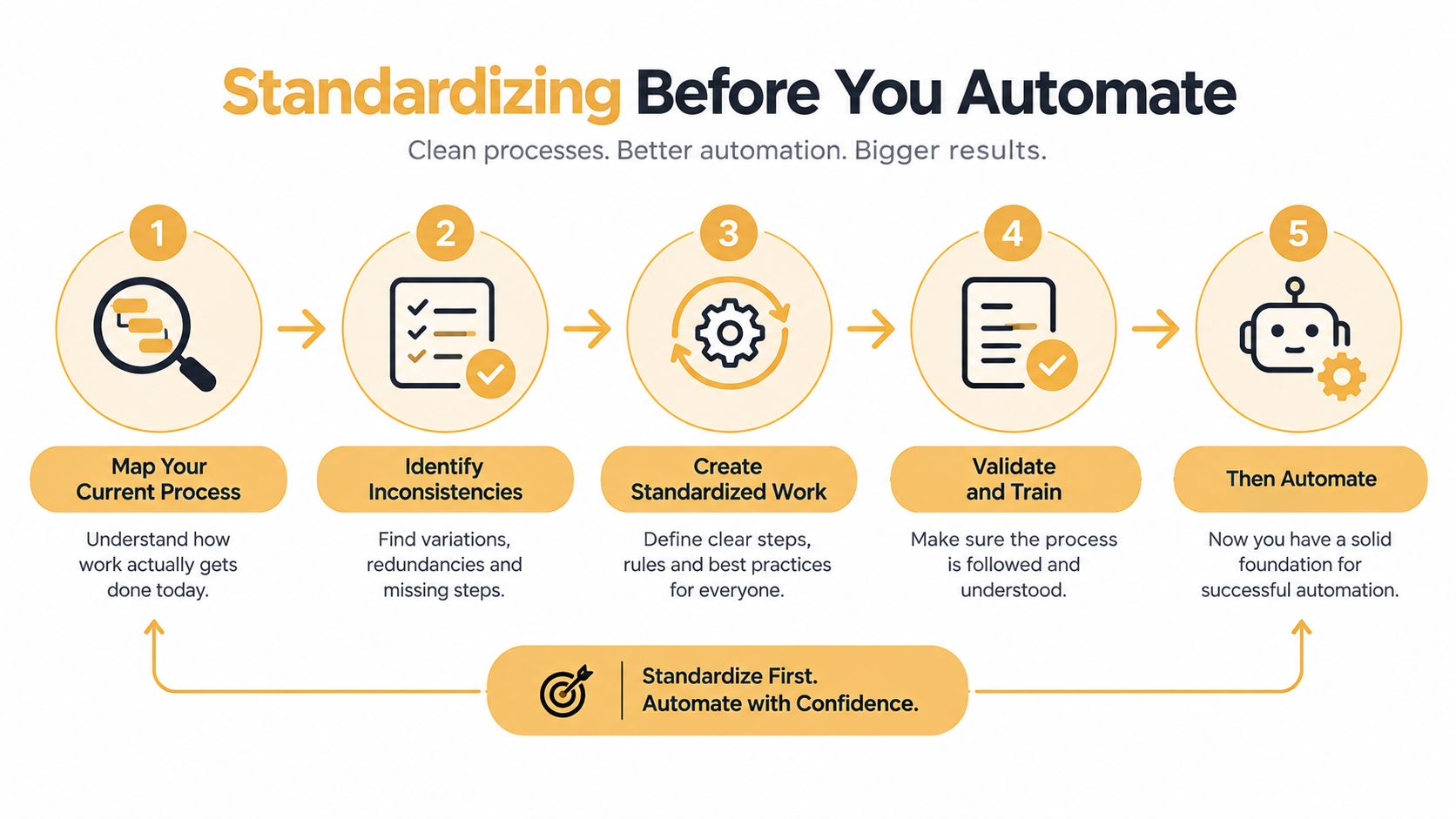
Standardizing Before You Automate
Automation doesn't clean up messy work. It repeats messy work at machine speed.
That's why some teams install a new workflow tool and end up with faster confusion. The software did what they asked. The problem was that three employees were doing the "same" task three different ways.
The sequence that works
A practical sequence looks like this:
- Document the current steps in plain language.
- Remove variation that doesn't improve customer outcomes.
- Automate only the stable pieces with clear triggers and expected outputs.
An academic study found a strong positive relationship between automation adoption and operational efficiency, with b = 0.62, p < 0.01, and reported benefits including higher productivity, greater process reliability, and fewer defects in the Journal of Scientific and Technological Research article on automation adoption. The same study warned, in practice, against scaling unstable processes.
That warning matters more than the software pitch.
What this looks like in an Omaha e-commerce shop
Take a boutique store on Benson Road processing Shopify orders. Before anyone connects APIs or adds bot logic, standardize the post-purchase flow:
- Pick slip format: One format only, with the same SKU conventions every time.
- Label generation rule: Define when labels are created and who checks exceptions.
- Tracking email template: Use one approved message path instead of custom replies.
- Inventory sync method: Decide which system is the source of truth before pushing data into QuickBooks.
If one team member prints pick slips by SKU family, another by order time, and a third batches by shipping zone, the automation project will get dragged into compensating for human improvisation.
For staffing support around repeatable admin tasks, some SMBs also explore options like Latin American virtual assistants after the workflow is standardized, especially when they need process capacity before full automation is justified.
The same rule applies to publishers and startups
A local publisher sending weekly newsletters through Mailchimp shouldn't automate social distribution until the editorial brief, image specs, link formatting, and CMS tagging taxonomy are all consistent. Otherwise, the team spends more time fixing malformed posts than they would've spent posting manually.
For startups, CRM workflows create the same trap. If lead stages mean different things to sales, ops, and the founder, the automation won't create clarity. It'll codify confusion. If you're thinking about implementation order, this AI implementation roadmap is useful for deciding what should be cleaned up before systems get connected.
A short checklist of changes that usually pay off before automation:
- Shared inbox routing rules: Stop relying on whoever checks first.
- Saved reply templates: Reduce one-off writing on repeat questions.
- Customer data source of truth: Pick one system that wins conflicts.
- Single approvals queue: Remove scattered signoff through Slack, email, and text.
One option some Omaha teams use at this point is Up North Media for custom workflow automation or web-app adjustments when the bottleneck sits inside the company's own digital stack rather than an off-the-shelf tool.
Red flag: If two people still explain the same step differently, standardize it one more pass before automating it.
Picking the Right KPIs to Measure
A crowded dashboard gives people the feeling of control without the discipline of control.
The right KPI set is smaller than you might think. If you're serious about how to improve operational efficiency, each metric should connect directly to a bottleneck, an owner, and a review rhythm.
Use a starter set your team can actually maintain
For a Shopify-based Omaha e-commerce business, a practical first layer is:
| Operation Type | KPI | Realistic Baseline | Review Cadence | Owner |
|---|---|---|---|---|
| DTC e-commerce | Order-to-ship hours | Under 24 hours | Weekly | Operations lead |
| DTC e-commerce | Return rate | Baseline from current state | Weekly | CX or ops manager |
| DTC e-commerce | Customer acquisition cost | Baseline from current state | Weekly | Marketing lead |
| DTC e-commerce | Repeat purchase rate | Baseline from current state | Monthly | Growth lead |
| DTC e-commerce | Support tickets per 100 orders | Baseline from current state | Weekly | Support lead |
| Digital publishing | Articles published per week | Baseline from current state | Weekly | Managing editor |
| Digital publishing | Draft-to-publish turnaround | Inside 10 working days | Weekly | Editorial operations |
| Digital publishing | Email open rate | Baseline from current state | Weekly | Audience lead |
| Digital publishing | Ad RPM | Baseline from current state | Weekly | Revenue or ad ops lead |
| Service or startup ops | First support response time | Under four business hours | Weekly | Support or founder delegate |
Those baselines are intentionally tight but manageable for many SMB setups. If your current operation is far outside them, that's useful information, not a failure.
Structure the dashboard around ownership
A small team doesn't need a BI initiative to start measuring well. It needs discipline.
Keep these rules in place:
- One source per metric: Don't let two reports argue over the same number.
- One owner per metric: Someone has to answer for changes.
- One review cadence: Weekly works for most operational numbers.
- One target band: A range is more useful than pretending every week should hit the exact same figure.
For teams building cleaner reporting systems, this guide to analytics implementation is a solid reference point for connecting operational numbers to a dashboard that people use.
Pair speed metrics with experience metrics
Teams drift into bad incentives.
If you only track speed, employees learn to close tickets fast, rush picks, or push drafts through before they're ready. The metric improves while the operation degrades.
Shorter handling time only matters if repeat complaints don't rise with it.
Pair each efficiency metric with a counter-metric. For example:
- Order-to-ship hours with return reasons
- Support response time with reopened ticket volume
- Draft-to-publish speed with correction rate after publication
The dashboard should tell you whether the team is moving faster and whether the customer experience is holding up.
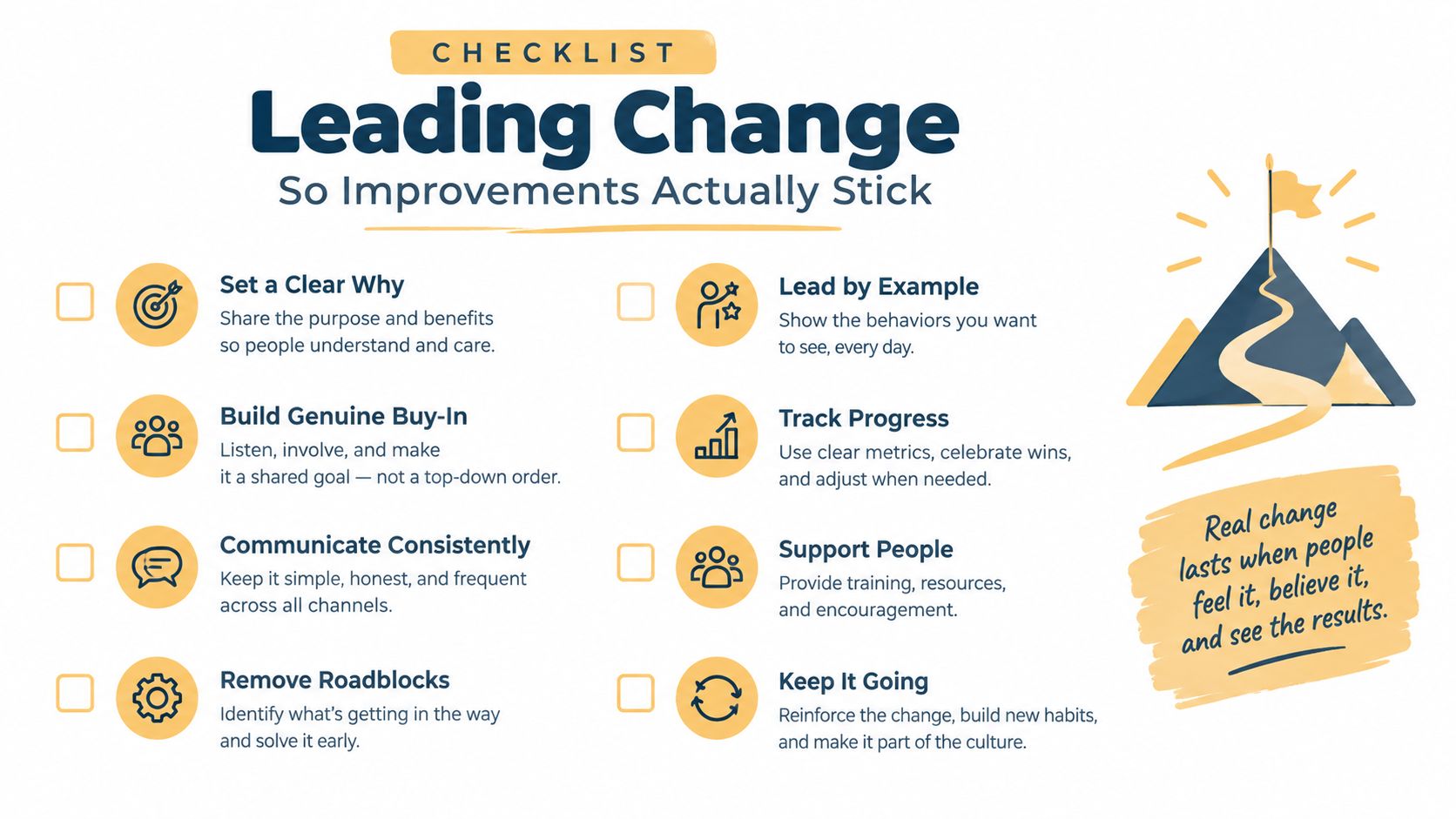
Leading Change So Improvements Actually Stick
A 12-person Omaha e-commerce team cleans up pick-pack flow, shortens order-to-ship time, and adds a few automations in Shopify. For two weeks, it looks like a win. Then customer service starts bypassing the new exception queue, warehouse notes live in text messages again, and nobody knows which version of the process is current. The problem was never the software. The change had no operating owner.
That pattern shows up in small companies because SMBs run on speed, trust, and memory. Those strengths help a team survive a busy month. They also make improvements fragile when the process lives in one person's head.
An independent synthesis reported that large-scale transformation efforts succeed at roughly 31% overall, while only about 12% achieve their original ambitions and sustain them for three years, according to this review of process improvement failure rates. In small businesses, the failure points are usually less dramatic than the headline suggests. A handoff gets fuzzy. A weekly review slips. A manager tolerates side paths because the team is busy. Three months later, the old workflow is back.
Automation-first thinking misses the deeper risk
Owners often buy the tool before they assign the operating rules.
In practice, the breakdown is predictable. One capable employee sets up the workflow, knows where the exceptions go, and remembers why each field matters. The rest of the team adopts pieces of it. Then priorities shift, that employee goes on leave or takes another job, and the process starts to fray.
PwC's 2026 operations survey found that 83% of respondents expect AI agents and automation to break down functional silos, but only 27% had fully embedded an AI strategy across business units and just 37% felt comfortable assigning AI agents to full end-to-end processes. The same survey found that only 51% said they establish a clean, structured data foundation before scaling digital initiatives, while 87% said poor data quality hampered digital value creation in the PwC digital trends in operations survey.
For an Omaha startup, that might mean HubSpot automations firing off stale lifecycle stages because nobody owns field definitions. For a local publisher, it can mean an editorial checklist exists in theory, but deadlines still depend on Slack reminders and whoever remembers the sponsor approval step. The constraint is rarely access to software. It is discipline around ownership, handoffs, and review.
Build a sustainment loop
The fix is less glamorous than a new platform, but it holds up better.
Set one person as the process owner. That person needs authority to make calls when sales wants one shortcut, service wants another, and operations has to live with the downstream mess. Keep a written change log. Run a short weekly review on exceptions, stuck work, and any metric that moved outside its target band. Recheck the standard steps every quarter, because drift is normal.
The details vary by business.
A five-person Omaha startup rolling out HubSpot automations needs one ops-minded lead who can lock stage definitions, clean up duplicate properties, and settle handoffs between sales and delivery. A publisher should spread the risk differently. Put one person in charge of maintaining the publishing checklist each quarter, then rotate that responsibility so the process survives staff changes. An e-commerce company usually needs tighter exception handling than either of those. If returns, damaged shipments, and backorders all bypass the same queue, the team will invent workarounds within a week.
Expect the first stretch to feel heavier
This is the trade-off owners need to hear up front.
A cleaner operation usually lets the same team handle more volume with less confusion. Early on, though, the work often feels slower. People have to document steps they used to do from memory. They need cleaner inputs. They lose some freedom to improvise.
That friction is normal.
The first 90 days often feel heavier than the old way because the team is giving up personal shortcuts and replacing them with shared rules. I have seen this in Omaha SMBs more than once. The owner looks at the extra clicks and assumes the redesign is creating bureaucracy, when the business is finally making work visible enough to manage.
There is also a labor trade-off that gets oversimplified. Firms often get more from workflow redesign than from headcount reduction. OECD-linked research on automation and productivity found positive productivity effects from robots across member countries, and a separate OECD assessment noted that by early 2024 many firms were using AI to handle operations previously done by existing equipment or software rather than directly replacing employee tasks in this OECD-linked research on automation and productivity. For a small business, that usually means better throughput, fewer drops between steps, and less rework. It does not mean every improvement should start with a staffing cut.
Sustainable efficiency comes from making the work clear, assigning ownership, and reviewing it long enough for the new habits to hold.
If your team knows operations are dragging but can't see where the friction really lives, Up North Media helps Omaha businesses tighten the digital side of the problem through web app development, analytics, and AI-driven workflow automation. If you want help mapping bottlenecks, cleaning up handoffs, or building a system your team will use, visit Up North Media.