
You're probably seeing the same frustrating pattern we see in audits all the time. A page ranks on page one, the title tag is solid, the content is relevant, and yet the click goes somewhere else because Google pulled a competitor's answer into the featured snippet.
That's why ranking isn't the full goal anymore. If your page deserves the answer, you need to format, target, and test it so Google can lift that answer cleanly.
Beyond Rankings to Winning Position Zero
A featured snippet is the extracted answer box Google places above standard organic results for certain searches. It's the answer users see first, often before they decide whether to click anything at all. In practice, that means your SEO target isn't just “rank well.” It's to own the answer format Google wants to show.
Google Search Central notes that pages in positions 1 through 5 are significantly more likely to capture a featured snippet, and 70% of sites that successfully rank for a featured snippet were already in the top 3 standard results before optimization (Google Search Central). That lines up with what we see in client work. Snippet wins usually come after a page is already competitive, not before.
Why page-one rankings still lose
A lot of businesses stop at “we're ranking.” That's where visibility starts, not where it ends.
If a competitor owns the snippet, they control the first definition, the first steps, or the first comparison a searcher reads. On informational queries, that changes how your brand is perceived before the user ever scans the blue links. It also changes what kind of traffic you can earn. Some searches now end without a click, which makes the top extracted answer even more important.
Practical rule: Don't treat snippet optimization as a separate SEO channel. Treat it as the final layer on top of already strong rankings.
That's also why foundational SEO still matters. If you need a refresher on the underlying mechanics, our guide to search engine optimization basics is the right place to tighten up the pages that need to move first.
The real objective
We don't approach snippet work as a one-off formatting trick. We approach it as a system:
- Find pages already close because those are the fastest opportunities.
- Match the answer format to the query type.
- Measure before and after so you know what changed.
- Repeat the process across similar pages and keyword clusters.
If you want another perspective on the mechanics of optimizing for featured snippets, it's worth reviewing alongside your own SERP checks. The useful part isn't a single tactic. It's recognizing that snippet wins come from combining ranking strength, answer clarity, and clean structure.
Uncovering Your Best Snippet Opportunities
The fastest snippet wins usually aren't new articles. They're existing pages that already rank well, already match search intent, and present the answer worse than the page holding the snippet.

Frase reports that 67% of featured snippets are triggered by long-tail, question-based keywords containing four or more words, and that content updated within the last 90 days is 3.2 times more likely to win a snippet (Frase). That gives you two immediate filters. Look for question-style queries, and don't leave target pages stale.
Start with pages that are already close
We use Ahrefs, Semrush, and Google Search Console for this, but the workflow is tool-agnostic.
First, pull keywords where your page already ranks on page one. Then isolate the terms where Google shows a featured snippet and your site does not own it. Those are your best candidates because the page already has enough relevance to compete.
A simple review process looks like this:
- Export page-one keywords from your rank tracker or Search Console.
- Mark queries with an existing snippet by checking live SERPs.
- Compare your page against the snippet owner for format, not just depth.
- Group opportunities by snippet type such as paragraph, list, or table.
- Prioritize pages you can update quickly and that matter commercially.
For teams doing this at scale, this breakdown of scalable SERP feature discovery is useful because it frames the work around repeatable filtering instead of manual hunting.
Build a target list that's actually worth working
Not every snippet opportunity deserves effort. We exclude a lot of them.
We usually move a page up the list when the query has these traits:
- Clear informational intent: “What is,” “how to,” “why does,” and “difference between” queries are easier to map to a snippet format.
- One obvious answer type: If the query wants a definition, don't force a list. If it wants steps, don't bury them in prose.
- A page that can be refreshed fast: If the page is already strong, a cleaner answer block may be enough.
- No internal conflict: If two pages on your site target the same question, fix that before chasing the snippet.
If your keyword discovery process is still messy, this primer on the basics of keyword research will help you clean up the input before you start snippet targeting.
Check the live SERP, not just the keyword report
Many teams waste time doing this. They trust the tool export and skip the actual results page.
You need to inspect the live SERP and ask:
- Is the snippet a paragraph, list, or table?
- Is Google pulling from a dedicated answer block or a deeper section?
- Is the current winner better, or just cleaner?
- Does the query also trigger People Also Ask entries that suggest supporting subheads?
When a page ranks but loses the snippet, the gap is often formatting clarity, not topical authority.
That's why we don't start by rewriting the entire page. We start by identifying the exact extractable section Google is most likely to lift.
Formatting Content for Paragraph Snippets
Paragraph snippets are the most common format, and they're also where teams overcomplicate the work. The winning version is usually shorter, cleaner, and more literal than the draft you want to publish.
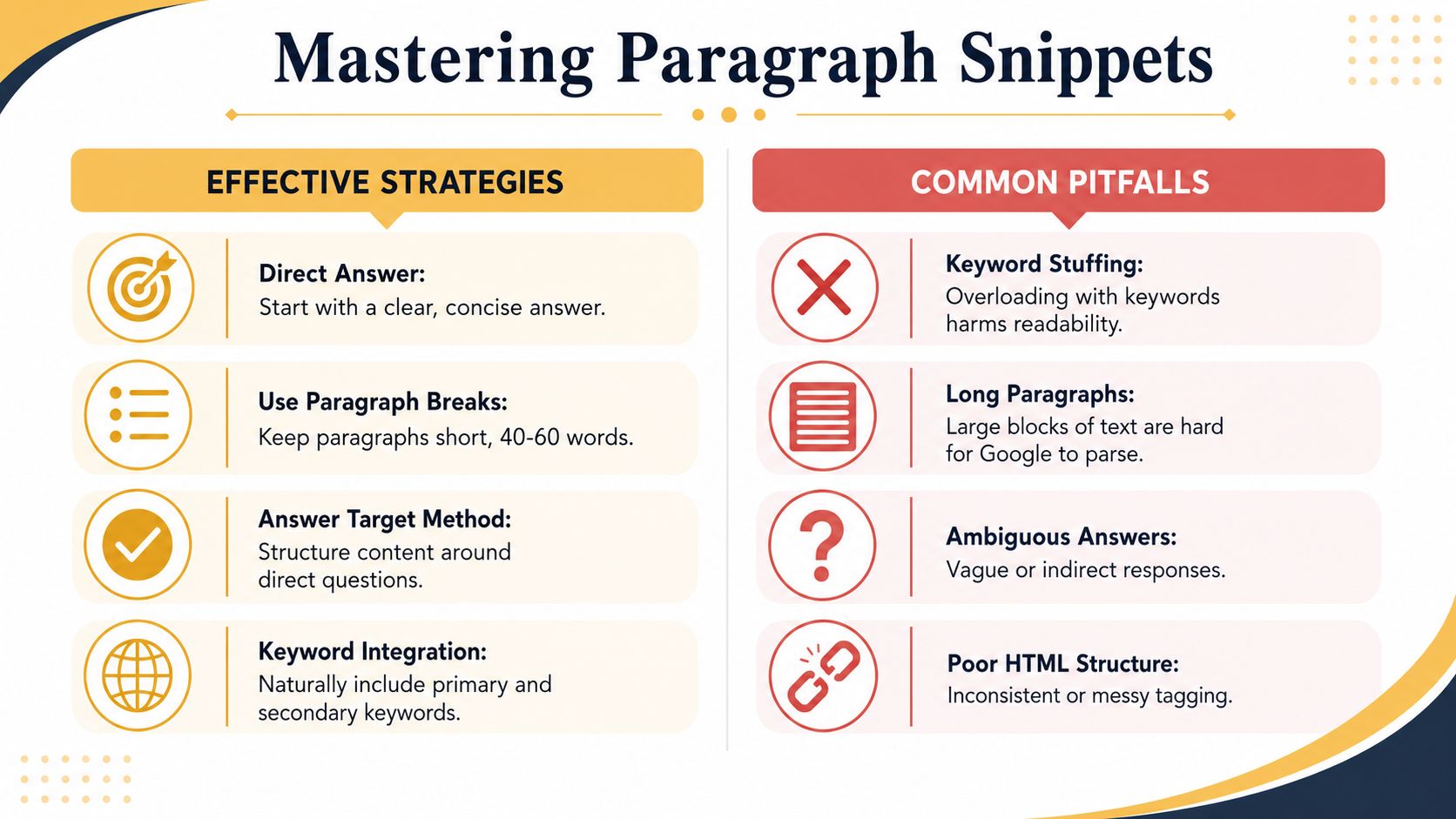
Semrush's guidance is the pattern we use most often: place a question-style heading above a self-contained answer block of roughly 40 to 60 words, put the core answer in the first sentence, and keep the extract concise because Google tends to prefer snippets under about 50 words (Semrush).
Use the answer target method
We call this the answer target inside content briefs. It's the section designed to be copied out of context and still make sense.
The structure is simple:
- H2 or H3 asks the question
- First sentence answers it directly
- Second sentence adds context
- Anything deeper goes below the snippet block
Here's what that looks like in practice.
Weak version
H2: Featured snippets and why they matter
Featured snippets can be very useful for SEO because they appear in prominent parts of the search results and can help increase brand exposure while also sometimes improving user trust and helping searchers quickly understand what a page is about before clicking.
Stronger version
H2: What is a featured snippet
A featured snippet is a short answer Google extracts from a webpage and places above standard organic results for certain searches. It's designed to answer a question quickly while linking to the source page for more detail.
The second version is easier for Google to lift because it's self-contained. It defines the term immediately and doesn't force the algorithm to trim filler.
Keep the HTML boring
Boring HTML wins this format more often than clever design.
We want:
- A clear H2 or H3 written as the question
- A plain paragraph tag directly underneath
- No accordion hidden behind scripts if you can avoid it
- No intro sentence between the heading and answer block
- No massive wall of copy before the answer appears
A clean example:
| Element | What to do |
|---|---|
| Heading | Write the exact question naturally |
| First sentence | State the answer directly |
| Length | Keep the extract tight and complete |
| Supporting detail | Put it below, not inside the answer block |
What doesn't work well
A lot of “optimized” copy fails because it sounds optimized.
Avoid these habits:
- Keyword stuffing: Repeating the exact phrase inside every sentence makes the answer worse.
- Delayed answers: If the first sentence dances around the point, Google has to work too hard.
- Opinionated language: Definition-style answers outperform brandy, persuasive intros.
- Mixed intent: Don't answer a “what is” query with a process explanation.
Write the snippet block like a dictionary entry. Write the rest of the section like a helpful human.
That balance matters. The extract has to be concise enough for Google and useful enough for the reader who keeps scrolling.
Winning Lists and Tables with Structured HTML
Some queries don't want a definition. They want steps, options, comparisons, or specs. That's where list and table snippets matter, and where the underlying HTML starts doing real work.
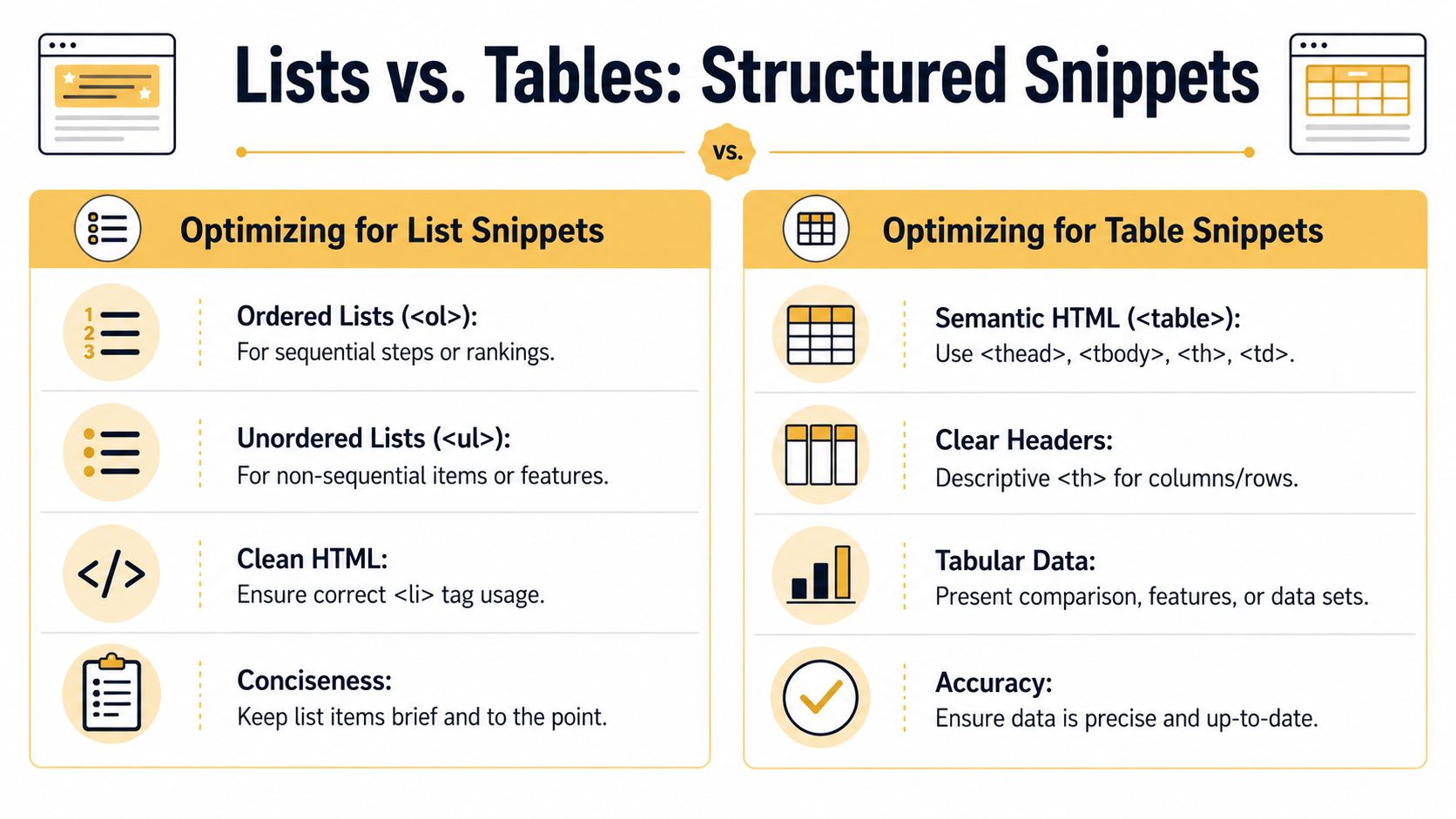
Leadsgagna's guidance is straightforward: for list snippets, the highest-yield method is to match page structure to query intent by using actual HTML ordered or unordered lists and concise parallel items, because that formatting directly helps Google extract the list (Leadsgagna).
Choose the format based on the query
We make this decision before rewriting a page.
If the query implies sequence, use an ordered list. If it implies a set of items, use an unordered list. If the user needs a side-by-side comparison, use a table.
| Query type | Best format | Example intent |
|---|---|---|
| Process | Ordered list | How to set up product schema |
| Collection | Unordered list | Best on-page SEO elements |
| Comparison | Table | Shopify vs WooCommerce features |
The mistake we see most is forcing everything into paragraphs because the author wants the page to “flow.” Google doesn't need flow. It needs structure it can extract.
Lists should be parallel and scannable
A list snippet gets weaker when each item uses a different style or length.
Better list formatting looks like this:
How to optimize for featured snippets
- Find a query with an existing snippet
- Match the snippet type
- Write a direct answer or step list
- Use clean HTML structure
- Reindex and monitor results
That's stronger than embedding the same steps inside a long paragraph, because each item is discrete and easy to interpret.
If the query says “steps,” give Google actual steps in actual list markup.
We also keep list intros short. One sentence is enough to frame the items. A long throat-clearing paragraph before the list can dilute the extraction target.
Tables work when comparison matters
For service pages and e-commerce content, table snippets can be useful when users are comparing features, plans, dimensions, or categories. The key is semantic structure.
Use:
<table>for the full container<thead>for header rows<th>for actual headings<tbody>and<td>for the data cells
If you're comparing two approaches, don't describe the comparison vaguely in prose if a simple table does the job better.
Clunky paragraph
Local SEO is often better for location-based companies, while national SEO can involve broader keyword targeting and usually requires a wider content footprint and link profile.
Cleaner comparison
| Approach | Best fit | Content focus |
|---|---|---|
| Local SEO | Location-based businesses | Service areas, maps, local intent |
| National SEO | Broader markets | Topic clusters, broader informational reach |
That format gives Google a clear extractable structure and gives users a faster answer.
A Repeatable Workflow for Testing and Measurement
Most snippet advice breaks down after the edit goes live. You're told to add question-based headings, tighten the answer, and use lists or tables. Fine. But if three pages change at once and one snippet appears two weeks later, what caused it?
That's the measurement gap. Search Engine Land points out that there's little standardized coverage of testing methodology or change attribution, even though snippet wins are volatile and depend on more than on-page formatting alone (Search Engine Land). That's why we treat snippet work like an experiment log, not a content refresh.
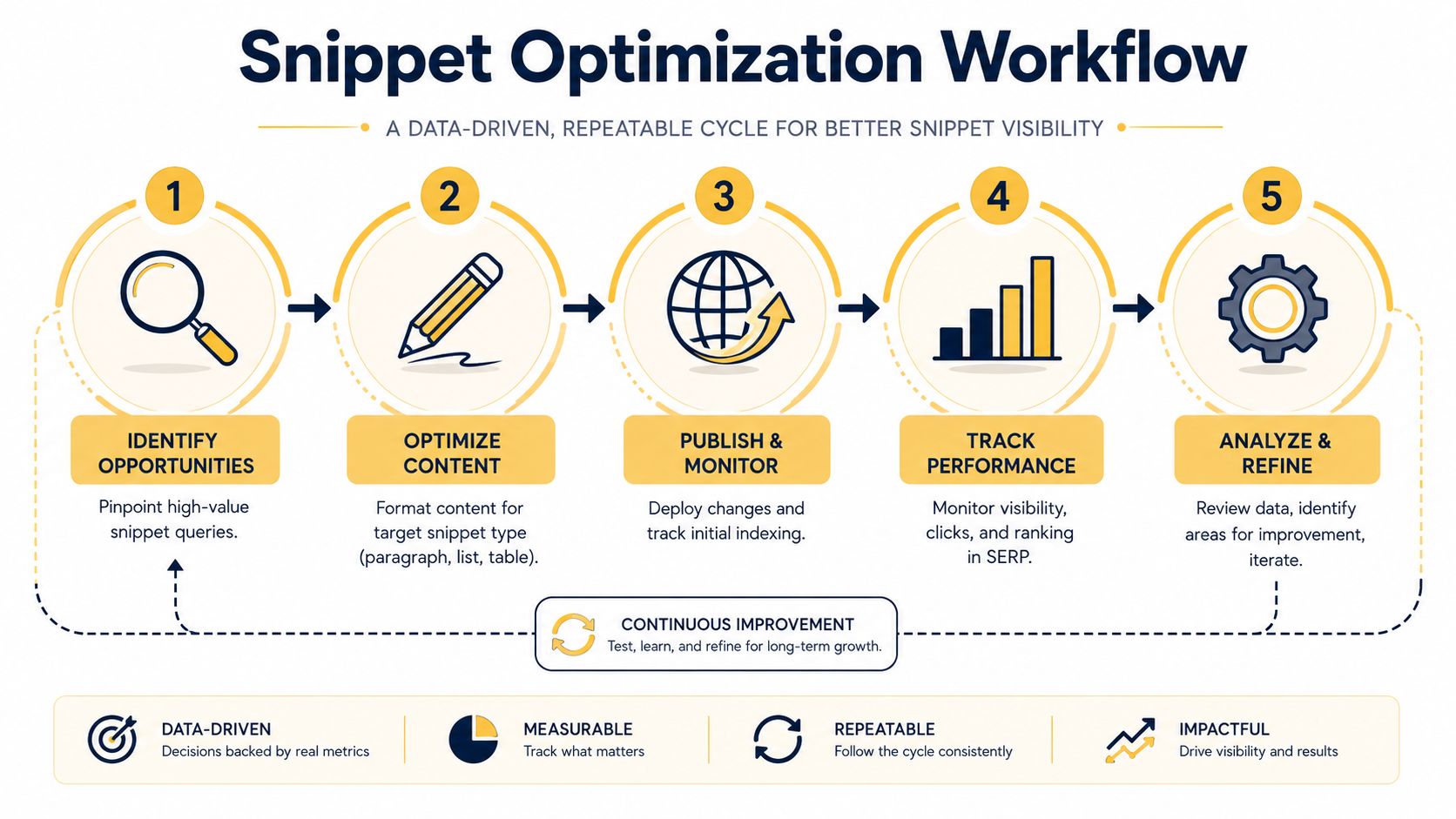
The five-step workflow we use
Our process is simple enough for a small team and disciplined enough for an agency account.
-
Pick one target page and one primary query
Don't optimize five questions at once if you want clean attribution. Choose the page most likely to win and define the exact query you're targeting. -
Make one meaningful structural change
Add a paragraph answer block. Convert a process into an ordered list. Turn a messy comparison into a table. Keep the change focused so you can connect cause and effect later. -
Request reindexing in Google Search Console
We don't assume Google will discover the change quickly enough on its own, especially on lower-crawl sites. -
Track the SERP for a set review window
Monitor the keyword, the ranking page, and the snippet owner. We log observations in a sheet with date, change made, current snippet type, and result. -
Document what happened and decide the next test
If the page wins, look for related pages where the same pattern may work. If it doesn't, compare the current winner again and identify the next single variable to test.
What to record each time
You don't need an enterprise dashboard to do this well. A clean spreadsheet works.
Track these fields:
- Target query
- Target URL
- Current organic rank
- Current snippet owner
- Snippet type
- Change made
- Date published
- Date reindexed
- Outcome after review period
- Next action
For larger content teams, automated SEO content systems can help standardize briefs and revision workflows. The useful part isn't automation by itself. It's keeping the formatting, test notes, and update cadence consistent across dozens of pages.
Why this matters more than another tactic
Without a testing loop, teams tend to do one of two things. They either over-edit pages and lose attribution, or they stop too early because one revision didn't stick.
That's why we tie snippet work to broader reporting. If you need a better framework for proving what SEO changes are doing, this guide on how to measure SEO ROI complements snippet testing well.
A snippet strategy becomes scalable when every edit creates a reusable lesson.
That's the part most businesses miss. The first win is useful. The system that explains why it worked is far more valuable.
Common Pitfalls and Your Next Steps
A page can rank in the top five and still miss the snippet for months because the answer is buried, split across two URLs, or wrapped in copy that is harder to extract than the current winner. We see that pattern often in client audits. The fix is rarely a full rewrite. It is tighter structure, cleaner targeting, and fewer competing signals.
Mistakes That Hurt Snippet Performance
These are the issues we find most often:
- Thin answer pages: A page built around one short answer may win an extraction briefly, but it often lacks the supporting context needed to hold rankings.
- Cannibalization: Two pages target the same query or close variants, so Google has no clear URL to feature.
- Messy heading hierarchy: H2s and H3s that do not match the searcher's question pattern make the page harder to parse.
- Overwritten answer blocks: The opening definition or response tries to sound clever, brand-heavy, or indirect instead of answering the query fast.
- Template noise above the answer: Large intros, comparison widgets, sticky elements, or promotional blocks push the useful content too far down the page.
The trade-off is straightforward. Pages written only for extraction often fail to hold organic strength. Pages written only for depth often bury the exact answer Google wants to lift. Strong snippet pages do both well.
What to do after the basics are in place
Once a page has the right format and a clean test history, improve the surrounding signals:
- Add visual support: Helpful images with accurate alt text can strengthen topical relevance and improve usability.
- Cover adjacent questions: Build supporting H2s and H3s around related queries that appear in People Also Ask or in competing snippet pages.
- Clean up internal pathways: Make sure the target page sits in a clear topic cluster with relevant supporting pages pointing to it.
- Review freshness on a schedule: Snippet targets should be reviewed regularly, especially for terms where the current winner updates often.
At Up North Media, we combine keyword targeting, on-page restructuring, and measurement in one operating process so teams can see what changed, when it changed, and whether it improved snippet ownership.
That process matters because snippet work breaks down when edits are random. One team rewrites intros. Another adds schema. A third changes headings. Then nobody can tell which update helped, which one hurt, or which pattern should be reused on the next page.
Winning featured snippets comes from a repeatable system. Build clear answer blocks, remove competing signals, track every revision, and apply what works across similar pages.
If you want help building a repeatable snippet workflow instead of guessing through page edits, Up North Media works with businesses that need structured SEO systems, measurable reporting, and content optimization tied to real business goals.