

If you've inherited an SEO strategy that created a page for every city, service variation, or keyword twist, there's a decent chance you're sitting on a doorway page problem right now. It often looks harmless at first. The pages are indexed, they mention your services, and somebody probably told you that “more pages means more chances to rank.”
That logic is exactly what gets small businesses into trouble.
Doorway pages can inflate a site without adding real value. They create the appearance of coverage while giving visitors thin, repetitive pages that all lead to the same place. For a local business, that usually means dozens of near-identical “service in city” pages. For an e-commerce site, it might mean shallow product-category variations built only to catch search demand.
The risk isn't theoretical. Google has treated doorway pages as spam for years, and the cleanup is usually slower and more painful than the original shortcut was worth. The good news is that you can audit for this yourself, fix the issue methodically, and replace those weak pages with assets that help your rankings.
What Exactly Are Doorway Pages in SEO
Think of doorway pages like a strip mall with a hundred different doors on the outside, each labeled for a slightly different need, but every door dumps the visitor into the same empty back room. The signs are different. The destination isn't. That's why this tactic fails both users and search engines.
Google defines doorway pages as sites or pages created primarily to rank for specific, similar search queries, leading users to intermediate pages that fail to match search intent in its post on Google's doorway pages update. The same guidance also points to common technical patterns such as near-duplicate content across multiple locations, automatic redirects, and pages that sit on the site as isolated “islands” with no internal linking.
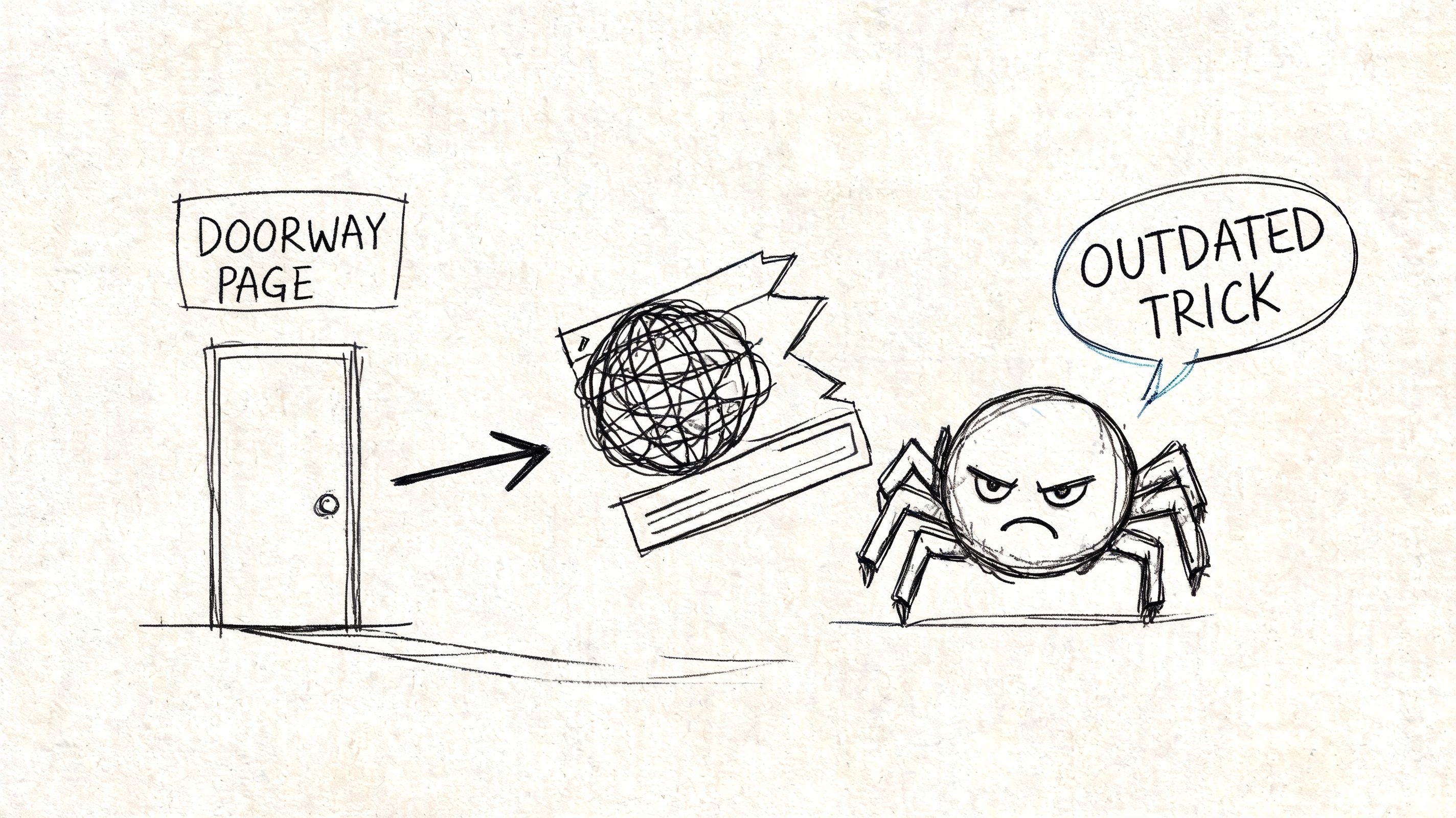
The three patterns that show up most often
The tactic changes shape, but most doorway pages seo issues fall into a few recognizable buckets:
- Location clones. A business publishes pages like “plumber in Omaha,” “plumber in Lincoln,” and “plumber in Bellevue,” but the copy is basically the same except for the city name.
- Product or service variants with no depth. A site spins out pages for every slight keyword variation even though the offer, content, and destination are the same.
- Funnel pages built only to redirect. These exist to capture a query, then push the user to a different page without delivering what the search listing seemed to promise.
Why Google treats this as spam
The core issue isn't just duplication. It's intent.
A legitimate page exists because a customer needs it. A doorway page exists because someone wants to rank for another keyword variation. That difference matters. If the page wouldn't deserve to exist without Google, it's probably a weak asset.
Practical rule: If you can swap the city, product modifier, or keyword phrase and the page still says the same thing, you're probably looking at a doorway pattern.
Google's 2015 update specifically targeted doorway campaigns, and the doorway update reference above notes evidence of 70% to 90% traffic drops for sites with 100+ doorway pages when those networks were demoted. That's not a sign of a gray-area tactic. It's a sign of a pattern search engines know how to detect.
What doorway pages are not
Not every landing page is a doorway page. Not every multi-location page is spam. A page can target a location or a specific offer without becoming manipulative.
A useful page stands on its own. It answers a real query, includes information that fits the location or offer, and helps the visitor take the next step without feeling tricked. A doorway page does the opposite. It borrows search intent and gives almost nothing back.
The High Cost of Doorway Page Penalties
A small business usually finds this problem after the damage is already visible. Calls drop. Form submissions slow down. A few high-intent pages stop appearing for the searches that used to drive leads. In many cases, nobody notices the cause until revenue is affected.
Doorway page penalties are expensive because they hit both visibility and trust. Google can demote the doorway URLs themselves, but the bigger problem is broader site quality signals. Once a site starts looking manipulative, recovery takes more than deleting a few weak pages. It often means a full cleanup, content consolidation, internal link repairs, and weeks or months of waiting for search performance to stabilize.
Google's doorway page policy has been enforced since 2015, and sites with clear doorway patterns still get caught. Ahrefs reported in its 2016 review of penalized domains that 15% were hit for doorway violations, with affected sites seeing an average 75% drop in organic traffic within 30 days. For an SMB, that kind of loss is not an SEO inconvenience. It is a lead generation problem.
What the penalty looks like in practice
For a local service business, the pattern is usually predictable. Someone builds dozens of near-identical city or service pages to reach more searches. Rankings may improve for a while. Then indexed pages stall, impressions slide, and the phone gets quieter.
There are two common outcomes:
| Problem type | What it feels like on the business side |
|---|---|
| Algorithmic demotion | Traffic declines across clusters of similar pages, local visibility weakens, and lead volume becomes less predictable |
| Manual action | Key pages disappear fast, cleanup becomes immediate, and the business may need to submit reconsideration documentation |
The secondary costs are easy to underestimate. Sales teams start blaming seasonality. Paid search has to cover the shortfall. Development time gets pulled into cleanup work instead of revenue projects. If the site also has thin pages that return poor user signals or low-value indexable URLs, it can start to resemble the kind of low-quality experience discussed in this guide to soft 404 errors and weak pages.
Why doorway pages fail as a growth strategy
Doorway campaigns look productive on a spreadsheet. More URLs. More city coverage. More keyword targets. That surface-level growth is what gets business owners in trouble.
Search engines do not reward page volume by itself. They reward pages that deserve to rank and satisfy the visit. A stack of near-duplicate location pages often creates the opposite result. Crawl budget gets wasted, signals get split across similar URLs, and the site becomes harder to maintain.
I see the same trade-off in audits for local businesses trying to expand service areas. The companies that improve rankings over time usually invest in fewer, stronger pages with real local proof, better internal links, and cleaner site structure. The companies chasing shortcuts often end up paying twice. Once for the pages, and again for the cleanup. If your broader goal is improving local search visibility on Gold Coast, doorway-style expansion is one of the fastest ways to undermine it.
The real business cost is recovery time
Penalty recovery is rarely instant.
Even after weak pages are removed or merged, the site still has to earn trust back. That means auditing clusters of overlapping URLs, choosing which pages to keep, redirecting or noindexing the rest, and rebuilding the content so each remaining page serves a distinct purpose. For an SMB using free tools such as Google Analytics and Screaming Frog, this is manageable, but it takes discipline and a clear process.
That is why doorway pages are such a poor bet. The upside is usually temporary. The cleanup is slow, visible, and expensive.
How to Audit Your Website for Doorway Pages
You don't need an enterprise stack to catch most doorway page issues. A basic audit with Google Analytics and Screaming Frog will usually uncover the obvious risks fast enough for an SMB to act on them.
Start with the pages that look quiet but suspicious. Thin city pages, old service variants, and forgotten campaign URLs are common hiding places.
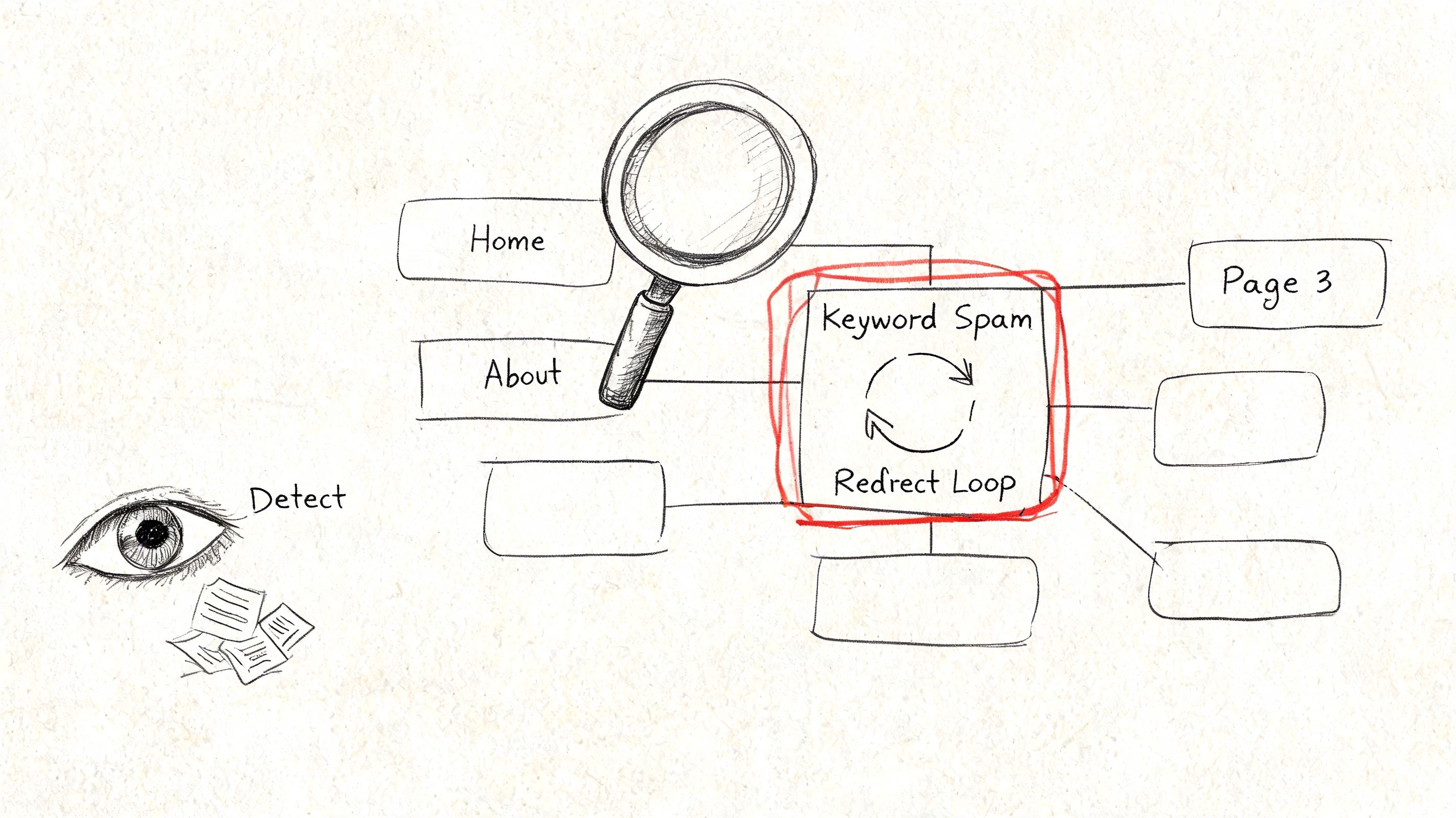
Step one with Google Analytics
Orbit Media's walkthrough on auditing doorway pages with Google Analytics and Screaming Frog recommends going to Behavior > Site Content > All Pages and exporting your URLs so you can isolate low-traffic pages with bounce rates above 70%. That's a practical starting point because doorway pages often attract a little search traffic but fail to hold attention.
Work through the export with a few questions:
- Does this page get very little traffic? Low traffic alone isn't a problem, but it often points you toward weak pages.
- Is the bounce rate high? If a page gets visits but people leave right away, the content may not match the promise of the query.
- Does the URL belong to a repeated pattern? City folders, service modifiers, and old landing page clusters stand out quickly in a spreadsheet.
A local company trying to expand into nearby markets often ends up with URL groups that reveal the pattern immediately. Ten pages targeting ten nearby cities can look legitimate in a sitemap but look obviously repetitive in a spreadsheet.
Step two with Screaming Frog
Next, crawl the site in Screaming Frog. You're looking for pages that are easy to publish but hard to justify.
Orbit Media's process above recommends flagging pages with minimal unique content below 300 words and pages with no internal navigation links. Those orphaned or lightly connected pages often exist only for search engines, not for users navigating the site naturally.
Check for these signals:
- Orphan-like behavior. Pages with no meaningful internal links pointing to them.
- Template repetition. Same H1 pattern, same paragraph order, same call to action, only the location or keyword changed.
- Redirect behavior. Pages that act like thin wrappers and route people elsewhere.
- Weak purpose. If the page can't answer why it exists beyond “to rank,” it's a candidate for review.
If your site has technical quality issues beyond doorway risk, a resource on soft 404 errors and how they affect SEO can help you separate thin-content problems from indexing and status-code problems.
Step three with a manual review
The tools surface patterns. Your judgment confirms them.
Audit shortcut: Open five similar pages side by side. If a customer wouldn't care which one they landed on because the content barely changes, the cluster needs attention.
A quick manual pass should include:
- Read the title tags together. If they differ only by city name or keyword modifier, note the group.
- Compare the body copy. Scan the first few paragraphs and service bullets.
- Check navigation presence. Is this page reachable through the main site structure, or is it buried?
- Look for local proof. Real local detail is hard to fake at scale.
- Mark the likely action. Keep, merge, redirect, or rewrite.
For businesses focused on service-area SEO, this type of review overlaps with broader site audit work. If you're looking at technical cleanup alongside improving local search visibility on Gold Coast, the same principle applies. Strong local SEO starts with pages that deserve to exist, not just pages that target a place name.
A short visual walkthrough can help if you want to see how these patterns show up on a site crawl:
A Step-by-Step Plan to Fix a Doorway Page Problem
A common SMB scenario looks like this. A site has 40 service-area pages, traffic is flat, leads are inconsistent, and half the pages have the same copy with a different suburb name. At that point, the job is not copy editing. The job is deciding what stays, what gets merged, and what gets removed.
Google's doorway guidance makes the risk clear. Pages built mainly to funnel users into the same destination can trigger ranking loss and broader site quality problems. Industry tracking after the March 2024 Core Update also showed heavy volatility for thin, scaled page sets, including many local doorway-style builds, as covered in Search Engine Land's reporting on the March 2024 core update and spam changes.
Use a simple decision framework
Once the audit is done in Google Analytics and Screaming Frog, work through each cluster with one question: does this page earn its place on the site?
Use three actions only.
| Situation | Best action | Why |
|---|---|---|
| Several thin pages target the same intent | Merge them | One stronger page gives Google and customers a clearer destination |
| The old page has no unique value | 301 redirect it | Redirects retire the weak URL and preserve any remaining equity |
| Similar pages must remain live for operational reasons | Canonicalize carefully | Canonicals can consolidate signals if you truly cannot remove duplicates |
Run the cleanup in order
Do this in a spreadsheet first. It keeps the work controlled and stops teams from deleting pages on instinct.
- Export the cluster and assign an intent label. Group pages by what the visitor wants, not by folder name.
- Pick the page with the strongest signals. Use current rankings, backlinks, internal links, conversions, and engagement to choose the survivor.
- Pull over anything worth keeping. That usually means proof elements, service specifics, FAQs, pricing cues, and genuine location detail.
- Rewrite the surviving page around real user need. If the page still reads like a template with swapped place names, it is still a doorway risk.
- Apply 301 redirects to retired URLs. Map every old page to the closest relevant destination.
- Update internal links and navigation. This matters more than many site owners expect. Internal links should support the new page hierarchy instead of feeding dead ends.
- Request reindexing for key pages and monitor the cluster for 8 to 12 weeks. Expect uneven movement before things settle.
For SMBs, this process often exposes a second problem. The site structure itself is usually encouraging page bloat. If that is happening, this guide on how to redesign a website without wrecking SEO is useful because doorway cleanup often turns into a navigation and template cleanup too.
What to consolidate, and what to keep separate
Some pages deserve to stay separate. Many do not.
Keep separate pages when the offer, audience, or proof is meaningfully different. A page for emergency plumbing and a page for blocked drains can both stay live if each solves a distinct problem, has different supporting content, and converts on its own.
Merge pages when they are competing for the same query and saying the same thing. Five suburb pages that all push users to one contact form usually become one stronger service-area page with clear coverage information, trust signals, and useful FAQs.
Business owners often become nervous. They worry that fewer pages means fewer rankings. In practice, fewer weak pages often gives one strong page room to perform. I have seen local sites improve only after cutting half the cluster.
Avoid the recovery mistakes that drag this out
Three mistakes slow recovery more than anything else.
- Leaving old pages indexed while testing the new version. That keeps duplicate intent live.
- Using AI rewording to make templates look different. Surface variation does not fix a low-value page set.
- Redirecting everything to the homepage. That wastes relevance and creates a poor user path.
The replacement page needs substance. A good standard is whether a buyer would still find it useful if search engines did not exist. Teams that need a cleaner editorial standard after consolidation can use these content best practices for marketers to improve the pages they keep.
One final rule helps during cleanup. Every URL that remains should answer a clear customer question, serve a distinct intent, or support a real business function. If it does none of those, remove it.
Building Legitimate Pages That Outperform Doorways
The safer alternative to doorway pages isn't “fewer pages no matter what.” It's better pages with a clear job. A legitimate location or service page should help a real buyer make progress. That's the standard.
According to this guide on location pages versus doorway pages and what Google looks for, legitimate pages should include unique H1s and meta data, 300+ words of original content, references to local landmarks, an embedded Google Map, and JSON-LD LocalBusiness schema. The same source notes that bulk-generated pages often show content similarity above 85% and time-on-page below 15 seconds, while well-built schema-enriched pages can see a 15% to 30% CTR uplift in competitive local markets.
The wrong way and the right way
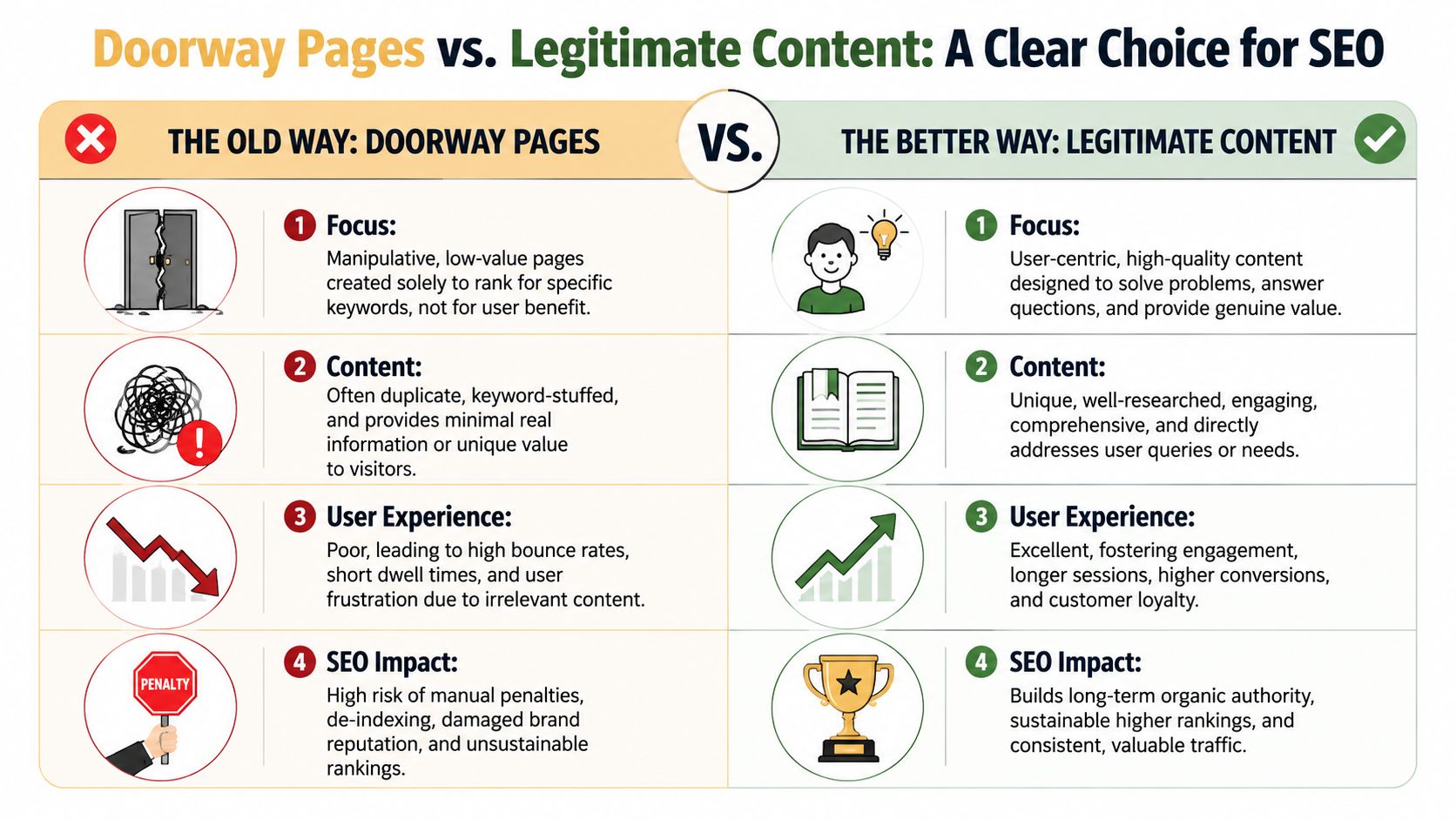
A doorway page says, “We serve this city,” then repeats generic service copy. A legitimate page proves it.
Here's the contrast:
-
Doorway page
- Thin copy with city names swapped in
- No clear local detail
- Weak internal linking
- Built in bulk
- Exists mostly to rank
-
Legitimate location or service page
- Unique headline and metadata
- Original copy tied to a real market or service context
- Local references buyers would recognize
- Embedded map and structured data
- Integrated into site navigation and supporting content
A blueprint you can actually use
If you're building a real local page, include the pieces that make it useful:
| Page element | What good looks like |
|---|---|
| Headline | Specific to the service and location, not a copy-paste template |
| Body content | Original explanation of the service in that market, with enough depth to stand on its own |
| Local proof | Landmarks, neighborhoods, service area specifics, or testimonials connected to that place |
| Trust signals | Clear business details, map embed, and schema |
| Navigation | The page is linked where a user would reasonably expect to find it |
If your team uses templates or scaled publishing, this is also where discipline matters. A helpful reference on content best practices for marketers is worth reviewing because quality control breaks down quickly when production speed becomes the main goal.
For businesses exploring scaled page creation, it's also important to separate legitimate systems from spammy ones. Programmatic SEO can be useful when each page has distinct value and structured differentiation. It becomes risky when the output is just a larger doorway network with better wording.
The page doesn't need to be long because Google likes length. It needs enough original substance that a customer in that market would actually use it.
One practical note from agency work: when a business serves many cities but has limited local proof, it's usually smarter to publish a smaller set of stronger market pages than to stretch the same message across every town on the map.
Frequently Asked Questions About Doorway Pages
Are all multi-location pages considered doorway pages
No. A multi-location strategy can be completely legitimate if each page has a clear reason to exist, meaningful local detail, and a place in the site's main structure. It becomes risky when the pages are mass-produced, lightly edited, and aimed at capturing keyword variations rather than helping visitors.
Are PPC landing pages doorway pages
Not automatically. A landing page built for an ad campaign is usually fine if it contains real information, matches the offer, and helps the visitor complete a task. It starts to look like a doorway when it exists only to trap search traffic and route people somewhere else without delivering useful content.
Can AI-generated content create doorway page problems
Yes, if AI is used to produce large batches of near-identical pages. AI can help with drafting, outlining, or workflow support. It becomes a problem when teams use it to manufacture “unique enough” pages at scale without adding real differentiation, editorial review, or user value.
Should I delete every thin location page immediately
No. Audit first. Some pages should be merged. Some should be redirected. A smaller number may deserve a full rewrite if they target a real market and you can support them with original content and local proof.
What's the simplest test for doorway pages seo risk
Ask whether the page would still deserve to exist if search engines disappeared tomorrow. If the answer is no, that page needs scrutiny.
If you want a second set of eyes on doorway pages seo risks, Up North Media can review your site structure, identify thin or repetitive page clusters, and help map the cleanup into merges, redirects, and stronger replacement pages that fit how your business sells.