
Your bays might be half full, your technicians might do excellent work, and your repeat customers might trust you completely. None of that helps when a driver with a flashing check engine light searches on a phone and calls the shop that shows up first.
That is the core job of SEO for auto repair shops. It isn't abstract marketing. It's making sure the next brake job, diagnostic visit, tire replacement, or tow referral lands with you instead of the competitor across town.
Most shop owners don't need another vague list of “optimize your website” tips. They need a working local playbook. The kind that starts with the fastest wins, fixes the weak spots that suppress visibility, and builds a search presence that works now while preparing for how customers are starting to search through AI answers and conversational prompts.
Why Your Shop Needs More Than a Sign on the Door
A strong reputation used to carry more of the load. Today, it helps only after people find you.
A customer hears a grinding noise, pulls over, and searches for “brake repair near me.” Another driver gets a dead battery outside an office park and searches for a mechanic nearby. In both cases, the search results page decides who gets the call first. That's why SEO for auto repair shops has moved from “nice to have” to operational necessity.
Google reports that searches containing phrases like “near me” have grown by more than 500% over the past decade, and 76% of people who search for something nearby on their smartphone visit a related business within a day, with 28% of those visits leading to a purchase, as cited by Autoleap's local SEO overview for auto repair shops. Those are not casual browsers. Those are buyers with active need.
Search is where urgency turns into revenue
Auto repair is one of the clearest local-intent categories in search. People rarely research “mechanic near me” for fun. They search because something is wrong, maintenance is overdue, or they need a trustworthy answer fast.
That changes how we approach SEO.
We don't optimize an auto shop site the same way we'd optimize a national blog or an e-commerce catalog. We focus on service visibility, location relevance, and frictionless contact paths. If a page ranks but doesn't make the phone number obvious, it underperforms. If a Google Business Profile exists but doesn't show the right services, it leaks leads.
Practical rule: If a stranded driver can't tell within seconds that you fix their exact problem in their area, your marketing is making them work too hard.
Good work alone doesn't create local visibility
This is the hard truth many owners run into. The better technician doesn't automatically win online. The clearer listing, stronger review profile, faster mobile page, and more specific service page often does.
That's also why adjacent service operators run into the same issue. If you're also thinking about related service expansion, this guide on planning a mobile detailing operation is useful because it shows how local service businesses need to think operationally about demand, visibility, and customer acquisition from day one.
A sign on the building still matters. Word of mouth still matters. But local search now acts like your second storefront, and in many cases it becomes the first interaction a new customer has with your shop.
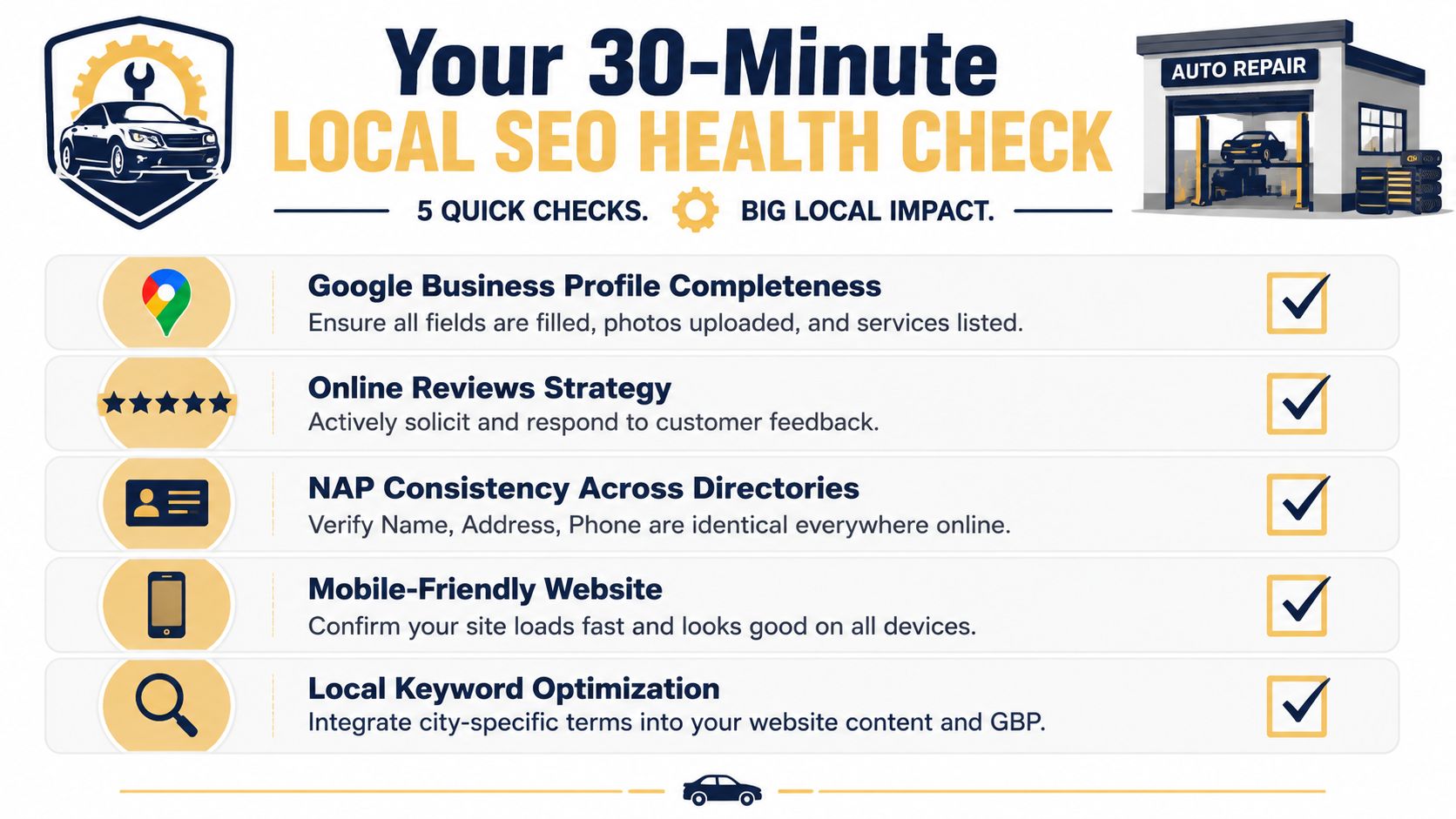
Your 30-Minute Local SEO Health Check
Before changing anything, get a clean read on what's broken. Most shops don't have a visibility problem everywhere. They have a few expensive weak points.
Use this as a quick diagnostic. You can do it between customer pickups and vendor calls.
Start with the highest-leverage checks
For local shops, the priority order is simple. Claim and fully optimize the Google Business Profile, keep your NAP consistent, add service-specific categories and pages, then run a review system. That workflow comes from 253 Media's guidance for auto repair shop SEO, which also notes an agency case study reporting a 180% increase in monthly leads after systematic review collection plus optimization.
Here's the fast audit we use.
-
Check Google Business Profile ownership
Search your shop name on Google. If your profile appears, confirm you control it. If a former employee, old agency, or personal Gmail owns it, fix that first. You can't manage categories, service details, updates, or review responses reliably without direct access. -
Look at NAP consistency
Your name, address, and phone number must match exactly everywhere you're listed. Not mostly. Exactly. “Suite B” in one place and no suite in another can create trust issues for search engines and confusion for customers. -
Search your core service terms
Use searches a real customer would make:- Brake repair + city
- Oil change + city
- Check engine light diagnostic + city
- Transmission repair + city
- Mechanic near me
Note whether you show in the map pack, organic listings, both, or neither.
What to flag immediately
Some issues are annoying but minor. Others suppress leads right now.
| Check | Healthy signal | Problem signal |
|---|---|---|
| GBP status | Claimed, complete, active | Unclaimed, sparse, outdated |
| Service visibility | Distinct services listed | Generic “auto repair” only |
| Reviews | Recent feedback and replies | Old reviews, no responses |
| Citations | Matching business details | Mixed phone numbers or addresses |
| Website mobile use | Fast, readable, tap-to-call | Slow, cluttered, hard to use |
Test the site like a customer would
Open your website on your own phone, using cellular if possible. Don't inspect it as the owner. Inspect it as someone whose car is acting up in a parking lot.
Ask:
- Can I tell what you fix right away
- Can I tap to call without pinching and zooming
- Do I see city or neighborhood relevance
- Is there a clear appointment path
- Do pages load quickly enough that I won't back out
If the homepage tries to say everything, your service pages usually aren't doing their job. If every page feels generic, local relevance is probably weak. If your site buries the phone number, it's losing urgent-intent customers.
Fix the control points first. Ownership, accuracy, service specificity, reviews, and mobile usability beat cosmetic redesigns every time.
Turn Your Google Business Profile into a Customer Magnet
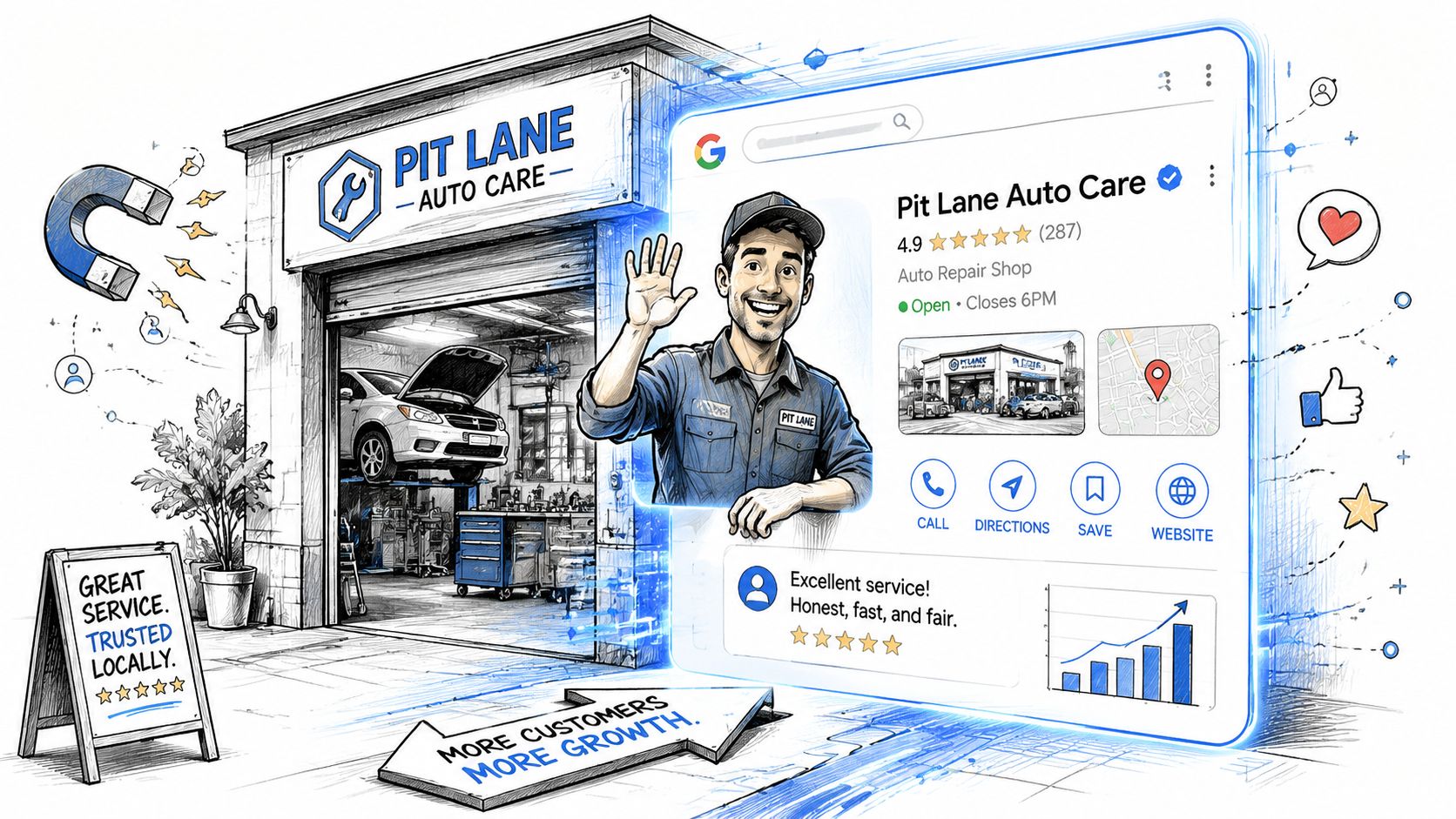
Your Google Business Profile does more selling than most shop websites. For many searchers, it's the entire decision environment.
They see your category, reviews, hours, photos, service highlights, and directions without ever visiting your site. That means a half-complete profile doesn't just look unfinished. It actively hands business to shops that present better.
Choose categories like a technician diagnoses symptoms
The primary category matters because it tells Google what lane you belong in. Don't pick a category because it sounds broad or prestigious. Pick the one that best reflects the core of your business.
Secondary categories are where many shops miss easy relevance. If you do brakes, tires, oil changes, AC repair, diagnostics, or transmissions, support that with the most accurate category mix available inside the profile. Categories should reflect reality. Don't stack irrelevant options hoping to rank for everything.
Fill every field that helps a customer decide
A strong profile answers practical questions fast. Include:
- Accurate hours including holiday changes when relevant
- Service list that matches what your team performs
- Business description written in plain language, not stuffed keywords
- Appointment options if your workflow supports them
- Photos of the exterior, front desk, bays, team, waiting area, and completed work
Shops often upload a logo, one building shot, and stop there. That's weak. Customers want visual proof that the business is active, real, and professional.
For owners who haven't set up the profile properly yet, this walkthrough on how to set up Google Business Profile is a good operational reference.
Photos do more than make the listing look nice
They reduce uncertainty. A clean service bay, clear storefront signage, and real technician photos help a customer trust the business before they call.
Use recent images. Avoid stock photography. If you're proud of your alignment rack, diagnostic equipment, waiting room, shuttle vehicle, or shop truck, show it. If the exterior is hard to spot from the road, upload a street-view style image so first-time visitors know what to look for.
A good profile doesn't try to impress everyone. It makes the right local customer feel sure they've found the right shop.
Use posts and Q&A to pre-handle objections
Most shops ignore Google Posts and the Q&A section. That's a mistake.
Posts are useful for seasonal reminders, specials, holiday hours, and service education. Keep them short and practical. Think “AC performance checks before hot weather” or “battery testing before the temperature drops,” not generic brand slogans.
Q&A is even more valuable because it lets you shape the conversation around real buyer hesitation. Add and answer common questions yourself, such as:
- Do you work on domestic and import vehicles?
- Do you offer same-day diagnostics?
- Do you handle fleet vehicles?
- Is after-hours key drop available?
- Do you provide digital inspections?
A quick visual walkthrough can help if you want to see how a high-converting profile is structured in practice.
What doesn't work
A lot of owners assume the profile is done once it's verified. It isn't.
These habits hold listings back:
- Set-and-forget management where hours, services, and photos never change
- Keyword stuffing in the business name or description
- Wrong categories selected by a non-technical marketer
- No review replies which signals low engagement
- Thin service detail that leaves both users and Google guessing
Your profile should look like a living representation of the shop, not a neglected directory listing.
Build Unbeatable Trust with Reviews and Citations
Two shops can offer the same service, sit the same distance from the customer, and charge roughly the same rate. The one with stronger review signals usually gets the call.
That's not because reviews are magic. It's because they reduce risk. A driver with a flat tire, an overheating engine, or a rattling front end wants reassurance that someone else already trusted you and had a good outcome.
The customer-choice test
A searcher compares two listings.
Shop A has a healthy stream of recent reviews, thoughtful replies, and clear signs that the business is active. Shop B has older feedback, few replies, and sparse listing details. Even before a website click, the buyer starts assigning confidence.
That's why review management isn't a reputation side task. It's part of the sales process.
Ask in a way that feels natural
The best moment to ask is right after a positive handoff. The keys are back in the customer's hand, the repair is explained clearly, and the experience is still fresh.
Keep the script simple:
-
At pickup
“If everything felt smooth today, would you mind leaving us a Google review? It helps other local drivers know what to expect.” -
By text after service
“Thanks again for trusting us with your vehicle. If you have a minute, we'd appreciate a quick review about your experience.” -
For loyal repeat customers
“You've been with us for a while, and we'd value your feedback online if you're open to it.”
Don't overcomplicate the ask. Don't script it so hard that advisors sound robotic.
Negative reviews aren't always a ranking problem. Unanswered negative reviews are often a trust problem.
Respond like an owner, not like legal counsel
Good replies sound human. They acknowledge specifics, thank the customer, and reinforce professionalism.
Bad replies sound defensive, vague, or copy-pasted.
A practical response pattern looks like this:
| Review type | Weak response | Better response |
|---|---|---|
| Positive | “Thanks for your review” | “Thanks for trusting us with your brake service. We appreciate you taking the time to share your experience.” |
| Mixed | “Sorry you feel that way” | “Thanks for the feedback. We're reviewing what happened with your wait time and appreciate the chance to improve.” |
| Negative | “This is inaccurate” | “We're sorry the visit didn't meet expectations. Please contact the shop so we can review the service and make this right if we can.” |
Citations are the trust layer behind the scenes
Citations are business listings across the web. Yelp, Apple Maps, local chamber directories, and industry sites all help confirm that your business is real and consistent.
What matters most is accuracy.
If your business name appears one way on your website, another way on Yelp, and a third way on older directory listings, you create friction. Search engines have to reconcile conflicting data. Customers do too.
A good citation cleanup focuses on:
- Matching NAP exactly across major directories
- Removing duplicate listings that split trust signals
- Updating old phone numbers from tracking systems or previous ownership
- Using the same website URL consistently
- Adding complete categories and descriptions where the platform allows it
If you want a practical primer on why old directory infrastructure still matters, this piece on Yellow Pages search engine optimization helps explain the citation side of local visibility.
What works better than chasing volume
Review strategy is not about begging every customer forever. It works better when it's built into the workflow.
Ask your latest satisfied customers consistently. Train service advisors on the timing. Make it easy with a direct review link. Reply to every review. Then support that trust signal by cleaning up citation errors that make your shop look less established than it is.
Engineer Service Pages That Win Local Customers
Your homepage can't rank for everything and convert everyone. Shops that rely on one generic “services” page usually underperform in local search because they force Google and the customer to do too much interpretation.
A brake customer should land on a brake page. A transmission customer should land on a transmission page. A diagnostics customer should land on diagnostics.
Build pages around real services and real places
The strongest service pages combine one service with one location context. Not spammy city stuffing. Clear relevance.
Examples:
- Brake repair in Omaha
- Check engine light diagnostics in Bellevue
- Oil change service in Papillion
- Auto AC repair near downtown
Each page should sound like it was written for a local customer with a specific problem, not for a keyword tool.
A service page template that actually converts
Use this structure as your default build:
-
Headline with service and location
Example: Brake Repair in Omaha -
Short opening that states the problem you solve
Mention symptoms, urgency, and vehicle types if relevant. -
Primary contact path above the fold
Phone number, appointment button, or request form. -
What's included in the service
Inspections, parts replacement, testing, fluid checks, road testing, or related diagnostic steps. -
Why drivers choose your shop
Certifications, process clarity, warranties if applicable, or communication style. -
Common questions
Address turnaround expectations, warning signs, and next steps. -
Trust elements
Reviews, photos, local references, or examples of the types of vehicles you commonly service. -
Final call to action
Book inspection, call now, request estimate.
Keep the copy specific
Weak page copy says “We provide quality auto repair services for all your needs.”
Strong page copy says what the shop does. Pads and rotors. Battery and charging diagnosis. Cooling system pressure tests. Steering and suspension inspection. Pre-purchase inspections. Fleet maintenance scheduling.
That specificity helps rankings, but more importantly, it helps conversion.
If every service page could swap business names with a competitor and still make sense, the page isn't specific enough.
Use internal structure that search engines can parse
A clean page should include clear headings, short paragraphs, and sections that answer discrete questions. Don't bury useful information in giant text blocks.
A good layout often includes:
- symptom-based subheadings
- vehicle or system-specific details
- FAQ content in plain language
- clear local relevance
- obvious conversion elements on mobile
Add schema markup so Google reads the page correctly
Schema markup is structured data. It helps search engines understand what your business is, where it operates, and what services it offers.
Below is a simple starting point you can adapt.
| Property | Example Value |
|---|---|
@context | https://schema.org |
@type | AutomotiveBusiness |
name | Main Street Auto Repair |
image | https://www.example.com/shop-front.jpg |
telephone | +1-402-555-0100 |
address.streetAddress | 123 Main Street |
address.addressLocality | Omaha |
address.addressRegion | NE |
address.postalCode | 68104 |
address.addressCountry | US |
url | https://www.example.com/brake-repair-omaha |
areaServed | Omaha |
serviceType | Brake Repair |
Here's a copy-ready example:
<script type="application/ld+json">
{
  "@context": "https://schema.org",
  "@type": "AutomotiveBusiness",
  "name": "Main Street Auto Repair",
  "telephone": "+1-402-555-0100",
  "url": "https://www.example.com/brake-repair-omaha",
  "address": {
    "@type": "PostalAddress",
    "streetAddress": "123 Main Street",
    "addressLocality": "Omaha",
    "addressRegion": "NE",
    "postalCode": "68104",
    "addressCountry": "US"
  },
  "areaServed": "Omaha",
  "serviceType": "Brake Repair"
}
</script>
Keep the schema accurate. Don't mark up services you don't offer or locations you don't serve.
What to avoid
Service pages fail when they're thin, duplicated, or stuffed with city names. They also fail when owners create dozens of near-identical city pages with no local detail.
One strong page for a real service is better than ten filler pages with rewritten intros. Quality beats inflation here.
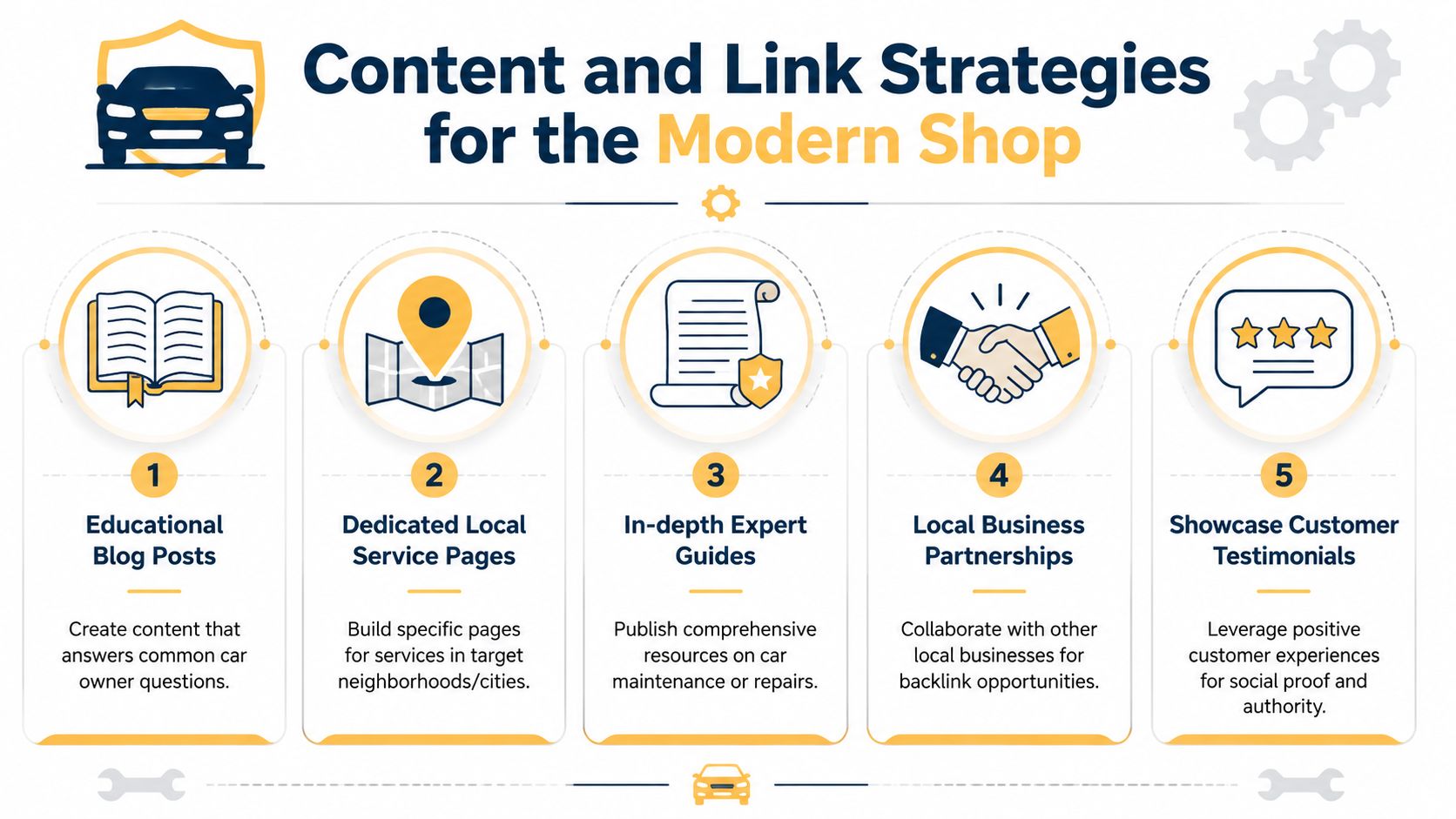
Content and Link Strategies for the Modern Shop
Once the foundation is stable, content and links become force multipliers. Often, many shops either do nothing or waste time publishing generic blog posts that never help rankings or bookings.
The better approach is to create content that serves three jobs at once. It should answer a real customer question, support a service page, and be easy for search engines and AI systems to extract and understand.
Write for searchers who ask full questions
A major underserved opportunity in SEO for auto repair shops is visibility for AI-driven and conversational queries, as noted by LinkGraph's analysis of auto repair SEO. Most advice still stops at profiles, citations, and reviews. Those matter, but they don't fully address how a shop gets surfaced when someone asks a more natural question like “Who fixes brakes near me and can get me in today?” or “Best local mechanic for a check engine light on a Honda.”
That changes how content should be written.
Instead of only targeting short phrases, publish pages and articles that directly answer:
- How do I know if my brakes need immediate service?
- What causes a check engine light to turn on suddenly?
- How often should I service a work truck used every day?
- Is it safe to drive with a coolant leak?
- What should I ask before booking a pre-purchase inspection?
Structure content for both humans and answer engines
AI systems and voice tools tend to favor content that is clear, direct, and well organized. That doesn't mean robotic writing. It means tight answers near the top of a section, followed by deeper explanation.
A strong content pattern looks like this:
| Content element | Why it helps |
|---|---|
| Direct question heading | Matches conversational search behavior |
| Short answer first | Easier to extract into answer surfaces |
| Detailed follow-up | Builds trust and supports conversion |
| Local examples | Reinforces relevance for nearby customers |
| Internal links | Moves readers to service pages |
One useful adjacent example is fleet content. If your shop works with vans, pickups, or service vehicles, resources about optimizing fleet operations can inspire content angles around maintenance scheduling, uptime, and inspection workflows that appeal to business customers rather than only retail drivers.
Clear answers win twice. They help the customer decide, and they give modern search systems cleaner material to cite.
Local links still matter, but relevance matters more
Many shops hear “build backlinks” and immediately think volume. That's the wrong instinct.
A local link from a chamber of commerce, neighborhood business association, community event page, youth sports sponsor page, or nearby commercial partner usually matters more than a random directory that exists only to sell listings.
Good link sources for repair shops often come from real business activity:
- Community sponsorships tied to local teams or events
- Partnership pages with apartment complexes, fleets, or towing companies
- Vendor and manufacturer listings where available
- Local press mentions tied to charity work or community events
- Trade associations relevant to your operation
The content formats that usually work best
Not every shop needs a weekly blog. Most do better with a focused library.
Prioritize:
- Service explainers for high-margin and high-intent work
- FAQ pages that answer common pre-booking questions
- Seasonal maintenance content tied to local driving conditions
- Vehicle-specific diagnostic articles based on what your team sees often
- Fleet and business service pages if you handle commercial accounts
What doesn't work is generic fluff. “Top 10 Car Care Tips” won't do much unless it's tied to local context, actual service demand, or a meaningful question your customers ask every week.
Measure Your SEO ROI and Track Booked Jobs
If you only track rankings, you'll make bad decisions. Rankings can move without improving revenue, and they can fluctuate while booked work improves.
The metrics that matter are the ones tied to customer action.

Track actions, not vanity metrics
For most shops, the core SEO KPI set is straightforward:
- Phone calls from your Google Business Profile and website
- Appointment form submissions
- Direction requests
- Booked jobs traced back to search
- Service-page leads by category
When a brake page starts generating calls, that matters. When your profile gets more direction requests but booked jobs don't rise, you need to check intake quality, reviews, or after-click experience.
Keep the reporting tied to service revenue
A simple operating model works well. Ask every new customer how they found you. Check Google Business Profile performance regularly. Review your website forms and call tracking. Compare lead sources against actual repair orders, not just inquiries.
For a practical framework, this guide on how to measure SEO ROI is useful because it keeps the conversation tied to business outcomes rather than traffic screenshots.
The most mature shops also tag leads by service type. That helps you see whether SEO is driving oil changes, diagnostics, brake work, fleet inquiries, or higher-value repairs. Once you know that, you can invest in the pages and queries that bring the best jobs, not just more clicks.
The right question isn't “Did we rank higher?” It's “Did SEO put more profitable work on the schedule?”
If your shop needs a clearer growth plan than “post more and hope,” Up North Media can help. They work with businesses that need practical SEO, stronger local visibility, cleaner tracking, and a roadmap that connects search performance to real revenue. If you want a second set of expert eyes on your shop's local presence, book a free consultation and get a no-pressure review of what's holding your visibility back.