
You've probably seen this play out in real life. A customer is driving across Omaha, asks their phone for “the best emergency plumber near me,” glances at the map, taps one result, and calls. Another customer is comparing running shoes while walking into a store and asks, “Which running shoes are best for flat feet?” They don't browse ten blue links. They want one usable answer.
That's why voice search isn't a side project anymore. If you want to know how to optimize for voice search, the job is broader. You're optimizing your site so search engines, featured snippets, AI Overviews, and voice assistants can all lift the same clean answer from your content.
The old framing was “How do I rank on Alexa?” The better framing now is “How do I become the answer wherever the answer gets surfaced?” That shift changes the work in useful ways. It pushes you toward better content structure, stronger local SEO, cleaner schema, and faster mobile performance. Those are the same things that tend to improve visibility across modern search.
Why Voice Search Still Matters in the Age of AI
A spoken search often starts on a phone, but it doesn't stay there. The answer might come from a featured snippet, a local business profile, a concise service page, or an AI-generated summary built from multiple sources. The interface changed. The underlying need didn't.
Recent guidance increasingly reframes voice search around answer engines and featured snippets, rather than as a standalone voice-only tactic. The bigger strategic question is not “how do I rank for voice?” but “how do I make content reusable across voice, AI Overviews, and snippets?” as noted by Circles Studio's voice search guidance.

Voice search is really answer formatting
A lot of teams still treat voice as if it requires a separate content library. Usually, it doesn't. What it needs is a different presentation layer.
If someone asks, “How much does a water heater repair cost?” or “Are neutral running shoes good for beginners?” the search system looks for content that does three things well:
- Matches natural language with wording close to how people naturally ask
- Delivers the answer early instead of making users scroll through an essay
- Adds enough context that the answer feels credible and complete
That's why voice work often overlaps with snippet work. The page that wins a spoken answer is usually the page that's easiest to quote.
Voice SEO works best when you stop thinking about devices and start thinking about answer extraction.
Where businesses get this wrong
The common mistake is chasing “voice keywords” as if they're a separate universe. Another is stuffing FAQ pages with robotic phrasing that no customer would ever say out loud.
A better approach is simpler. Take the questions people already ask sales, support, and front-desk staff. Then publish pages that answer those questions in plain English.
For a local business, that might mean a service page that immediately answers “Do you offer same-day drain cleaning in Omaha?” For an e-commerce brand, it might mean a product category page that clearly answers “What kind of running shoe is best for long-distance training?”
The durable takeaway
Voice search still matters because the underlying search behavior is still here. People ask full questions out loud, especially on mobile devices, in the car, or when they need a quick local answer. The pages that satisfy those searches are also better positioned for AI-powered search surfaces.
If you're learning how to optimize for voice search in 2026, don't build a niche voice strategy. Build content and local signals that answer cleanly, load fast, and can be reused everywhere.
Mastering Conversational Keyword Research
The fastest way to miss voice search is to optimize for phrases nobody says out loud.
By 2026, industry guidance consistently treats conversational, long-tail keywords, FAQ-style answers, and structured data as the foundation because voice queries are usually phrased as complete questions rather than short keyword strings, according to Proofed's overview of voice search strategies.
Start with how people speak, not how SEOs shorten things
A local plumbing company in Omaha might want to rank for “water heater repair Omaha.” That phrase still has value. But the spoken version is more likely to be “Who fixes water heaters in Omaha?” or “Can I get same-day water heater repair near me?”
An e-commerce brand selling running shoes might target “best running shoes flat feet.” The voice version sounds more like “What are the best running shoes for flat feet?” or “Which running shoes help with overpronation?”
That difference matters because spoken queries reveal intent more clearly. They often include urgency, location, product use case, or buyer hesitation.
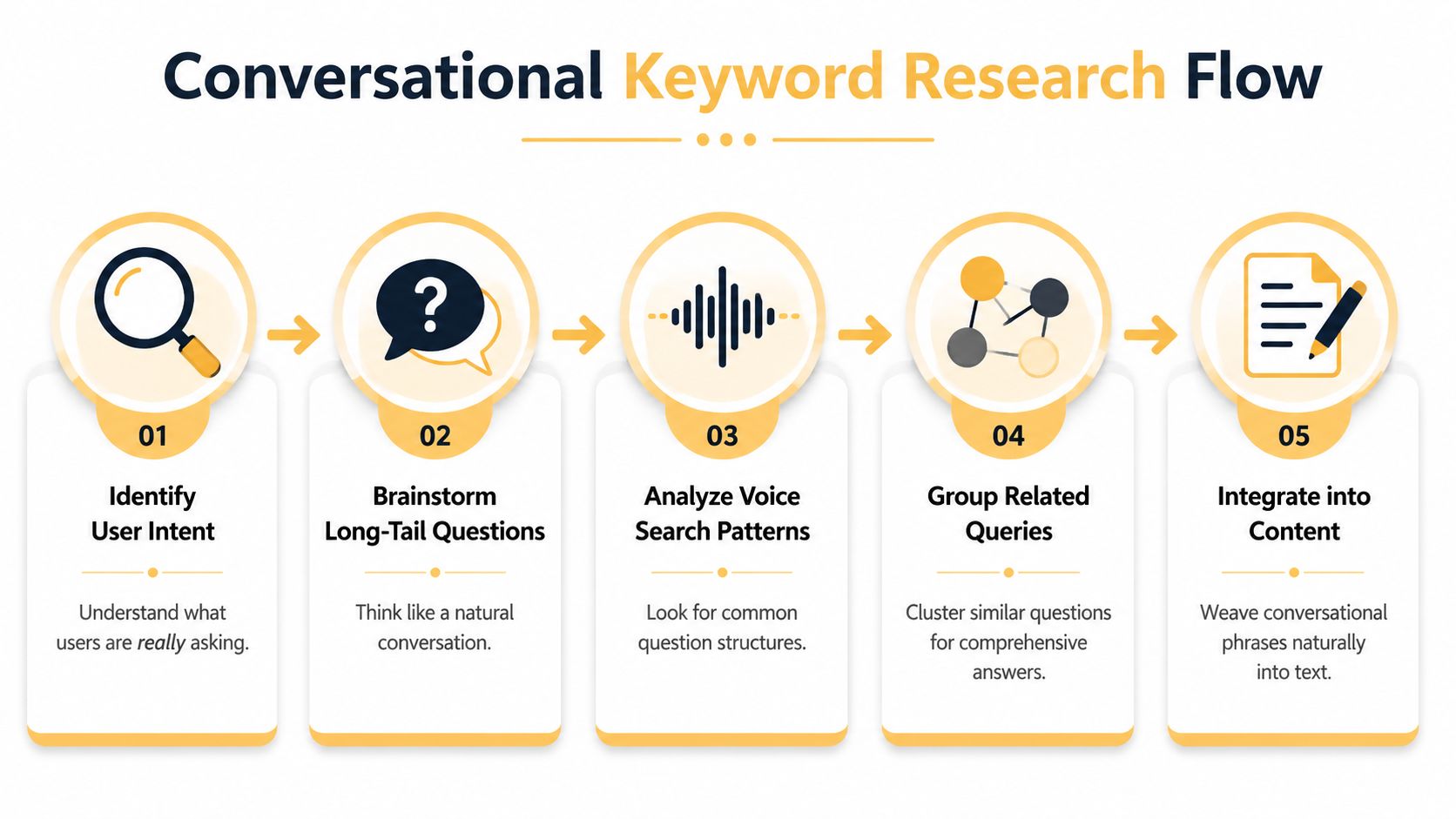
A practical research workflow
You don't need a complex stack to start. You need a repeatable process.
-
Pull question-style queries from Google Search Console
Look for impressions and clicks tied to who, what, where, when, why, and how. This is often the cleanest starting point because it reflects real searches that already connect to your site. -
Use Google itself as a research tool
Autocomplete, People Also Ask, and related searches are useful because they reflect actual wording patterns. Pay attention to the full sentence forms, not just root terms. -
Review customer-facing conversations
Support emails, chat logs, sales call notes, product Q&A, and in-store questions often produce better phrasing than keyword tools do. -
Cluster by intent, not just wording
“How much does drain cleaning cost?” and “What do plumbers charge to clear a drain?” belong together. They may need one page section, not two separate posts. -
Prioritize pages that can influence revenue
Service pages, location pages, category pages, high-intent buying guides, and FAQ hubs usually matter more than publishing another generic blog post.
If you need a refresher on building those keyword groups, this guide on keyword research basics is a solid companion.
Use two lenses for prioritization
For local service businesses, ask:
| Query type | Example for Omaha plumber | Best page type |
|---|---|---|
| Urgent service | “Who does emergency plumbing near me?” | Service page |
| Price question | “How much does drain cleaning cost?” | Service page with FAQ |
| Trust check | “Who is the best plumber in Omaha?” | Review-rich location page |
| Availability | “Is a plumber open now in Omaha?” | GBP plus hours page |
For e-commerce, ask:
| Query type | Example for running shoes | Best page type |
|---|---|---|
| Fit guidance | “What running shoes are best for flat feet?” | Buying guide |
| Product comparison | “Are stability shoes better than neutral shoes?” | Comparison page |
| Use case | “What shoes should I wear for marathon training?” | Category guide |
| Transaction support | “Do these running shoes run true to size?” | Product page FAQ |
What works and what doesn't
What works is language that sounds like a customer. What doesn't is turning every heading into an awkward keyword variation.
Practical rule: If the phrase sounds unnatural in a sales call, it probably belongs in your metadata, not your visible copy.
The strongest conversational keyword sets usually come from three places at once: Search Console, customer questions, and real SERP patterns. When those align, you're not guessing. You're mapping your content to how people ask.
Formatting Content for Snippets and Voice Readouts
Keyword research gets you to the right topic. Formatting determines whether your page becomes the answer.
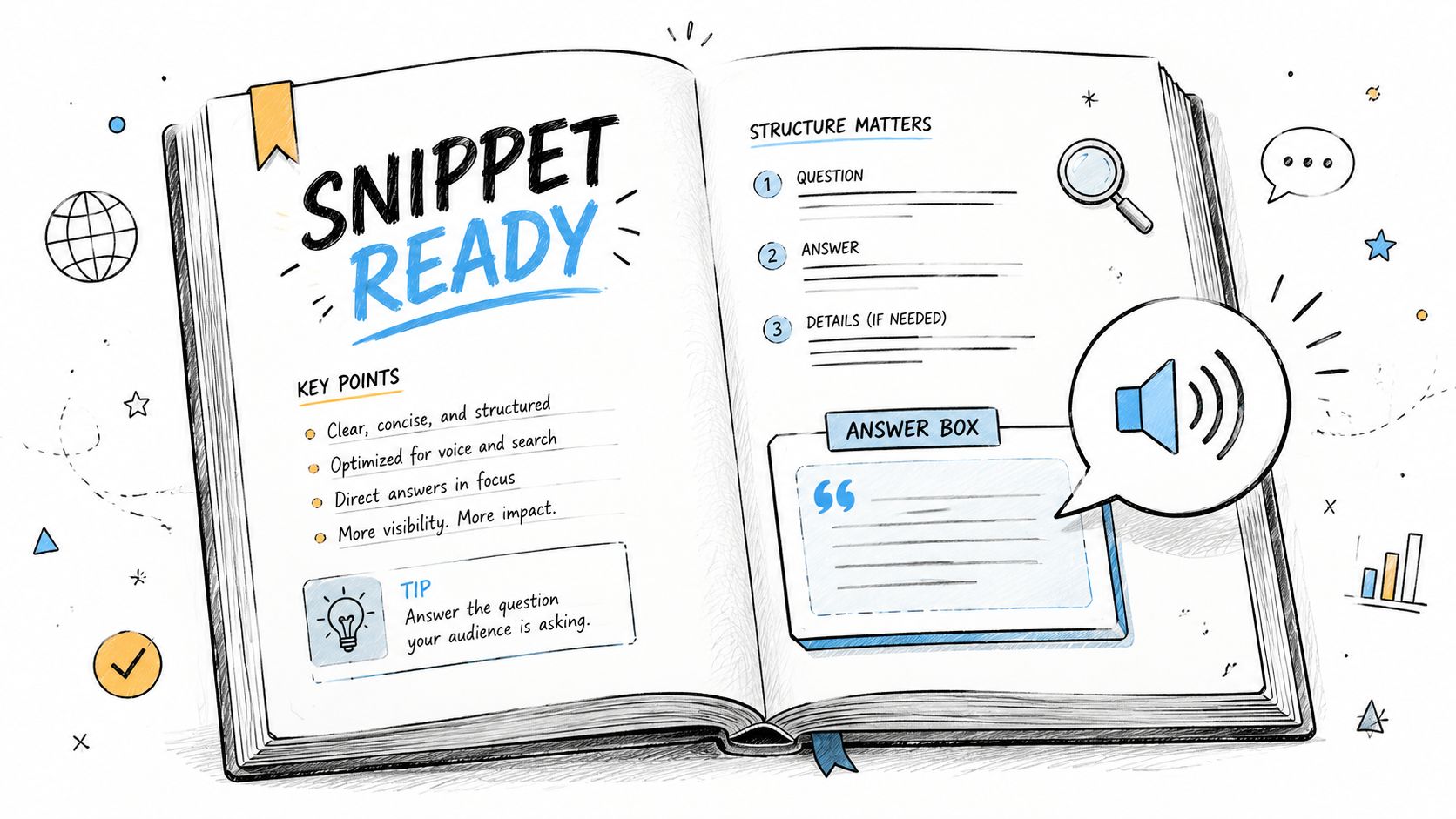
A practical workflow for voice optimization is to audit existing content, find question-style queries, and rewrite pages so each section starts with a direct answer of roughly 40 to 60 words, which improves eligibility for featured snippets and voice-readout results, according to Semrush's voice search workflow.
Lead with the answer
Most pages still bury the useful part under throat-clearing copy. That hurts voice visibility.
If your heading is “How long does shipping take for running shoes?” the next paragraph shouldn't begin with brand history or policy context. It should answer the question directly in a short block, then expand.
Here's the model:
- Heading as the question
- Short answer immediately below
- Supporting details after that
- Lists or tables when the query implies steps or comparisons
This structure helps both humans and machines. A customer gets the answer quickly. A search engine can extract it cleanly.
A before-and-after example
Weak format
Shipping Information
We know shipping is an important part of the buying process. Our company works hard to deliver products efficiently and offers several fulfillment options depending on region, inventory status, and seasonal demand.
That copy says almost nothing.
Stronger format
How long does shipping take for running shoes
Most running shoe orders ship within the stated fulfillment window shown at checkout. Delivery timing depends on the shipping option you choose, your location, and whether the item is in stock at the nearest fulfillment point.
Then you can add details about standard, expedited, returns, or holiday exceptions.
If a voice assistant only read your first two sentences, would the listener feel fully answered? That's the right test.
Use headings that mirror the spoken query
An Omaha HVAC company shouldn't label a section “Service Details” if the actual search is “Do you repair furnaces the same day?” Write the heading the way the customer asks it.
That doesn't mean every heading needs a question mark. It does mean the structure should reflect real intent.
Good options include:
- How much does AC repair cost in Omaha
- Do you offer same-day furnace repair
- Which running shoes are best for beginners
- Are waterproof trail shoes worth it
For deeper snippet work, Silva Marketing's featured snippet advice is worth reading alongside your own on-page testing.
This walkthrough also pairs well with a more focused guide on how to optimize for featured snippets.
Format by query type
Not every answer should be a paragraph. Match the structure to the question.
| Query type | Best format |
|---|---|
| Definition | Short paragraph |
| Process | Numbered list |
| Comparison | Table |
| Requirements | Bullet list |
| Local service details | Short paragraph plus FAQ |
A short video can help your team spot these patterns during content reviews:
What usually blocks snippet eligibility
Three issues come up repeatedly:
- Long introductions that delay the answer
- Keyword-stuffed prose that sounds unnatural when read aloud
- Messy page structure with vague headings and dense paragraphs
When people ask how to optimize for voice search, this is often the most impactful content fix. Not more words. Better structure.
Using Schema Markup and Improving Site Speed
Once the content is clear, the technical layer has to support it. Search engines need help understanding what a page is, what a business offers, and whether the mobile experience is good enough to trust.
Digital Marketing Institute reports that over 20% of mobile searches are by voice and notes there are 8.4 billion voice-assisted digital assistants in use. Their takeaway is straightforward: businesses should prioritize mobile speed and schema markup because voice is already a large-scale search behavior, especially on phones and assistants, as covered in Digital Marketing Institute's voice search article.
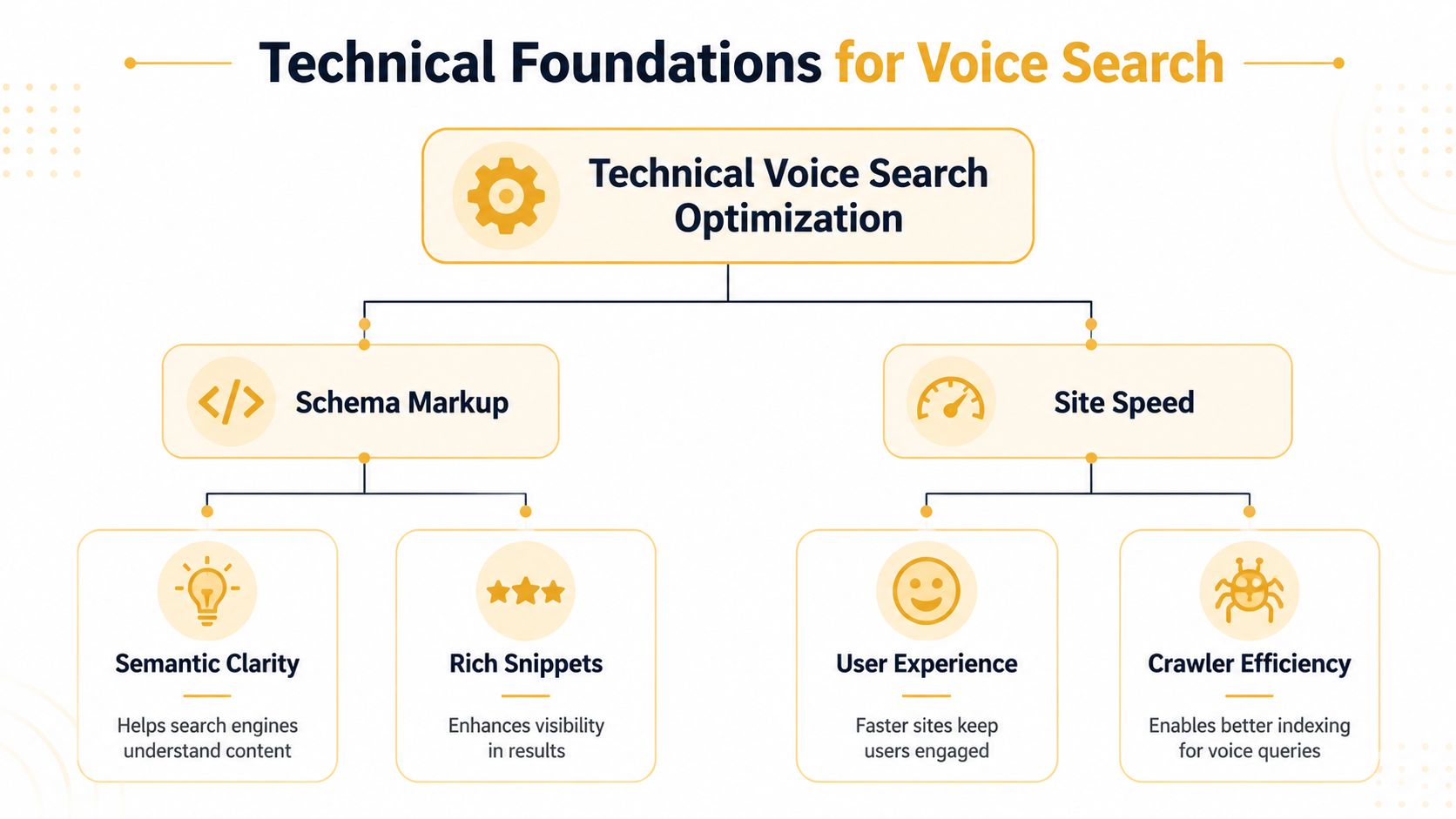
Treat schema like a translator
Schema markup doesn't make weak content strong. It does make strong content easier to classify.
For voice and answer-engine visibility, the most useful schema types are usually:
- FAQPage for clear question-and-answer sections
- HowTo for step-based instructional content
- Article for editorial pages with defined structure
- LocalBusiness for local service companies, retailers, and multi-location brands
A local Omaha service business might use LocalBusiness on its location page, FAQPage on service FAQs, and HowTo on educational blog content.
A simple LocalBusiness example
Here's a clean JSON-LD example for a hypothetical Omaha plumbing company:
{
  "@context": "https://schema.org",
  "@type": "LocalBusiness",
  "name": "Omaha Emergency Plumbing Co.",
  "image": "https://example.com/plumber-team.jpg",
  "url": "https://example.com/",
  "telephone": "(402) 555-0100",
  "address": {
    "@type": "PostalAddress",
    "streetAddress": "1234 Maple Street",
    "addressLocality": "Omaha",
    "addressRegion": "NE",
    "postalCode": "68102",
    "addressCountry": "US"
  },
  "openingHours": "Mo-Su 00:00-23:59"
}
Keep it accurate. If your hours, phone number, or address vary across the site and listings, schema won't save you.
Site speed is part of answer eligibility
A lot of voice searches happen in moments of impatience. Someone wants a fast local result, a quick product answer, or a spoken response while multitasking. Slow mobile pages create friction before content even has a chance.
The practical benchmark from independent guidance is to tune mobile pages so they load in about 2.5 to 3 seconds. That's less about chasing a perfect score and more about removing obvious drag.
Focus on the fixes that matter most:
- Compress large images on location pages, blogs, and product pages
- Limit script bloat from unnecessary plugins and trackers
- Use mobile-friendly layouts with readable text and tap-safe buttons
- Keep templates clean so important content loads early
Technical shortcut: If your mobile page opens with a giant hero image, delayed text, and five third-party scripts, voice optimization isn't your first problem.
What works in practice
For local businesses, schema plus fast location pages usually beats fancy experiments. For e-commerce, clean product pages, FAQ markup, and a lighter mobile experience tend to do more than adding another promotional widget.
Technical SEO rarely feels glamorous. It's still the layer that lets answer engines trust what they're pulling.
Dominating Local Voice Search Results
If you run a local business, voice work usually provides its earliest payoffs.
Independent guidance reports that 76% of voice searches target local businesses, which makes local schema and Google Business Profile completeness major ranking factors for assistants that rely on business listings, according to WPRiders' local voice search guide.
Why local voice SEO is the highest-leverage move for SMBs
A spoken local search often comes with immediate intent. The person asking wants a nearby option, current hours, directions, or a fast answer before they call. That's different from broad research traffic.
For a plumber, dentist, med spa, coffee shop, or auto shop, voice visibility often comes down to whether your business data is complete, consistent, and easy to trust. A strong website helps. A neglected local footprint can still hold you back.
If you want a broader local ranking framework, this breakdown of local SEO ranking factors is useful context.
The local checklist most businesses leave half-finished
A lot of owners claim their profile and stop there. That's not enough.
Use this as a working checklist:
-
Claim and verify your Google Business Profile
Make sure the business name, primary category, phone number, hours, service area, and website are correct. -
Fill in service and product details
Don't leave the profile generic. Add actual services, not just a category label. -
Add photos regularly
Fresh, real-world photos help users compare visually, which matters because many voice searches now lead into a visual local decision. -
Publish FAQ-style content on your site
Answer spoken local questions like “Do you offer weekend appointments?” or “Are you open now in West Omaha?” -
Create location pages with unique local proof
Don't duplicate the same city template across every page. Mention neighborhoods served, service specifics, parking details, or local context where relevant.
Don't rely on Google alone
This is one of the most overlooked local voice trade-offs.
Google Business Profile is central for Google-powered surfaces. But guidance also notes that assistants like Alexa, Siri, and Cortana may pull from other local directories. If your data is incomplete outside Google, your visibility can weaken on non-Google assistants.
That means you need consistent NAP data across major directories, not just your GBP.
| Local asset | What to check |
|---|---|
| Google Business Profile | Category, hours, services, photos, website |
| Website location page | Matching NAP, local FAQs, unique content |
| Third-party directories | Consistent name, address, phone, hours |
| Schema markup | Accurate LocalBusiness details |
What local businesses should write next
If you need content ideas that support local voice visibility, start with high-intent questions:
- Near-me intent such as “emergency plumber near me”
- Availability intent such as “open now” searches
- Location-modified services tied to city or neighborhood
- Trust questions about pricing, insurance, timelines, or service areas
Keep local answers short and direct first. Spoken local results usually favor clarity over long paragraphs.
For SMBs, voice optimization often isn't about publishing more. It's about cleaning up the operational details that search systems use to decide which local business they can confidently mention out loud.
Frequently Asked Questions About Voice Search SEO
Voice optimization is really modern SEO with stricter formatting, better local data, and a stronger answer-first mindset. If your pages are easy to quote, easy to trust, and easy to load on mobile, you're moving in the right direction.
Existing content often tells businesses to optimize Google Business Profile, but it rarely answers the practical questions owners ask, like which profile fields affect spoken local answers, how to measure calls or visits from voice queries, and how to think about multimodal searches, as noted in Cox Media's local voice search discussion.
Can you measure voice search directly
Not cleanly in most analytics platforms.
What you can do is infer impact by looking at signals that usually move with voice and answer-engine visibility:
- Question-style query growth in Google Search Console
- Featured snippet gains on pages you reformatted
- Lift on local action pages such as contact, directions, or call clicks
- Google Business Profile activity trends alongside local page improvements
For local businesses, ask call handlers and front-desk staff what language customers use when they mention finding you. That qualitative feedback often reveals whether spoken discovery is increasing.
Do you need a blog to rank for voice queries
No. You need pages that answer real questions.
For some businesses, that means a blog. For others, the better move is improving service pages, product pages, location pages, and on-site FAQs. A strong plumbing service page can do more for voice visibility than ten broad blog posts. The same goes for a well-structured running shoe category page with fit questions answered clearly.
Is voice SEO different for B2B and e-commerce
Yes, but mostly in query type.
B2B buyers often ask process and expertise questions. They want answers like “How long does ERP implementation take?” or “What does managed IT support include?” E-commerce shoppers ask fit, comparison, and purchase-support questions such as sizing, shipping, compatibility, or use case.
The optimization method is similar. The content format changes with the buyer's decision.
What about local SEO for e-commerce brands
This matters more than many retailers assume, especially if they have stores, pickup options, local inventory, or regional landing pages.
For teams working through that overlap, local SEO solutions for e-commerce brands is a useful resource because it connects store-level visibility with broader organic strategy.
Which local profile fields are worth the most attention
There isn't a clean public hierarchy that answers this perfectly, and that's part of the gap in most voice search advice. In practice, the fields that deserve the closest attention are the ones users act on immediately: business category, hours, phone number, address, services, website link, and photos.
If any of those are outdated, spoken local discovery gets harder because the platform has less confidence in the listing.
If you want help turning your site into something answer engines can use, Up North Media helps businesses improve SEO, local visibility, web performance, and AI-ready content structure. Whether you run a local service company in Omaha or an e-commerce brand with national reach, their team can help you find the gaps, clean up the technical issues, and build pages that are easier to surface in search.