

You're probably here because an Angel Tree tag is sitting on the counter, a school wants to host a drive, or your church or workplace said, “Can someone take this on?” The instinct is to treat it like a simple holiday kindness project. Don't. The Salvation Army Angel Tree toy drive works best when you treat it like a distributed logistics system with a charity mission attached. That shift in mindset is what keeps gifts from getting lost, mislabeled, or stuck in the wrong room on pickup day.
How the Angel Tree Toy Drive Actually Works
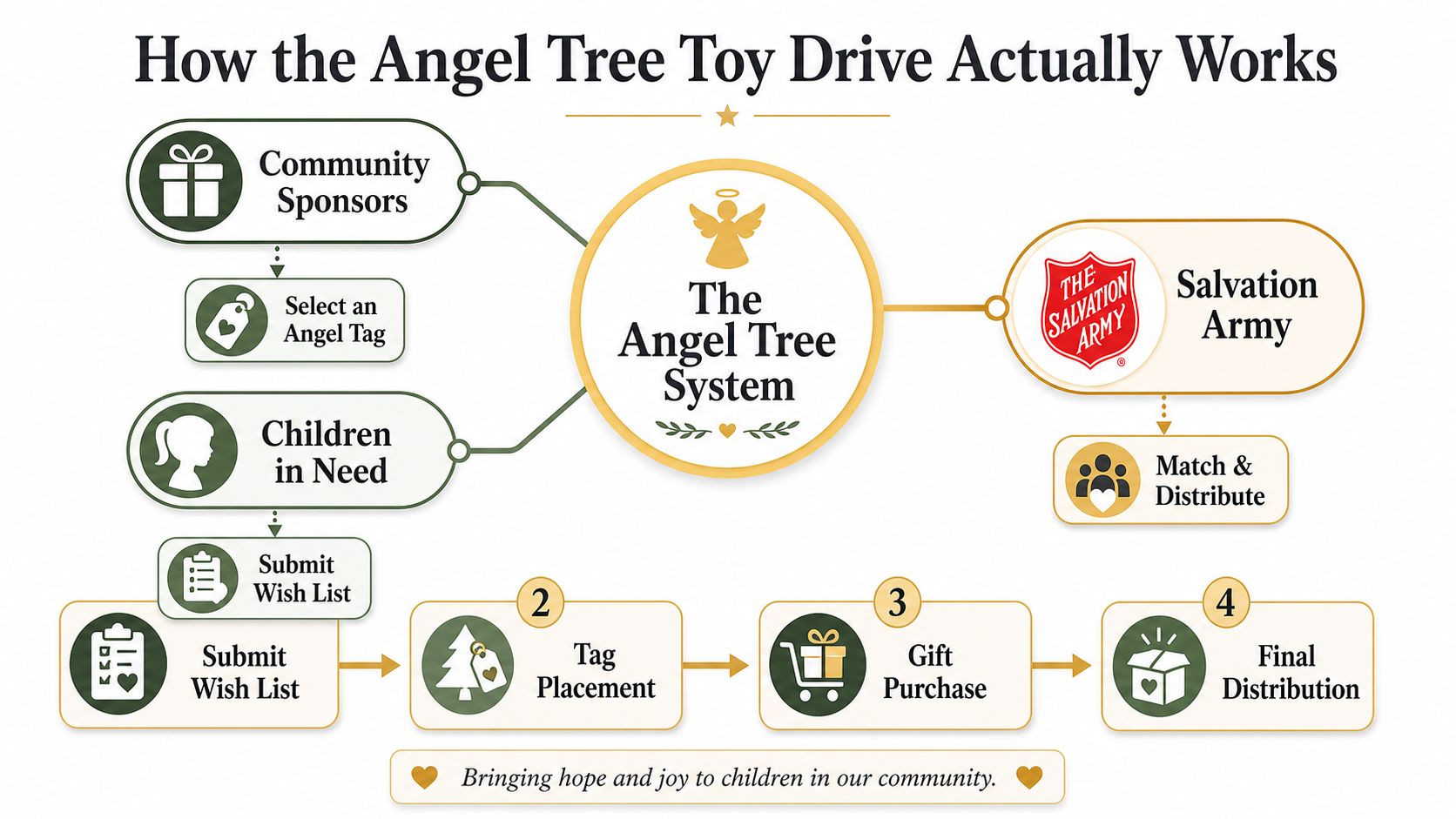
A lot of people start with the same assumption, they think they're just grabbing a tag, buying a toy, and dropping it off. That's the front end. The system is a matching and distribution chain that starts with a child's wish list and ends with a family pickup window handled by local Salvation Army staff. The national Angel Tree site says the program is not universal, because some local units use other application systems, so the exact intake process can vary by city and region. The core idea still stays the same, a child's needs become a tag, a sponsor fills that tag, and the Salvation Army sorts the gift for controlled distribution through a local warehouse or pickup site. The Angel Tree program overview spells out that structure clearly.
That is why the Walmart Angel Tree partnership matters. The national site says participating Walmart stores begin adding collection bins starting November 15, with new locations added weekly, and that mix of in-store displays plus online shopping extends the program into a retail network that can handle more donors and more collection points. This isn't a random donation bin in a foyer, it's a repeatable process that can scale across multiple markets.
What actually moves through the system
The child submits a wish list, local staff turn that into an Angel Tree tag, and the sponsor buys the exact items listed on that tag. Then the gifts move back through a warehouse or designated drop-off point before family pickup. That middle step is where most first-time helpers underestimate the work, because the program only functions when the gift, the tag, and the intake process stay aligned.
Practical rule: If the gift can't be matched back to a specific angel quickly, the system slows down.
That's why guides for related fundraising campaigns, including using ChurchSocial.ai for campaigns, are useful only as a supporting layer. Promotion helps people show up. The Angel Tree process still lives or dies on matching, labeling, and timely return.
Picking and Fulfilling an Angel Tag as a Sponsor
The sponsor side is simple on paper and fussy in practice. You pick an angel, buy the items listed on the tag, and return the gifts in the exact condition requested. The National Capital Area sponsor manual says completed gifts should be shipped or dropped off to the Angel Tree warehouse at 5160 Lawrence Place, Hyattsville, MD, and that the warehouse is open weekdays 9am to 4pm. It also instructs sponsors to use a shipping-label format that includes the Angel Name and ID #, which cuts down on misrouting during intake and sorting. The sponsor manual is blunt about the basics, shop early, label everything correctly, and deliver during the stated window.

The nonnegotiables
Don't wrap the gifts unless your local unit specifically tells you to. The operational reason is obvious, staff need to verify what's inside against the child's wish list before storage and staging. Keep the tag attached, keep the items new, and don't split one angel's gift across multiple unlabelled bags.
The most common mistakes are boring but costly.
- Late shopping: You lose time to stock shortages and shipping delays.
- Incomplete labels: A missing Angel Name or ID # creates sorting headaches.
- Missed warehouse hours: A good gift is still a problem if no one can receive it.
The sponsor manual's weekday window matters more than many expect. A sponsor who shows up after hours has not “mostly completed” the task. They've created work for staff who now have to rescue the package later.
Shop early, print the label cleanly, and deliver during office hours. That's the whole game.
If your local unit gives you a tag and a hard return date, treat that deadline like a business cutoff, not a suggestion. The drive only works when gifts arrive in a condition staff can process fast.
Organizing a Toy Drive From Scratch
Run the drive like a small logistics operation, because that is what it is. For a school, business, or community group, the first job is to define the scope, publish a clear wish list, set up donation bins and signage, coordinate transport, and lock in a fixed delivery deadline. The Salvation Army-affiliated guidance makes the process plain, and the London Community and Family Services guidance is useful because it treats the work as planning, sorting, and handoff, not just collecting donations. A deadline such as December 10 matters because gifts that arrive late are no longer helping children on time, they are creating extra sorting work.
Start with the handoff, then build everything around it. If the final drop-off date is fixed, the rest of the schedule becomes easier to control.
Build the calendar backward from delivery
Work backward from the delivery cutoff and stop pretending the holiday rush will sort itself out.
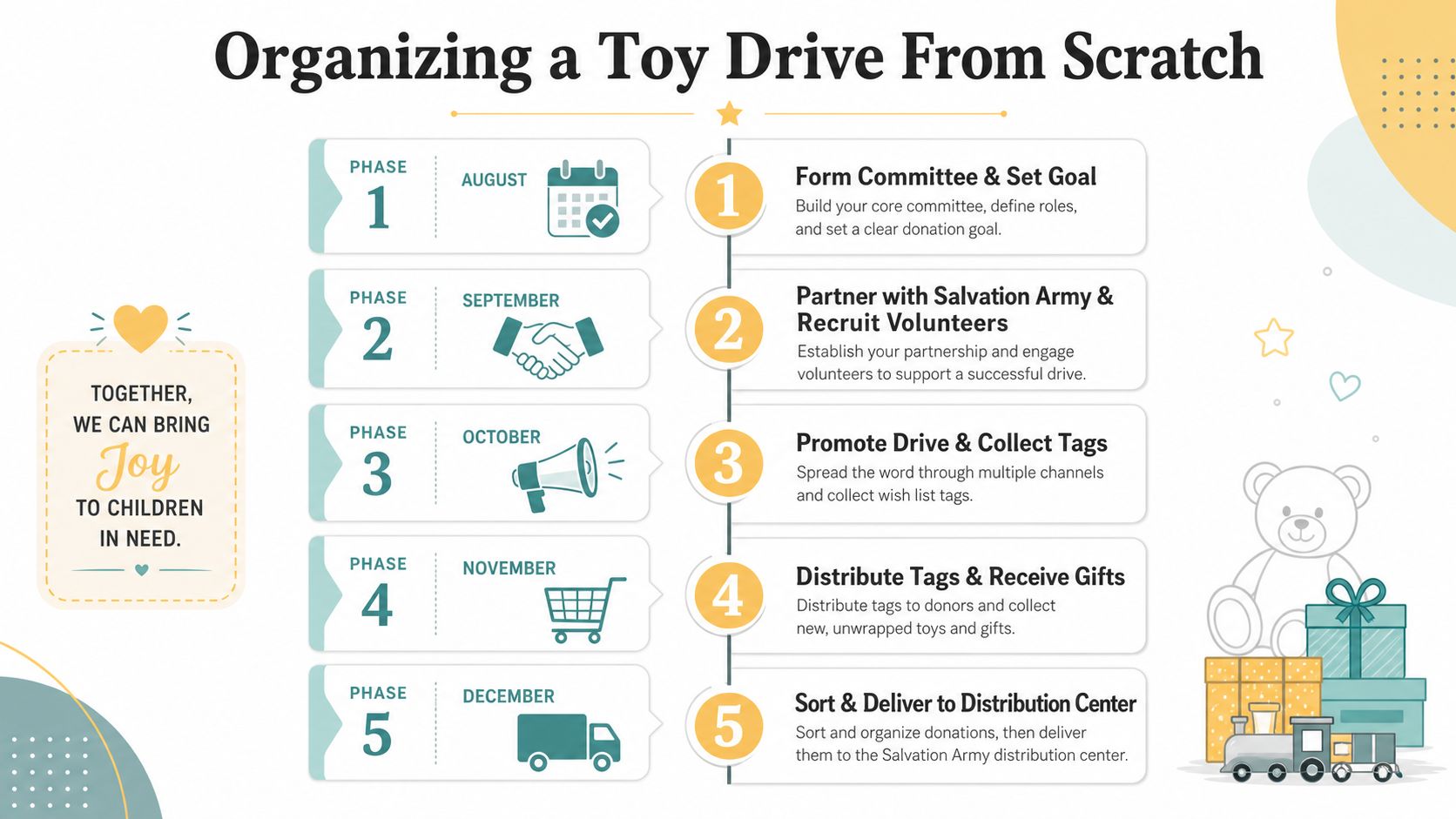
- August: Form the committee and decide who owns what.
- September: Confirm the local Salvation Army contact and recruit volunteers.
- October: Launch promotion and start tag collection.
- November: Receive gifts, track returns, and sort by category.
- December: Deliver everything to the distribution site before the cutoff.
The primary challenge is usually category imbalance. A drive can collect plenty of toys and still miss the mark if the gifts do not match the ages and child-specific needs on the tags. That is why local Salvation Army materials keep pressing the same operational rule, buy what is listed on the tag, return it unwrapped, and stage it so staff can store and sort it without guesswork.
A single coordinator prevents the usual mess. Western Pennsylvania's transition notice points to centralized volunteer and donor communication through one coordinator, and that is the right setup when several people want to help but nobody wants to own the deadline. If the staff, volunteers, and donors all know who makes the call, fewer gifts disappear into the wrong pile and fewer instructions get contradicted.
A toy drive does not fail because nobody cared. It fails because nobody owned the deadline.
For a business team, school group, or church committee, split the work cleanly. One person tracks the wish list, one tracks returns, and one handles transport. That division keeps the drive moving when calendars fill up and everyone starts assuming someone else already covered the basics.
Hosting a Drop-Off Site as a Business or Group
A host site is a handling point, and handling is where toy drives usually break down. A bin by the door looks organized, but it does nothing if staff have no place to stage bags, sort tags, or keep gifts secure until pickup. Edmonton Salvation Army guidance says drop-off locations need storage capacity and clear office-hour access, and that tracks with real work on collection day. Digital marketing for local businesses helps bring people in, but it only matters after the site can receive what they bring.
Set the site up like a back-room operation
Put the collection point where donors can find it fast, then plan the rest like you expect a full van to show up. Visibility gets the first donation. Storage keeps the drive from falling apart.
The cleanest host sites handle three things without confusion:
- Pre-plan storage: If gifts cannot sit safely until transfer, the site is not ready.
- Limit receiving hours: Clear office hours cut down on missed handoffs and rushed drop-offs.
- Name one contact: One person should answer the Salvation Army coordinator, donors, and staff.
One contact keeps the whole process straight. If five people are giving different answers about what can be accepted, where it goes, or when pickup happens, donors notice that mess right away. Corporate donors and community groups stop trusting a site that changes the rules midstream.
community outreach for churches has a useful lesson here, even outside church settings. The message is simple, every group needs one owner, one intake plan, and one storage plan. That is the difference between a site that helps and a site that creates extra cleanup for everyone else.
Bulk drop-offs need direct handling. If a workplace arrives with several bags or boxes, someone has to receive them, check that the tags are attached, and move them into storage right away. That is basic logistics, not charity theater. Gifts should be returned unwrapped with tags attached, so the host site has to make that rule obvious before anyone walks in.
A lobby bin works only when the building is set up for it. If the front desk can manage intake, fine. If it cannot store donations safely, the better move is to partner with a site that can. Donor goodwill is easy to find. A secure place to stage gifts is what keeps the drive from turning into a pileup.
Promoting Your Drive and Coordinating Volunteers
A toy drive can look busy and still fail at the handoff stage. Posters, emails, and social posts get people in the door, but the core work is keeping labels straight, drop-off windows clear, and volunteers assigned before gifts start piling up. If your group already works with faith partners, community outreach for churches offers a useful reminder, one person should own the message, one plan should handle intake, and one setup should handle storage.
Keep the ask simple
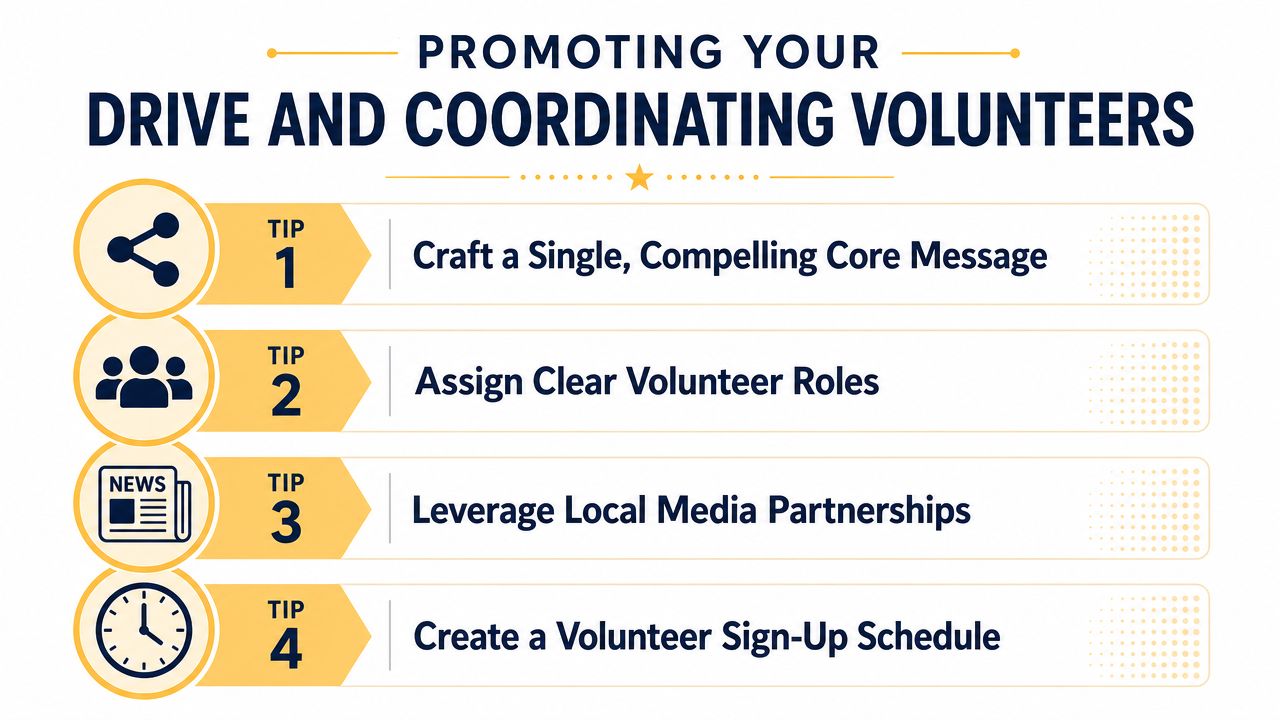
Pick one message and repeat it everywhere. If the flyer says one thing, the email says another, and the lobby sign adds a third version, donors hesitate and volunteers start improvising. Use the same wording for workplaces, schools, houses of worship, and neighborhood groups, then give each group a clear person to pass that message along.
The coordinator role matters because it keeps the whole operation from splintering. One contact handles sign-ups, reminder emails, donor questions, and last-minute changes. That is how you avoid the mess of people showing up unsure about what can be accepted, where to leave it, or who is responsible for moving it into storage.
Volunteer work should be narrow and boring. One person prints signs, one person checks gift counts, one person answers messages, and one person handles transport. Short shifts and clear jobs keep people useful without forcing anyone to manage the entire drive alone.
A tight promotion calendar keeps the pressure in the right places:
- Early announcement: Tell people what to buy and where to bring it.
- Middle of the drive: Keep repeating tag reminders and drop-off locations.
- Near the deadline: Push return timing hard so gifts do not arrive late.
- Final week: Shift the focus to sorting, pickup, and delivery status.
The cleanest drives treat volunteer coordination like a distribution problem. Gifts have to be labeled correctly, received at the right time, and moved to the right place without confusion. That is why the same discipline used in a content distribution strategy works here too, choose the right channel, keep the message consistent, and make the next step obvious.
A few roles are worth assigning up front. One volunteer should handle signage and table setup. Another should track incoming gifts and flag tag issues. A third should send thank-yous and updates. If you have a larger group, give someone responsibility for bulk drop-offs so office staff do not get stuck dealing with pallets, bags, or boxes at random times.
Use a simple checklist for every volunteer shift:
- who is on intake
- where donations go after arrival
- who checks tags
- who contacts the coordinator if something is missing
That kind of setup keeps the site calm on busy days. It also protects the host from the classic problem of a lobby full of gifts and nobody sure where they should go next.
Gift Guidelines, Wrapping Rules, and Last-Minute Questions
The questions that come up late in the season are usually the ones that cost the most time. Can gifts be wrapped? What if the requested item is sold out? Where does a company send a bulk drop-off? The answer starts with the same rule repeated across Salvation Army materials, buy the items listed on the tag, return them unwrapped, and keep the tag attached. That setup lets staff verify the contents against the wish list before storage and staging.
If the requested item is unavailable, don't improvise with something unrelated just to check the box. Ask the local coordinator what the unit will accept. Some regional guides also set office-hour delivery windows or central warehouse instructions, so the person running the drive should be the one to answer the question, not the person at the front desk.
Fast answers for common problems
- Wrapped gifts: Usually a bad idea unless your local unit says otherwise.
- Late deliveries: Escalate to the coordinator immediately, don't assume someone will still be there.
- Bulk corporate drop-offs: Coordinate ahead of time so staff can receive, sort, and store everything.
- Age fit: Stick to the child-specific tag instructions, not what feels broadly “kid friendly.”
The age issue matters because the program isn't built around generic toy volume. It's built around matching. If the age range or gift type misses the tag, staff still have to untangle it before distribution, which slows the whole process.
If you're handling a problem gift, tell the coordinator early. Don't wait until the day before pickup and hope a staff member can fix it in five minutes. That's how good intentions become operational backups.
When in doubt, keep the package simple, clean, and labeled. The easier you make intake, the faster a family gets the right gift.
Putting It Together for Maximum Local Impact
The most effective moves are straightforward. Define scope early, lock the December deadline, centralize communication through one coordinator, and treat the host site like a logistics hub, not a donation bin. The Salvation Army works this way because the process depends on matching, sorting, and timely distribution, not just goodwill. If you're in Omaha, the smart move is to coordinate directly with your local Salvation Army unit, then line up your community partners so promotion and drop-off logistics don't drift apart. Local search marketing can help people find your drive, but the drive still has to be run well.
Pick one action today, adopt an angel, host a bin, or recruit a workplace team. Then make sure someone owns the labels, the deadline, and the handoff. That's how a holiday idea turns into gifts in the right hands.
A CTA for Up North Media.