

Small-business SEO typically runs $500 to $3,000 per month in 2026, with most Omaha-area firms landing between $1,000 and $2,500. Treat that as a starting point, not a quote: your actual cost depends on what your business needs to accomplish, the condition of your website, and the competition you face.
You've just opened an SEO proposal. The monthly fee looks substantial, the list of deliverables is unfamiliar, and there's no obvious way to tell whether you're buying meaningful work or a tidy report. That's a real problem, because SEO doesn't come with one published rate card.
A 2019 survey found businesses using SEO services spent an average of $497.16 per month, or about $5,966 annually, but spending varied widely: half spent less than $1,000 a year, while 14% spent at least $5,000 and 2% exceeded $25,000 (Backlinko's SEO services statistics). The useful lesson isn't that your business should match an old average. It's that an average can't tell you what your campaign needs.
Before you approve a budget, decide which pricing model fits, how much capacity you need, who should do the work, and how you'll measure what you bought. Those answers are more useful than comparing retainers in isolation.
The Question Every Owner Asks First
“Is this a reasonable price?” is the natural response to an SEO proposal. But the number alone can't answer it. A business with a technically sound website and a narrow local focus needs a different level of work from an online retailer with complex product pages or a service company entering new markets.
The proposal should reflect business goals, website condition, and competitive context. Ask what's holding your site back today. Is it difficult for search engines to crawl? Are important service pages missing? Are local listings inconsistent? Does the business need better conversion tracking before it invests in more traffic? Each answer changes the work, and therefore the cost.
Judge capacity, not just price
A low fee can be sensible if the scope is narrow and specific. For example, a local service business might start by correcting its business listings, fixing technical issues on priority pages, and improving a small set of high-intent service pages. An e-commerce company may need a much broader program that addresses product architecture, category pages, and measurement.
Problems arise when the fee is low but the promise is broad. If a provider says they'll handle technical SEO, content, link building, local optimization, and reporting, ask how much work is allocated to each. A monthly report isn't the same as implementation.
Practical rule: Buy a defined amount of useful work aimed at a business outcome, not a vague promise of “more visibility.”
Your goal is to understand what the proposal makes possible. Once the capacity is clear, you can decide whether the price fits your business and whether the provider's model suits the work.
How SEO Agencies Actually Price Their Work
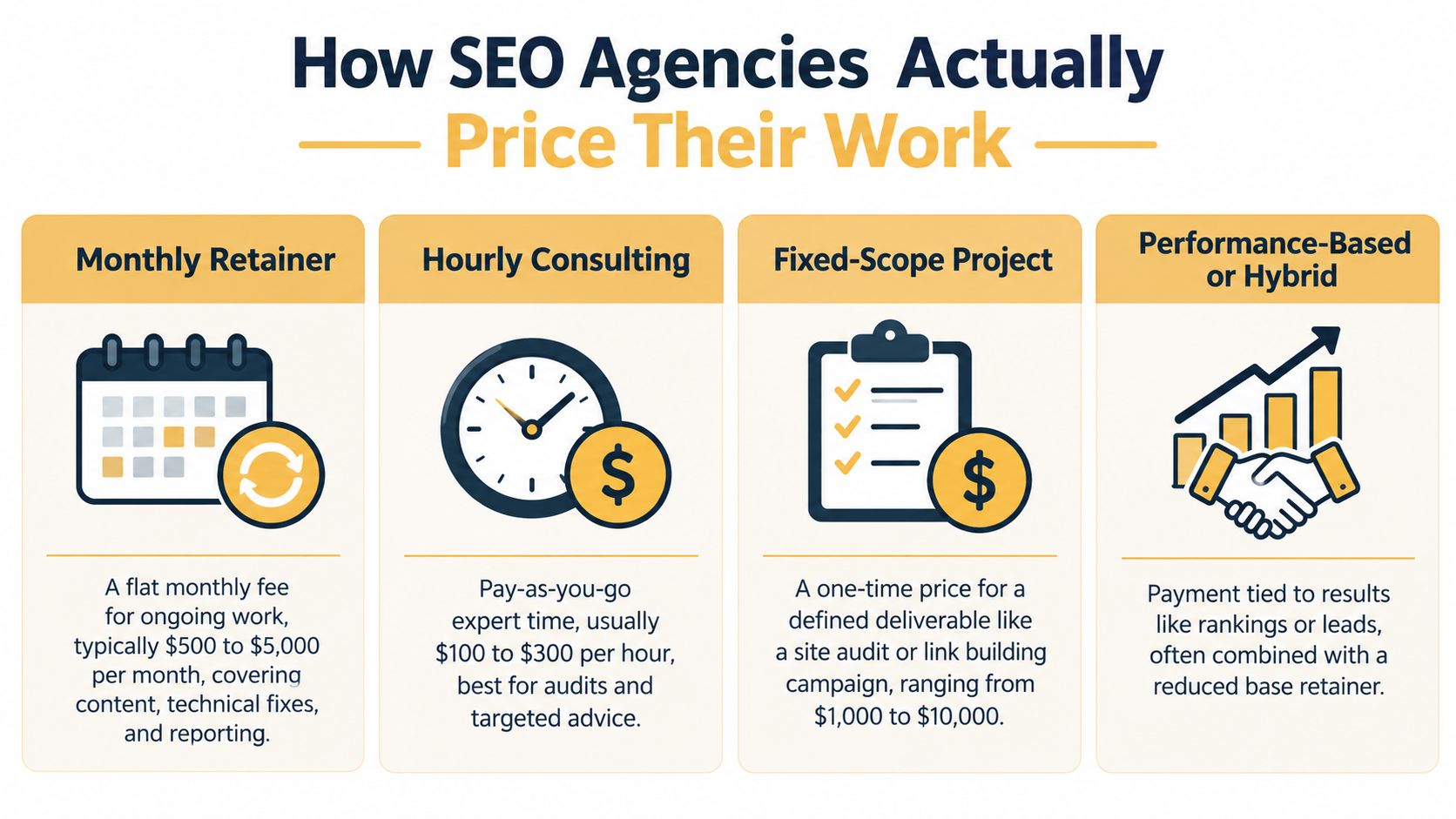
SEO providers generally charge through a monthly retainer, hourly consulting, a fixed-scope project, or a performance-based or hybrid arrangement. The model tells you how the provider gets paid, but it doesn't tell you whether the work is right for your business.
An Ahrefs pricing summary covering 439 SEO providers reported an average monthly retainer of $2,917. Agency retainers averaged $3,209, consultancy retainers $3,250, and freelancer retainers $1,348; about 63% of businesses spent between $500 and $5,000 monthly (the 2024 SEO pricing summary). These are market reference points, not a promise that a particular price buys a particular result.
Pick a model that matches the work
Monthly retainer: You pay a recurring fee for ongoing work. It fits when the business needs continuous technical improvements, content, local optimization, or measurement. Make sure the contract names the work, not just the monthly reporting cadence.
Hourly consulting: You pay for expert time, often to diagnose a problem, review a strategy, or advise an in-house team that can do the implementation. It's useful when you need direction more than ongoing production.
Fixed-scope project: You pay for a defined deliverable, such as a technical audit or a prioritized implementation plan. This is a strong choice when you need clarity before committing to ongoing work.
Performance-based or hybrid: Some fees are tied to outcomes, sometimes alongside a base fee. Don't accept a contract that rewards rankings without defining which terms count, how leads are verified, and what happens when search conditions change.
A simple decision cue: choose a retainer when you have ongoing work and someone will implement it; choose a project when you need a bounded diagnosis or deliverable; choose hourly consulting when your team can execute but needs specialist guidance. If you're comparing recurring costs across different digital tools, LunaBloom AI's video generator pricing options offer a useful example of how a service can present its pricing choices for evaluation.
What Drives an SEO Quote Up or Down
An SEO quote rises when the provider must solve more problems, produce more work, or compete across a broader search market. Read each line item as a description of time and capability, not as a mysterious SEO surcharge.
Start with scope and site condition. A small site with a few priority pages may need limited cleanup. A large site with crawl and indexation problems can require detailed technical investigation and coordination with a developer. Ask which pages and issues the provider will address, and whether they'll implement fixes or only recommend them.
Competition and geography matter too. A business targeting one local service area has a narrower assignment than a company pursuing regional or national visibility. More locations, services, and commercial search terms usually mean more research, page work, and ongoing maintenance.
Then inspect the production work. Content volume should mean named pages or clearly defined content tasks, not a vague promise to "create content." Link acquisition should come with a transparent explanation of methods. Reporting depth should help you make decisions by connecting activity to leads and revenue, rather than listing rank movements.
Match the scope to the business
A local service company may prioritize its Google Business Profile, technical fixes, review visibility, and a limited set of location pages. An e-commerce retailer may need attention to product architecture, faceted navigation, structured data, and category content. A publisher may need to strengthen useful, original coverage and understand which pages attract qualified audiences.
AI-generated search results also affect what a program should prioritize. A provider may need to focus on clear, authoritative pages and brand visibility, not just produce more articles. That work should be explained as part of the strategy, not presented as an automatic add-on.
A 2024 small-business survey found that 23% spent less than $1,000 a month on SEO, while 46% spent less than $5,000 monthly; 94% of small-business marketers considered SEO effective (the small-business search marketing survey). Those figures describe spending and opinion, not what your campaign should cost.
A $1,000 plan that only delivers reports and a $1,000 plan that resolves technical issues and improves priority pages are different purchases. Ask the provider to connect every major cost to a deliverable and a business need.
Agency Versus In-House at Real Dollar Numbers
Hiring internally doesn't make SEO free. It changes what you pay for: instead of a vendor's team and process, you take on salary, management, tools, and the challenge of covering all the necessary specialties.
A U.S.-based mid-level SEO hire commonly earns a base salary of $65,000 to $95,000, while a senior hire commonly earns $90,000 to $130,000. Payroll taxes, benefits, software, recruiting, and management time push the employer's effective cost above salary (WebFX's comparison of in-house and agency SEO).
| Delivery model | Typical annual cost | Best fit |
|---|---|---|
| Freelancer | Depends on scope and hours | Defined tasks or specialist support |
| Boutique agency | Depends on retainer and scope | Ongoing work with a focused team |
| Full-service agency | Depends on retainer and scope | Multiple capabilities under one provider |
| Mid-level in-house SEO hire | $65,000–$95,000 base salary, before added employer costs | Consistent workload and internal coordination |
| Senior in-house SEO hire | $90,000–$130,000 base salary, before added employer costs | Strategic ownership and complex ongoing needs |
Use the table as a comparison of structure, not a complete quote. The available salary figures cover employee base pay, and agency costs vary by provider and deliverables. Compare all options by annual cost per capability delivered, including internal labor, software, implementation, and management.
When outsourcing makes more sense
A freelancer can be a practical choice when you have a defined need, such as technical review or local page improvements, and someone on your team can manage the work. A boutique agency may provide access to several disciplines without requiring you to hire each specialist. A full-service agency can make sense when SEO must coordinate with content, development, analytics, or conversion work.
Internal hiring can win when SEO is a steady, central part of the business and a staff member can work closely with product, sales, and leadership. It's a weaker fit when the workload is unpredictable or the business needs expertise across technical SEO, content strategy, digital PR, and conversion analysis, but can't keep multiple specialists busy.
Before rejecting an agency fee as expensive, compare it with the fully loaded cost of a qualified hire. Then ask which capabilities you would receive under each option.
How to Translate SEO Spend Into Real Numbers
Measure SEO as a path from investment to customers, not as a race for rankings. Start with two figures: cost per qualified lead and cost per acquired customer. Both require reliable tracking and agreement on what counts as a qualified lead.
For example, an Omaha HVAC company could pay a $1,800 monthly retainer. To calculate customer acquisition cost, divide that monthly SEO spend by the number of customers that the business can credibly attribute to organic search during the same period. To calculate cost per lead, divide the spend by qualified organic leads. Without the actual lead and customer counts, there's no honest result to calculate.
Don't confuse site traffic with business value. Informational visits may not produce calls or service requests, and a page can attract visits without reaching the people most likely to buy. Track qualified forms, phone calls, booked appointments, assisted conversions, and revenue alongside search visibility.
Build a usable measurement loop
Before work starts, confirm that analytics and call tracking can distinguish organic inquiries from other channels. Agree on how your team will mark lead quality and whether a later sale can be connected to the original inquiry. If attribution is incomplete, treat the first reporting period as a measurement setup problem, not proof of success or failure.
Then compare SEO with alternatives your business uses. Paid search and outbound can generate leads through different mechanisms and with different costs; compare them using the same lead-quality and customer-value definitions. Don't claim SEO is cheaper just because the retainer looks smaller than another channel's total budget.
AI summaries complicate the traffic picture. Forbes, citing Pew Research Center, reported that users click traditional results at about half the rate when Google displays an AI summary, and that 1% of searches with an AI summary produced a click on a link inside that summary (Forbes on small businesses and search traffic). A ranking may therefore matter without producing the visit you expected.
For a practical framework on defining and tracking SEO returns, use this guide to measure SEO ROI. Your dashboard should help you decide whether to keep funding the work, change its scope, or invest in a different source of demand.
Building an SEO Budget You Can Defend
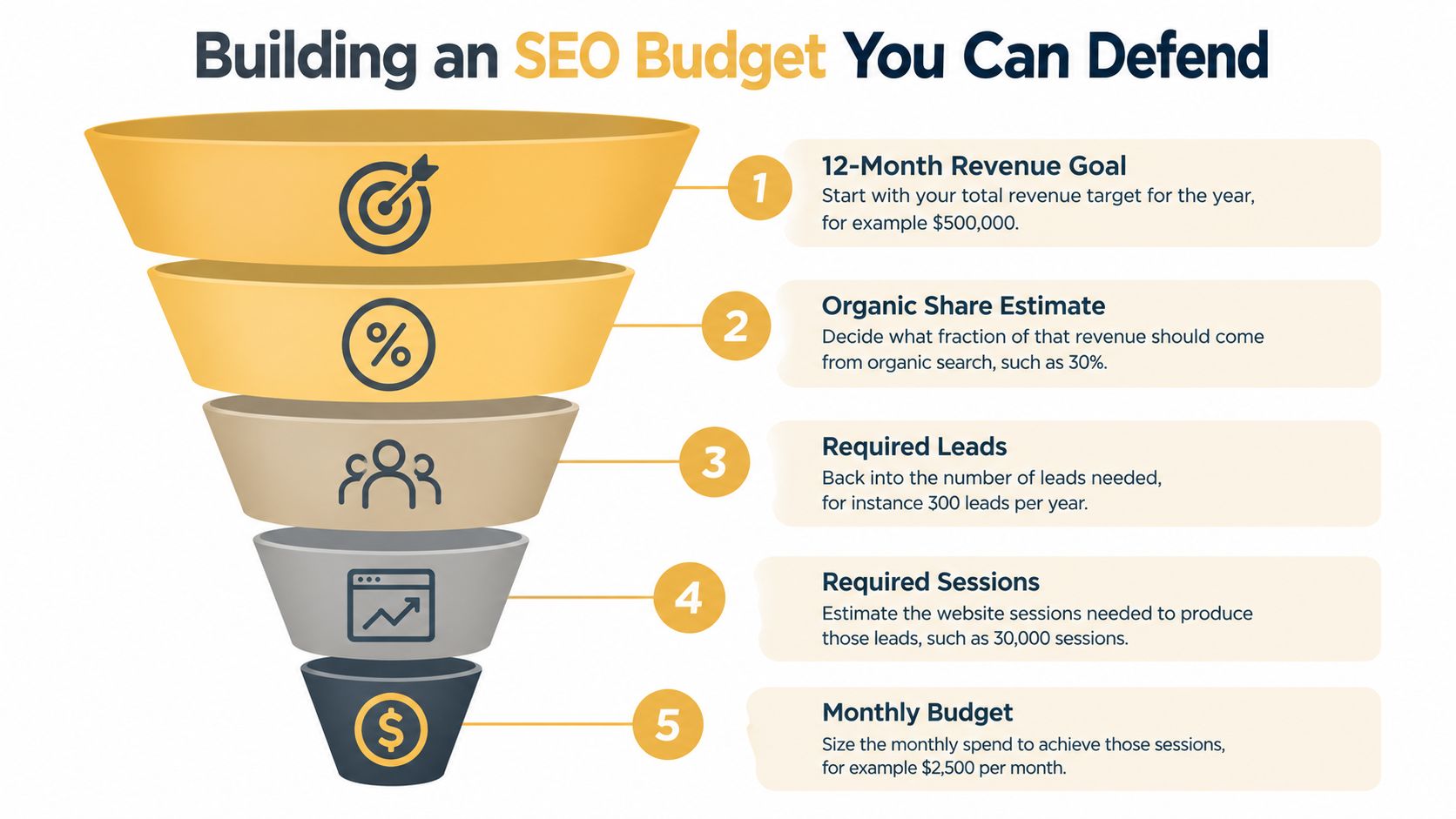
A defensible budget starts with your business goal, then works backward to the search work that could support it. Don't begin by choosing a monthly fee and hoping the right strategy fits inside it.
First, name the revenue goal you want organic search to support. Next, estimate the share of that goal that organic search could reasonably contribute, based on your business model and current performance. Then work backward from customer value to the number of qualified leads required. Use your own sales data to estimate how many relevant visits may be needed, and identify what the website must improve to attract and convert them.
That process won't produce false certainty. It will reveal whether your current site is far from the goal, whether you need better conversion tracking, or whether a narrow first project is more sensible than a continuing retainer.
Set checkpoints before spending
Small businesses don't all have room for a large marketing commitment. Morningscore reported that businesses with 10 or fewer employees were 31% more likely to have a marketing budget below $500 per month, and 33% of small businesses had total monthly marketing budgets under $1,000 (Morningscore's small-business SEO cost discussion). A budget should fit your finances as well as your ambitions.
Use planned reviews to decide whether to stop, adjust, or scale. At 90 days, check whether tracking is working and whether agreed technical and content tasks have been completed. At 180 days, review qualified leads, conversion quality, and progress on priority pages, then change the scope if the work isn't addressing the actual bottleneck. At 365 days, compare the business outcomes with the cost and decide whether the program deserves more investment.
A smaller starting budget isn't a failure if it funds a useful, clearly bounded scope. The important thing is to know what the spend is meant to change and what evidence would justify continuing.
Why SEO Value Is Changing in the AI Search Era
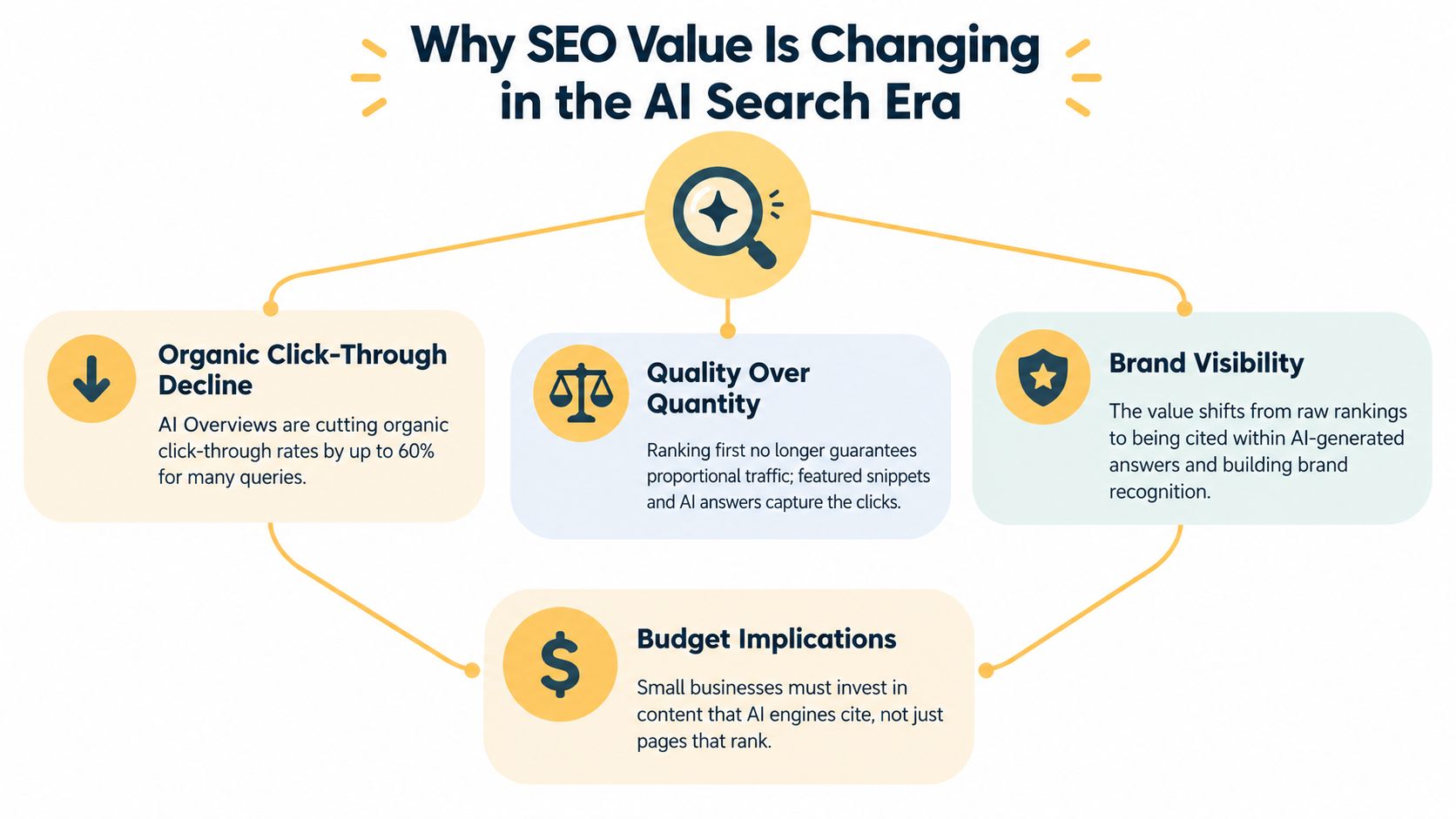
A higher ranking no longer guarantees a proportional increase in website visits. Search results can answer questions directly, and a business may gain visibility without earning the click that older SEO plans treated as the main outcome.
That changes what you should ask an SEO provider to deliver. A sound plan can still pursue conventional organic traffic, but it should also strengthen brand recognition and give search systems clear, credible information to reference. For local companies, that means useful service pages, accurate business information, strong reputation signals, and content grounded in real expertise. For publishers, it means original evidence and useful coverage, not a higher volume of interchangeable pages.
Buy evidence and execution, not article volume
Ask how the provider will measure visibility when a searcher doesn't click. The answer should include more than rankings. Consider search impressions, branded searches, qualified leads, assisted conversions, calls, and revenue, while being clear about which signals your analytics can reliably measure.
A vendor still selling a 2019-era approach may promise more articles and higher rankings without asking how those activities connect to your customers. Push for a clear explanation of how the work will improve your site's usefulness, authority, and ability to convert demand. For a broader explanation of optimization for AI-driven search, see this guide to AI search optimization.
For many small businesses, a fixed-scope diagnostic and prioritized implementation plan is a better starting point than an indefinite retainer. It shows what's broken, what matters most, and what your team can tackle first. Commit to ongoing work once you know which tasks require sustained outside support.
The video below can help frame the discussion around AI-generated search results and changing visibility.
Questions to Ask Before You Sign Anything
Treat a sales call as a chance to test the proposal, not just the provider's presentation skills. Ask direct questions and listen for concrete answers about the work, ownership, reporting, and exit terms.
Start with scope: Which pages, search themes, and technical problems are included? A provider should be able to connect its recommendations to your site and business priorities. If the deliverables could describe any company in any industry, they're too vague to evaluate.
Pressure-test the contract
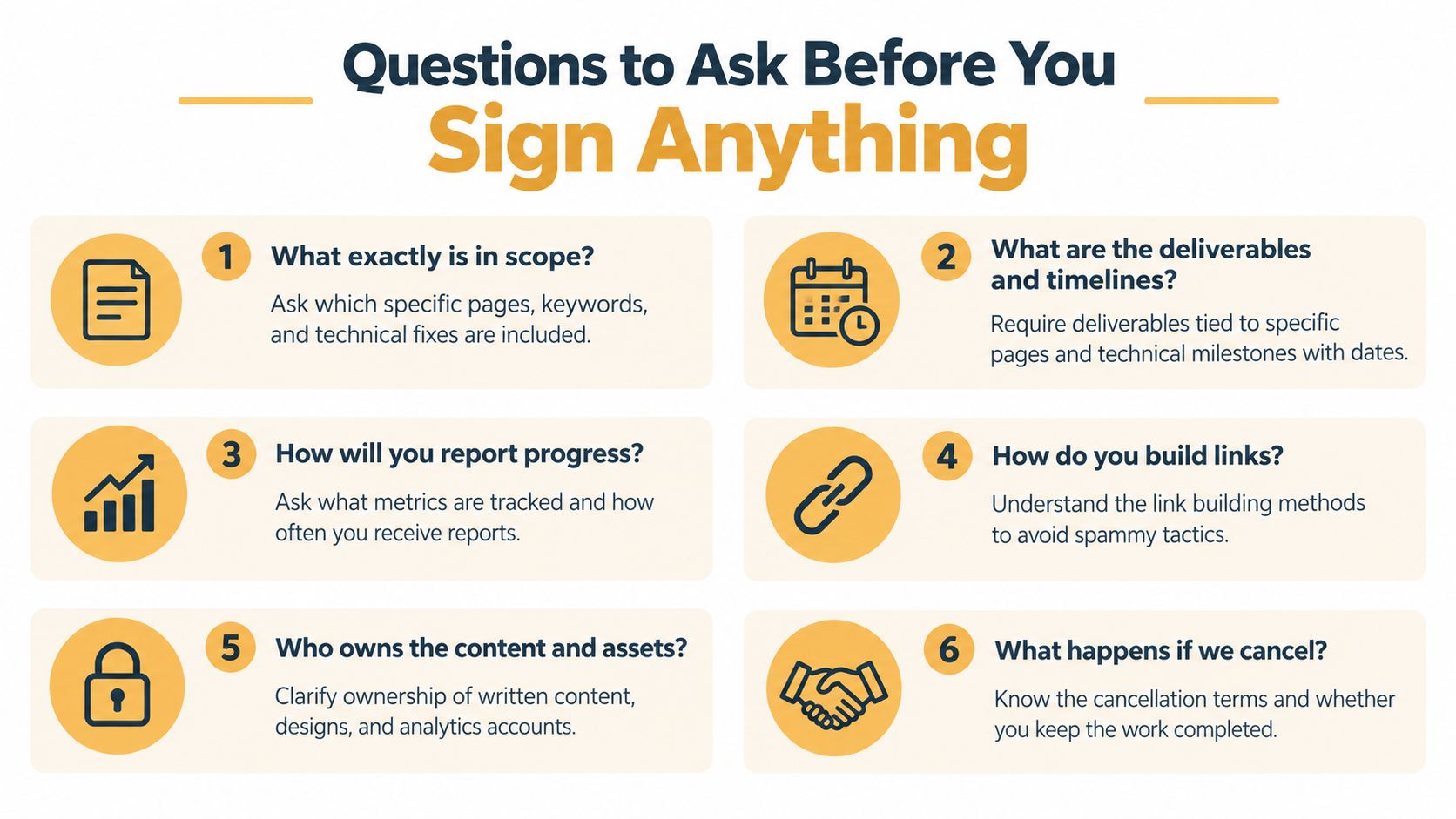
Use these questions before signing:
- What exactly is in scope? Ask which pages, technical fixes, and search priorities the provider will address.
- What are the deliverables and timelines? Get specific work products and milestones, not just a promise of ongoing effort.
- How will you report progress? Confirm which business and search metrics you'll see, and how often.
- How do you build links? Ask about the process and how the provider avoids manipulative or irrelevant placements.
- Who owns the content and assets? Clarify access and ownership for content, designs, analytics, and business accounts.
- What happens if we cancel? Check notice terms and confirm you keep completed work and access to your assets.
Ask how the provider will define success and what happens if the agreed work doesn't move the business toward it. Guaranteed rankings are a warning sign because a vendor can't control search results. Be cautious, too, if the provider refuses to explain its methods or provide relevant examples of prior work.
For a fuller guide to evaluating a provider, review what to expect from an SEO agency. Then put your questions in writing and ask the vendor to answer them against the proposed scope. Clear answers give you a basis for comparing offers without pretending that the cheapest fee is automatically the best value.
Up North Media works with Omaha-area businesses on data-driven SEO, custom web development, and AI consulting, with project scopes tied to business goals and measurable outcomes. If you're weighing a retainer against a diagnostic or internal hire, visit Up North Media to discuss which approach fits your needs.