
The most popular advice about AI search optimization is also the least useful: add structured data, write shorter answers, and hope an AI system mentions your brand. Those tactics can help, but they miss the central problem. AI search systems must decide which passages to retrieve, trust, summarize, and cite, often without sending the user to your website.
That changes the question businesses need to ask. It isn't only, “How do we rank higher?” It's, “Can an AI system find the right evidence about us, understand it correctly, and include it in an answer that influences the buyer's next step?” That is the foundation of what is AI search optimization.
What Is AI Search Optimization?
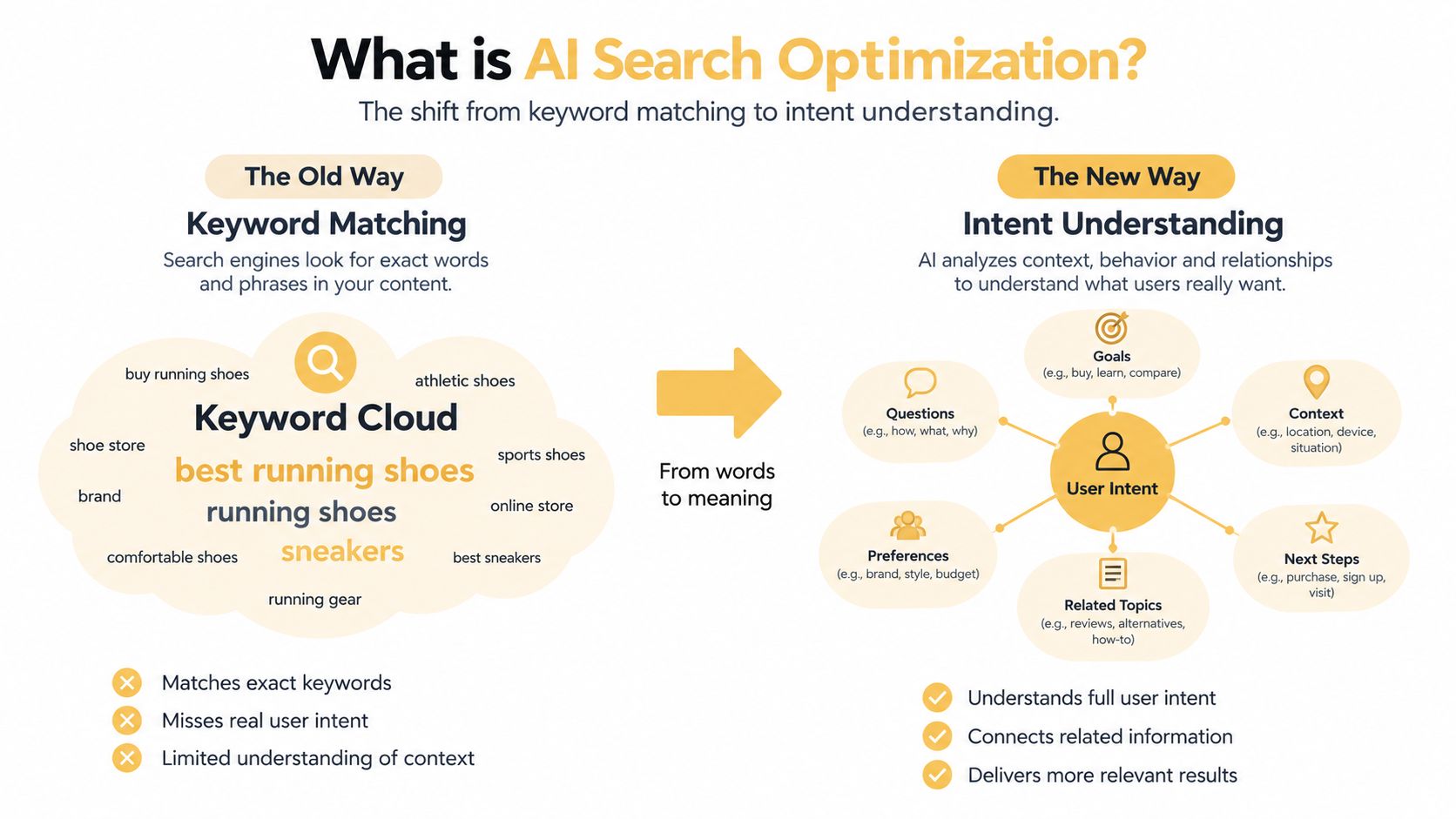
AI search optimization, also called generative engine optimization, or GEO, is the practice of preparing a company's content, website, and public evidence so AI systems can accurately discover, summarize, cite, and recommend the business. It is less like polishing a page for one ranking position and more like preparing a reliable evidence file that an answer system can select and explain.
Its importance grew after Google launched AI Overviews in the United States in May 2024 and began expanding the feature internationally in August 2024. The underlying research describes this shift from conventional search to AI-mediated answers.
Ranking is no longer the whole objective
A conventional search engine may match a query with a page and present that page in a list. An AI search system can interpret a longer question, separate its related needs, retrieve supporting passages, and combine them into a response. It may add citations, suggest follow-up questions, or recommend businesses that fit the user's situation.
In one large-scale experiment, researchers ran 11,372 real-world queries across seven countries and collected 79,604 Google results. Generative-AI content appeared in 56% of general-knowledge queries and 51% of health queries, compared with 5% of shopping queries and 1% of COVID-related queries. The findings show that AI-generated answers appear unevenly across search contexts, so optimization depends on the questions a business needs to answer rather than on a universal checklist.
Traditional SEO still provides the foundation. Google states that pages used in AI features generally need to be crawlable, indexed, and eligible to display a normal search snippet. No separate AI-only file guarantees inclusion. A page also needs to work at the passage level, meaning an AI system can extract an accurate, useful statement without reconstructing the meaning from the entire document.
Practical rule: Keep optimizing for rankings, but write and structure important pages so an AI system can extract a correct answer without guessing.
For a local service company, that may mean stating its service area, contact details, qualifications, process, and answers to customer questions in readable page content. For an ecommerce business, it may mean defining products, use cases, constraints, and comparisons clearly.
Being cited is only an intermediate result. The commercial question is whether the cited passage gives a potential customer enough accurate context to choose a next step, such as contacting the company or evaluating a product. AI search optimization therefore addresses both retrieval quality and citation eligibility, then connects that visibility to actions that can produce revenue.
How AI Search Systems Actually Work
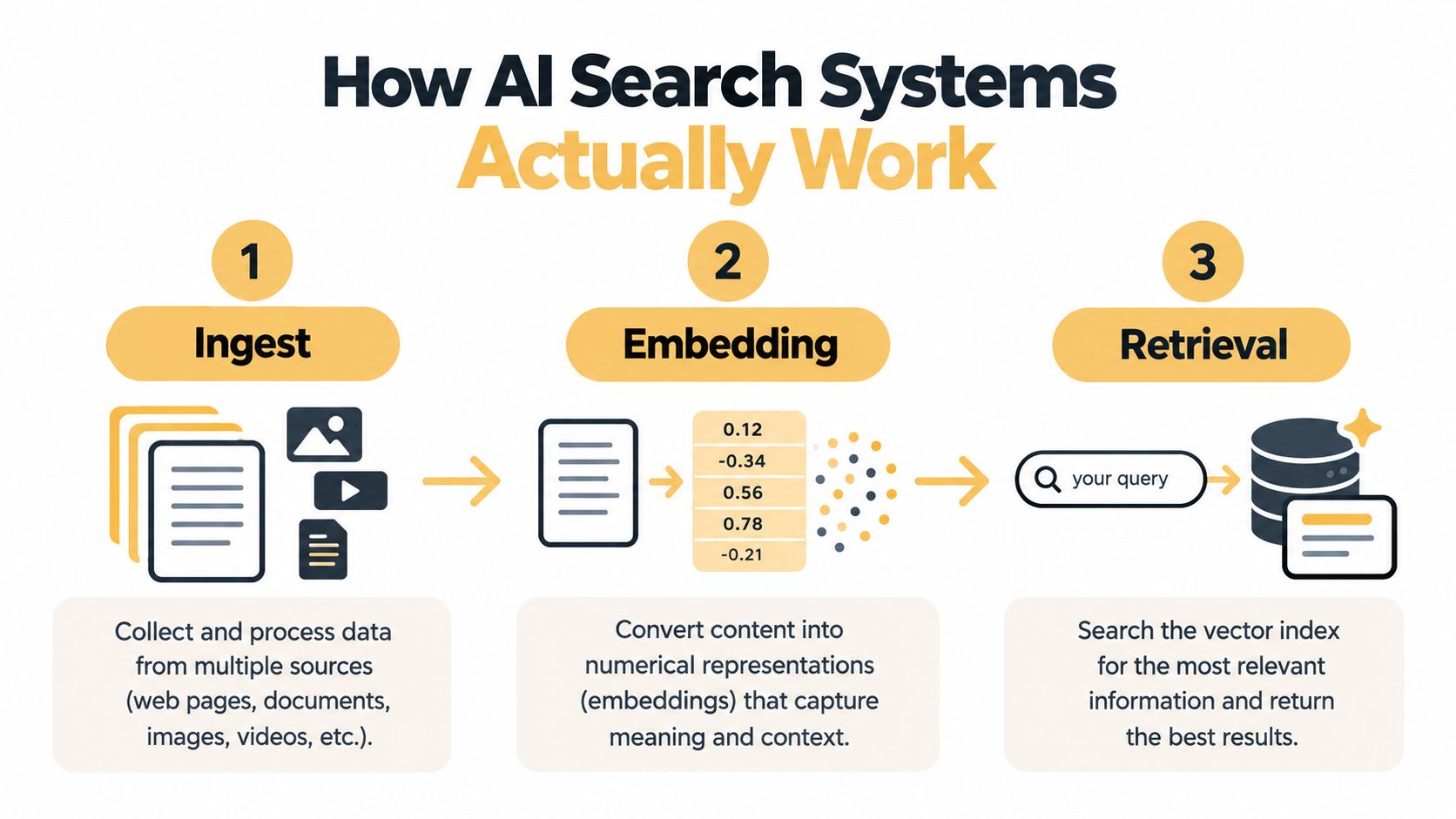
AI search is easier to understand when you separate the process into three jobs: finding relevant material, judging its usefulness, and generating an answer. The system doesn't just scan a page for the exact phrase a user typed. It tries to understand the meaning of the question and locate passages that address its components.
From a question to usable passages
Suppose a business owner asks, “Which accounting software works for a growing construction company that needs job costing and payroll support?” An AI search system may break that request into related searches involving construction accounting, job costing, payroll, business size, and implementation requirements. This process is often described as query expansion or query fan-out.
The system then retrieves candidate passages. Semantic search helps it connect related meanings, even when the wording doesn't match exactly. Vector-based methods represent text as mathematical relationships so that content about “project expense tracking” can remain relevant to a question using the phrase “job costing.”
Retrieval-augmented generation, commonly called RAG, adds a grounding step. Instead of relying only on what the language model already knows, the system retrieves current or relevant material and uses that material to form an answer. The quality of the final response depends heavily on whether the retrieved sources are accurate, specific, and relevant.
Why passage structure matters
A page can contain the right information and still be difficult for a retrieval system to use. If the answer is buried under vague headings, mixed with unrelated claims, or expressed through inconsistent terminology, the system has more work to do before it can cite the page confidently.
Independent retrieval research shows why this matters. In a controlled scientific question-answering benchmark, late-interaction ColBERT retrieval achieved a mean answer-quality score of 3.94 out of 5 and retrieved the correct paper in the top three results for 92.8% of problem queries and 94.8% of method queries. The retrieval study explains the benchmark and its results.
The business lesson is straightforward:
- Answer near the heading: Put the direct response close to the question the section addresses.
- Define entities clearly: State what a company, product, service, location, or organization is.
- Separate claims: Don't combine pricing, qualifications, process details, and guarantees into one dense paragraph.
- Use consistent language: Refer to the same service or location in the same precise way throughout the site.
Writers also need to maintain editorial judgment. If you're reviewing AI-assisted drafts, a guide to AI watermark removers for writers can be a useful resource for understanding how detection and editing workflows fit into content production. The important quality control remains human verification of facts, sources, and claims.
Technical decisions matter too. Teams evaluating how a search system should choose among retrieval methods can consult this comparison of algorithm selection approaches. The best content strategy can't compensate for pages that aren't accessible, indexed, or logically connected to the rest of the site.
From Keywords to Evidence
A keyword list tells you what people type. It doesn't tell an AI system why your business deserves to appear in the answer. That requires a stronger foundation of clear entities, verifiable claims, and passages that directly satisfy an intent.
Consider a fictional Omaha web agency page titled “Digital Growth Solutions.” The page mentions SEO, development, analytics, and consulting in broad marketing language. A buyer asks an AI system which Omaha agencies provide technical SEO for software companies, but the page doesn't clearly state the agency's location, service scope, client type, or process. The business may be relevant, yet its evidence is difficult to extract.
A better page would use a focused heading such as “Technical SEO for Software Companies” and open with a direct explanation of the service. It would identify the agency, specify the relevant service area, describe the work involved, and link to supporting pages. The copy would still sound natural, but each important passage would answer a recognizable buyer question.
Build the technical foundation first
Google's guidance makes an important point: AI features use the same core eligibility model as standard Search. That means optimization should begin with indexability, canonicalization, fast rendering, clear page purpose, and consistent entity information. Google's documentation explains the relationship between AI features and standard Search requirements.
Structured data can reinforce machine-readable facts about an organization, local business, product, article, or service. It must match the visible content, though, and it doesn't independently guarantee that a page will be selected as a citation.
For a small or midsized company, review these elements:
- Organization details: Keep the business name, description, contact information, and official identity consistent.
- LocalBusiness details: Expose location and service-area information in readable HTML, not only in hidden fields.
- Service architecture: Give major services focused pages instead of placing every offering on one general page.
- Internal relationships: Link related services, educational content, proof, and contact paths so both users and crawlers can understand the site.
- Visible evidence: Support expertise claims with authorship, dates, qualifications, examples, or reputable references where appropriate.
Replace stuffing with semantic coverage
Keyword stuffing is a poor substitute for relevance. A useful guide to semantic keyword research can help teams map the related concepts and questions surrounding a topic, but the final page should serve the reader rather than repeat variations mechanically.
A strong page might answer what the service does, who needs it, how implementation works, which constraints apply, and what the buyer should do next. Each answer should use precise language and stand on its own. This creates content that is easier for a retrieval system to match with a specific subquery and easier for a human buyer to trust.
Evidence beats volume: One precise, well-supported passage can be more useful than several paragraphs of broad promotional language.
Traditional SEO vs AI Search Optimization
AI search optimization doesn't replace SEO fundamentals. It changes what you add after those fundamentals are in place. The comparison below shows how the working objective shifts from earning a result position to becoming a reliable answer source.
| Traditional SEO focus | AI search optimization equivalent |
|---|---|
| Target a keyword and improve ranking | Cover the complete conversational intent and its likely follow-up questions |
| Optimize the page as a single document | Make individual passages clear, self-contained, and easy to retrieve |
| Earn a blue-link click | Earn accurate inclusion, citation, recommendation, or follow-up visibility |
| Repeat target terms naturally | Define entities and relationships with precise, consistent language |
| Use links mainly to support authority and discovery | Use reputable references and original evidence to make claims verifiable |
| Track rankings and organic sessions | Track citation presence, factual accuracy, qualified visits, and conversions |
Academic GEO research reported that tested techniques increased visibility in generative-engine responses by as much as 40% across a 10,000-query benchmark. Adding quotations produced gains of up to 41%, statistics produced gains of roughly 30% to 40%, and source citations produced gains of about 30%. Keyword stuffing performed worse than taking no optimization action. The available evidence summarizes these experimental findings.
These results don't mean every page should be filled with quotations or statistics. Unsupported numbers can reduce trust, and a quotation without context may not answer the user's question. The useful principle is to include specific, attributable evidence when it clearly clarifies a claim.
SEO teams should preserve crawlable pages, sensible architecture, internal linking, and strong user experience. They should add answer-ready headings, explicit definitions, source citations, and content that addresses the full problem rather than only the shortest version of the query.
The workflow also needs a different review question. Instead of asking only whether a page contains the target phrase, ask whether an independent system could extract the correct answer and identify the business without relying on assumptions.
The Citation Dilemma and Business Value
A citation is a visibility outcome, not a revenue outcome. An AI system can mention your business accurately, yet the user may never visit your site, call your team, submit a form, or purchase a product.
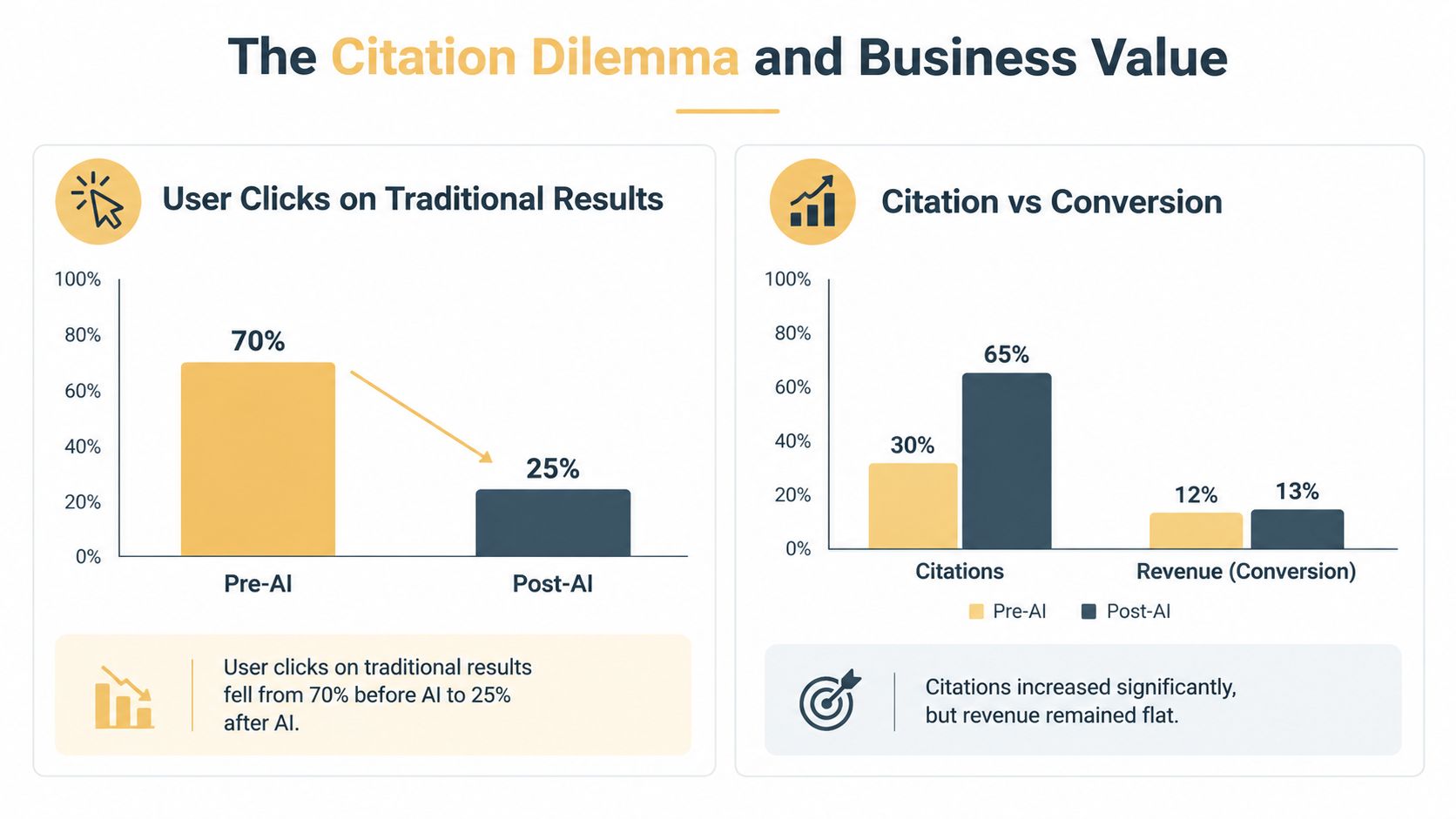
Evidence summarized from a Pew Research Center study shows the tension. Users clicked a traditional result in only 8% of Google visits when an AI summary appeared, compared with 15% when no summary appeared. 26% ended their search after seeing an AI-generated summary. The study summary provides the reported search behavior.
That means a business can become more visible inside an answer while receiving fewer conventional visits. The old measurement model, where more organic sessions represent nearly all progress, can't capture the full commercial picture.
Separate visibility from value
A practical measurement framework has three layers:
- Answer visibility: Does the business appear for branded, category, comparison, local-intent, and problem-focused prompts? Is the description accurate? Which sources does the system cite?
- Qualified response: Do AI-exposed users visit the site, search for the brand, call, request a quote, or begin a purchase journey?
- Commercial result: Do those interactions produce revenue, booked work, completed orders, or another defined business outcome?
A local company should compare citation presence with branded search activity, phone calls, form submissions, and assisted conversions. An ecommerce team should examine product discovery, returning visits, direct traffic, and transactions associated with AI-exposed research. The exact dashboard will vary, but the principle is consistent: measure what happens after visibility, not visibility alone.
Accurate business profiles and consistent third-party references can support this process. Teams reviewing their off-site presence may find trust signals through directories useful as part of a broader effort to keep public business information reliable and corroborated.
The strategic response isn't to abandon traffic. It's to build conversion paths that offer something an answer summary can't fully deliver, such as a consultation, personalized recommendation, interactive tool, proprietary assessment, or clear next step. A citation may create awareness, but the business still needs a distinctive reason for the buyer to continue.
For a more detailed operating framework, review this guide to optimizing for AI Overviews. It should be treated as part of a measurement program, not as a replacement for one.
Practical Steps for Implementation
Small businesses don't need to rebuild every page at once. Start with the pages and questions closest to revenue, then improve the evidence that answer systems need to represent the company correctly.
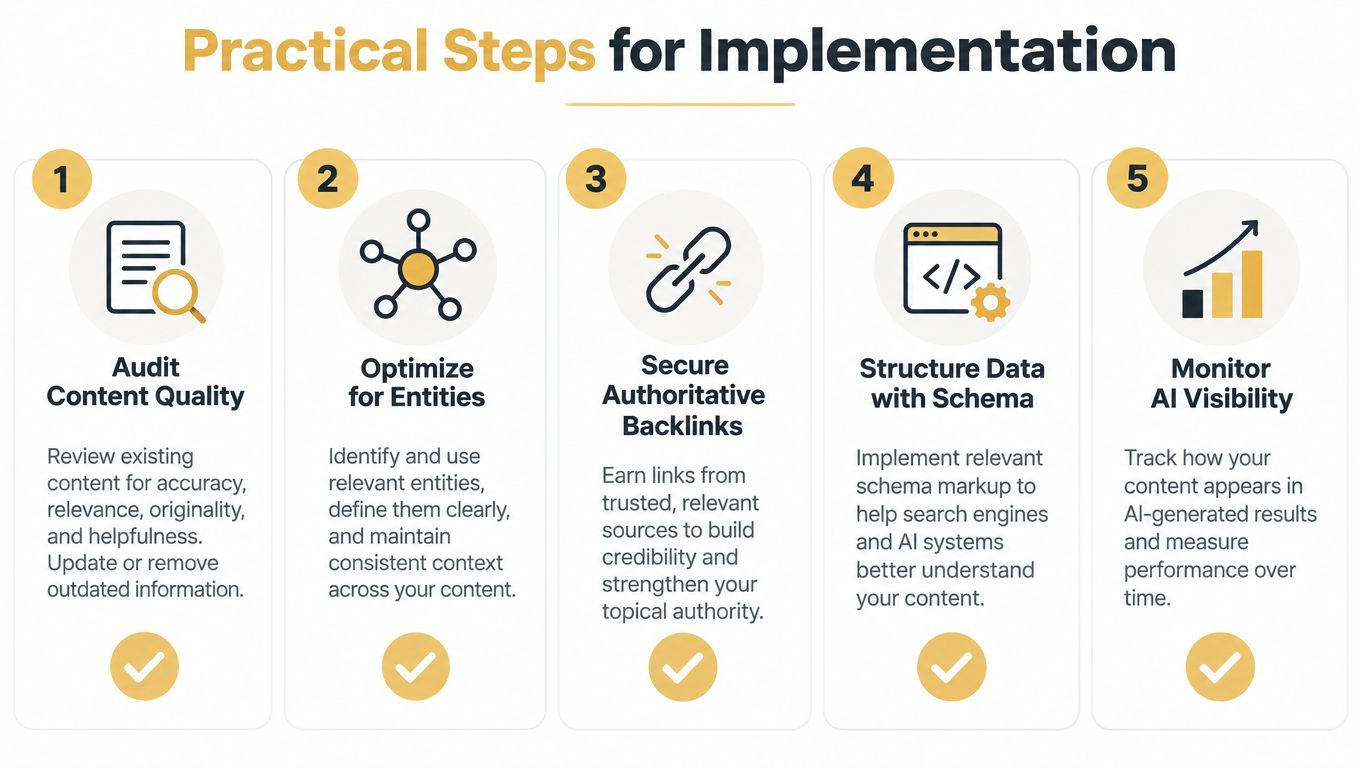
A workable starting sequence
-
Audit the pages that matter commercially. Choose service, location, product, comparison, and contact pages. Check whether each page has a clear purpose, a direct answer, accessible HTML, accurate dates, and supporting evidence. Note claims that sound persuasive but can't be verified.
-
Map real buyer prompts. Write the questions customers ask before contacting you. Include pricing considerations, implementation constraints, integrations, availability, service areas, comparisons, and common objections. Test the same prompts across more than one AI search system and record which businesses and sources appear.
-
Improve entity clarity. State who the company is, what it offers, where it operates, who it serves, and how its services differ. Keep those facts consistent across the website, business profiles, directories, and relevant third-party pages.
-
Make important passages answer-ready. Use descriptive headings and place the direct answer near the top of each section. Explain one main relationship at a time. Add reputable citations where a claim needs support, and use structured data only when it accurately reflects visible content.
-
Monitor representation and outcomes. Track whether systems cite your pages, describe the business correctly, and include the right services or locations. Pair those observations with branded searches, qualified referrals, calls, forms, purchases, and other commercial signals.
A useful audit doesn't stop at “Are we mentioned?” It asks whether the right page is cited, whether the statement is accurate, whether competitors are being preferred, and whether the resulting exposure contributes to a meaningful buyer action. Citation eligibility is an ongoing practice because content, competitors, and search interfaces change.
Start with one topic cluster: Improve one important service or product area, test its buyer questions, and use what you learn to shape the next cluster.
Up North Media offers an AEO Audit that tests real buyer queries across major AI search systems and evaluates crawler accessibility, schema, site structure, answer-ready formatting, content gaps, and off-site entity signals. For help turning those findings into a practical SEO and AI search plan, visit Up North Media and request a consultation focused on your highest-value search questions.