

Most guides treat server-side rendering vs client-side rendering as a contest with one winner. That advice is convenient, but it fails the moment a real business site contains a marketing page, a product catalog, an account area, and a personalized dashboard. Those routes don't have the same SEO requirements, payload size, freshness needs, or interaction model.
The practical answer is route-specific. Measure Largest Contentful Paint, Time to Interactive, crawlable HTML, JavaScript execution, cache behavior, and server capacity for each important route. Controlled testing shows that SSR is more resilient on slower connections, while CSR can remain competitive on fast networks and is often a better fit for authenticated, app-like workflows. A hybrid architecture usually gives businesses the strongest result because it assigns each route the rendering model it needs.
Why the SSR vs CSR Question Is the Wrong Question
The popular question is, “Should we use SSR or CSR?” The useful question is, “What must this route deliver before JavaScript finishes, and who should pay the rendering cost?”
A local-service landing page needs its headline, service details, location signals, calls to action, and internal links available quickly and reliably. A logged-in dashboard has a different job. It needs secure data, responsive controls, filtering, and sustained interaction after the user signs in. Applying one rendering model to both routes creates an avoidable compromise.
A 2025 academic study found that SSR delivered a more consistent LCP experience under throttled network conditions, while CSR showed greater variation and severe degradation on slower connections. Under ideal, unthrottled conditions, CSR could produce slightly better average LCP, which is exactly why the blanket claim that SSR is always faster is wrong. The comparative thesis documents these conditions and results.
Practical rule: Choose the rendering model according to the route's first-load obligation, not according to the framework your team already knows.
Three tests settle the decision.
- Real network performance: Does the primary content appear reliably on constrained mobile connections, not just a developer laptop?
- Search accessibility: Can crawlers receive meaningful content, links, metadata, and page identity without depending on fragile client execution?
- Long-run economics: Does the route consume more origin CPU and memory than its business value justifies, or does it push too much work onto visitors' devices?
This framing also changes how you evaluate architecture proposals. “We use Next.js” tells you almost nothing by itself. Next.js can serve statically generated pages, dynamically render routes, stream server output, or deliver a client-heavy application. The route configuration matters more than the logo on the technology diagram.
For most business websites, the first public response should be HTML-first. That doesn't mean every component must be rendered on the server. It means the page's essential commercial and informational content shouldn't wait behind a large JavaScript startup sequence. Private workflows can then become progressively more client-driven once the user has entered the application.
How Each Rendering Model Actually Works
Think of rendering as deciding where and when HTML is produced.
With server-side rendering, the browser requests a route, the server fetches the required data, builds substantially complete HTML, and sends that HTML to the browser. A local plumber's service page can arrive with its heading, copy, service areas, and links already present. The browser can paint meaningful content before it downloads and executes the application's full JavaScript bundle.
With client-side rendering, the server initially returns a smaller document, often an application shell. The browser downloads JavaScript, executes it, fetches data, and constructs much of the visible interface. That model works well for a dashboard where the user expects a rich application, but it creates more startup work before a public page becomes useful.
Static site generation, or SSG, renders HTML ahead of the request, usually during a build. A documentation page or stable service page can be prepared once and served as a file through a cache or CDN. It isn't request-time SSR, but the visitor still receives complete HTML.
Incremental static regeneration, or ISR, extends that approach. The system serves a generated page and refreshes it according to an invalidation or revalidation strategy. That makes ISR useful for catalogs and editorial pages where content changes, but not necessarily on every request.
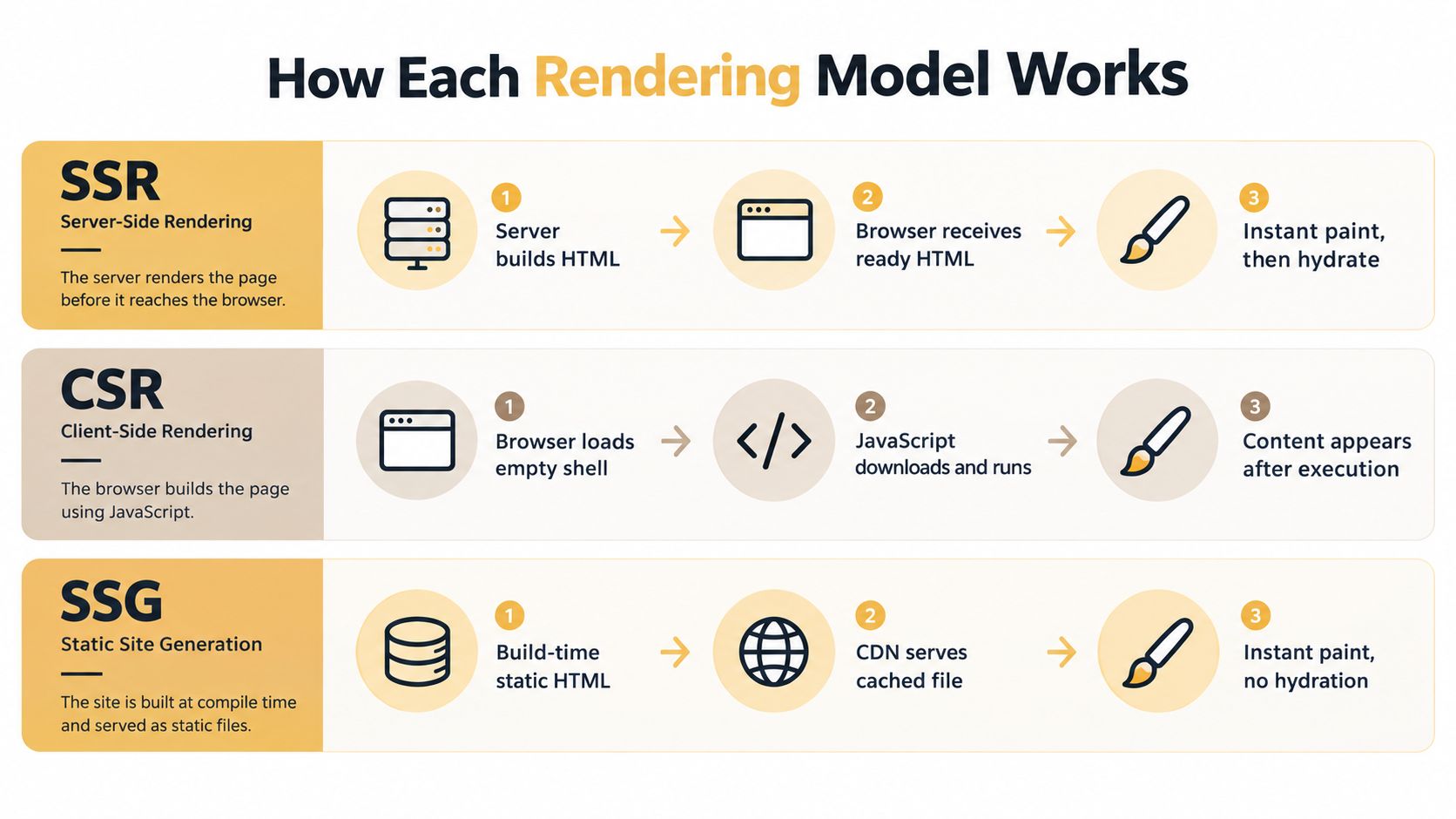
Hydration is a second delivery phase
An SSR page can still need JavaScript. Hydration attaches client-side behavior to HTML that already arrived from the server. A product page may display its title, description, images, and purchase information immediately, then hydrate a quantity selector, image gallery, or filtering control.
That distinction matters because “the page rendered on the server” doesn't mean “the page is fully interactive immediately.” A route can have excellent initial HTML and still suffer from slow interaction if hydration requires too much JavaScript execution. Measure both the first meaningful content and the moment the important controls respond.
A single-page application and a rendering model aren't the same thing. A site can use server-rendered entry pages with client-side navigation afterward. If you're comparing application structures as well as delivery methods, this overview of single-page applications versus multi-page applications provides useful context.
Finally, rendering decisions should sit inside broader system architecture design principles. Cache boundaries, data ownership, failure behavior, authorization, and deployment operations often matter as much as the initial HTML strategy.
Five Criteria That Decide the Winner
A blanket SSR-or-CSR verdict is poor engineering. Choose rendering route by route, using measured user experience, crawl requirements, server capacity, and the value of post-load interaction. The right architecture may combine models across one site.
LCP under representative conditions
Largest Contentful Paint records when the main visible content arrives. Controlled testing found that, with bandwidth reduced to slow 3G, SSR cut LCP by more than 10 seconds compared with CSR. The same study found SSR faster for JavaScript-related measurements across tested network speeds and CPU-throttling conditions. Review the measured SSR and CSR comparison.
Run tests on representative mobile hardware, cold and warm caches, and the routes producing the most organic and paid traffic. An unthrottled desktop result cannot guide a mobile acquisition route.
Time to Interactive
LCP shows when content appears. TTI shows when the interface becomes usable, while current responsiveness metrics and key interactions add necessary context. A page can paint quickly while JavaScript still blocks a filter, calculator, or checkout control.
Measure the first useful content and the response of the controls that affect conversion. If a route displays well but responds late, its delivery model has solved only half the problem.
Crawlable content
Public acquisition routes should return the content that defines the page. SSR and SSG put that material in the initial response. CSR can serve the same purpose, but crawlers and other consumers depend on JavaScript execution, data requests, and successful DOM construction.
Inspect both raw HTML and the completed DOM. Teams improving application visibility can also use this guide to improve SEO for web applications.
Server cost and capacity
SSR shifts rendering work to the origin. That can strengthen first-load performance, but uncached or dynamic requests may require server-side data access and HTML generation. CSR shifts more work to the visitor's device and can reduce repeated rendering after the application loads.
Measure server CPU, memory, concurrent requests, cache-hit behavior, and response time. Lower origin work is not automatically a better customer experience, especially when it leaves users waiting for scripts or data.
Ongoing interactivity
CSR fits dashboards, configurators, editors, and workflow tools where users perform many actions after startup. Client-side state and route transitions can make those sessions efficient. SSR fits pages whose first response carries commercial or informational value, including public landing pages and product routes.
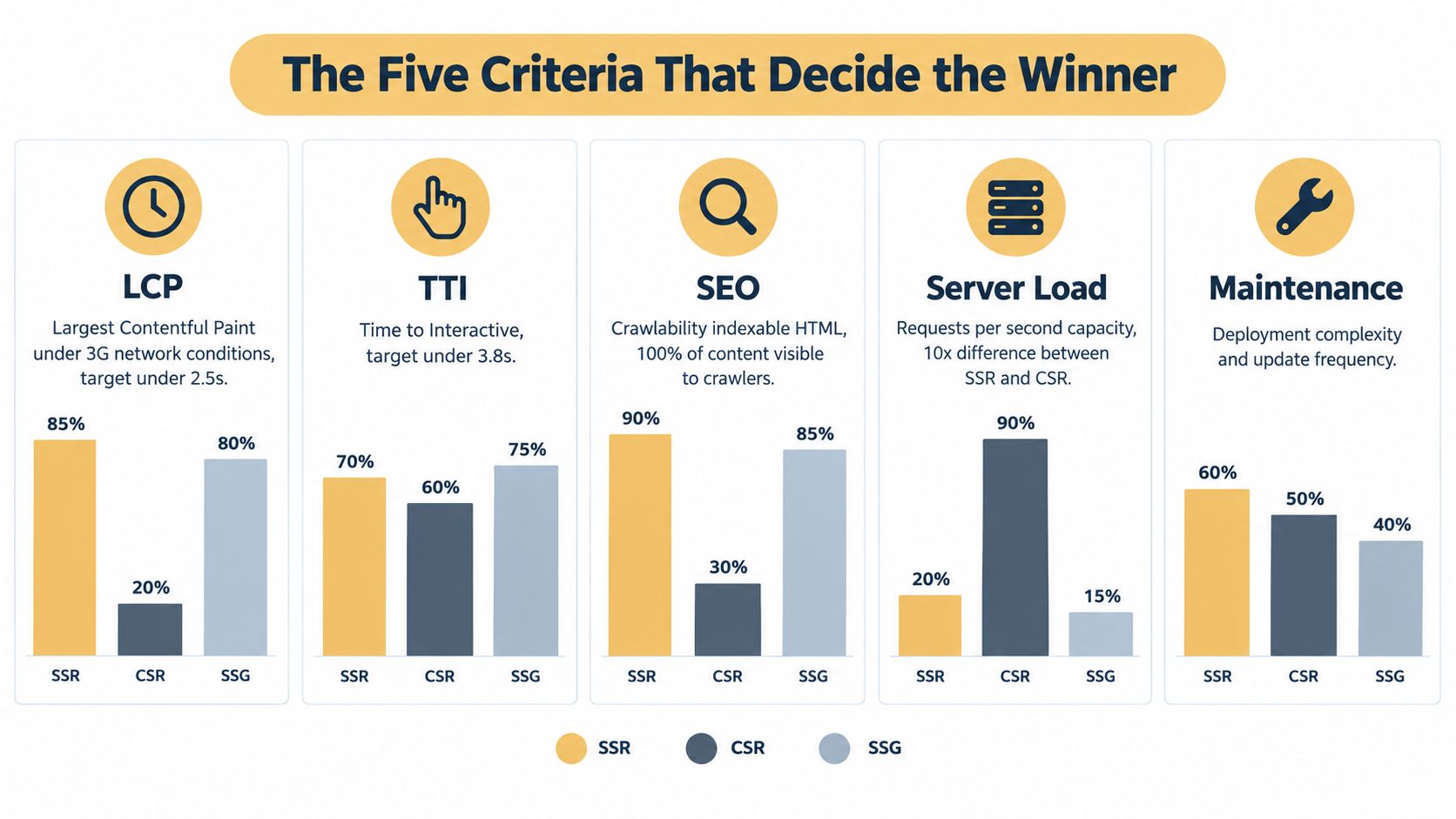
Score each route against these five criteria, then assign SSR, CSR, SSG, or a hybrid approach. That route-aware decision connects Core Web Vitals and server cost to business risk instead of treating framework preference as architecture.
SSR vs CSR Side by Side on Real Workloads
The right verdict is route-specific. SSR usually wins when a page must deliver substantial first-load content, expose dependable HTML to crawlers, or remain usable on slower networks. CSR fits better when the page is simple, access is authenticated, and sustained interaction matters more than search visibility.
Page-level Next.js results show why averages are poor architecture guidance. On an authentication page, CSR took 422 milliseconds, compared with 274 milliseconds for SSR, making CSR approximately 54% slower in that test. On a profile page, CSR took 608 milliseconds versus 706 milliseconds for SSR, reversing the result. On the main page, CSR took 1,350 milliseconds, while SSR took 1,525 milliseconds. The comparative study reports these mixed page-level outcomes.
These results support a route-by-route decision. Page complexity, payload size, data dependencies, device conditions, and server processing can change which model performs better. The same study cited under LCP also reports page-level Next.js timings, so a framework-wide verdict would hide the differences that matter.
| Criterion | SSR | CSR |
|---|---|---|
| Initial content | Sends substantially complete HTML | Sends a smaller shell before JavaScript builds content |
| Slow networks | More consistent first-load behavior | Can degrade sharply while scripts and data load |
| Crawlability | Essential content is available in the response | Important content depends more heavily on client execution |
| Post-login interaction | May require hydration and additional client behavior | Strong fit for persistent application interaction |
| Origin workload | Server performs rendering work | Browser performs more rendering work |
| Best default | Public, content-heavy, conversion-critical routes | Authenticated, app-like workflows |
A separate Blazor benchmark measured initial-load times of approximately 1.2 seconds for SSR versus 2.5 seconds for CSR, with TTI of about 1.5 seconds versus 3.0 seconds. CSR's WebAssembly and runtime startup delayed usability, while the same evaluation found better scalability for CSR because more rendering work moved to the user's device. See the Blazor benchmark methodology and results.
Payload size can change the outcome again. In a photo-gallery application tested across payloads from 498 kB to 26 MB, SSR reduced TTI by 62.3% and LCP by 58.7%, with the advantage becoming clearer as data volume increased. CSR performed better for First Contentful Paint and Speed Index with smaller datasets. The photo-gallery research shows why payload size changes the verdict.
Choose SSR for public routes where first impressions, crawlable content, and conversion carry weight. Choose CSR for authenticated tools with long interactive sessions. For most business sites, assign the model per route, then validate the choice against Core Web Vitals and server capacity.
A one-second interaction delay creates a poor first impression on a public landing page. On a dashboard used for a sustained session, the same trade-off may be acceptable if it produces a more capable interface and lowers repeated origin work.
Implementation Patterns and the Hybrid Reality
The most practical architecture is rarely pure SSR or pure CSR. It usually combines several delivery modes, with each route assigned according to freshness, search value, payload, and interaction depth.
Pure request-time SSR
Frameworks such as Next.js can render a route on every request, including dynamic data and personalized output. This is useful when the response must reflect current request context, but it also creates origin work and makes caching more demanding. If you choose it, define cache behavior, invalidation, error handling, and server capacity before launch.
Next.js App Router patterns can stream HTML progressively, while traditional Express templates provide direct control over markup. Both can deliver HTML-first pages, but neither removes the need to measure server response time and browser execution separately.
CSR for application workflows
A Vite and React Router application can send a client shell, load route code, fetch API data, and manage state in the browser. Lazy loading can keep the initial JavaScript payload smaller, but it doesn't make a public route automatically crawlable or fast. The route still depends on successful script execution and data retrieval.
CSR is a sensible choice for private tools, internal screens, and highly interactive workflows. It becomes a poor default when the first response must sell, explain, rank, or establish trust.
SSG, ISR, and selective hydration
Stable editorial pages can use SSG. Catalog routes can use ISR when a controlled stale window is acceptable and updates have a reliable invalidation path. Selective hydration limits client work to the components that need it, rather than turning the entire document into a JavaScript application.
The failure mode teams miss is partial interactivity. An SSR page may arrive with complete content but still require hydration for a key form, filter, or purchase action. Test the page with JavaScript delayed, blocked, or failing, then test the interaction after the bundle arrives.
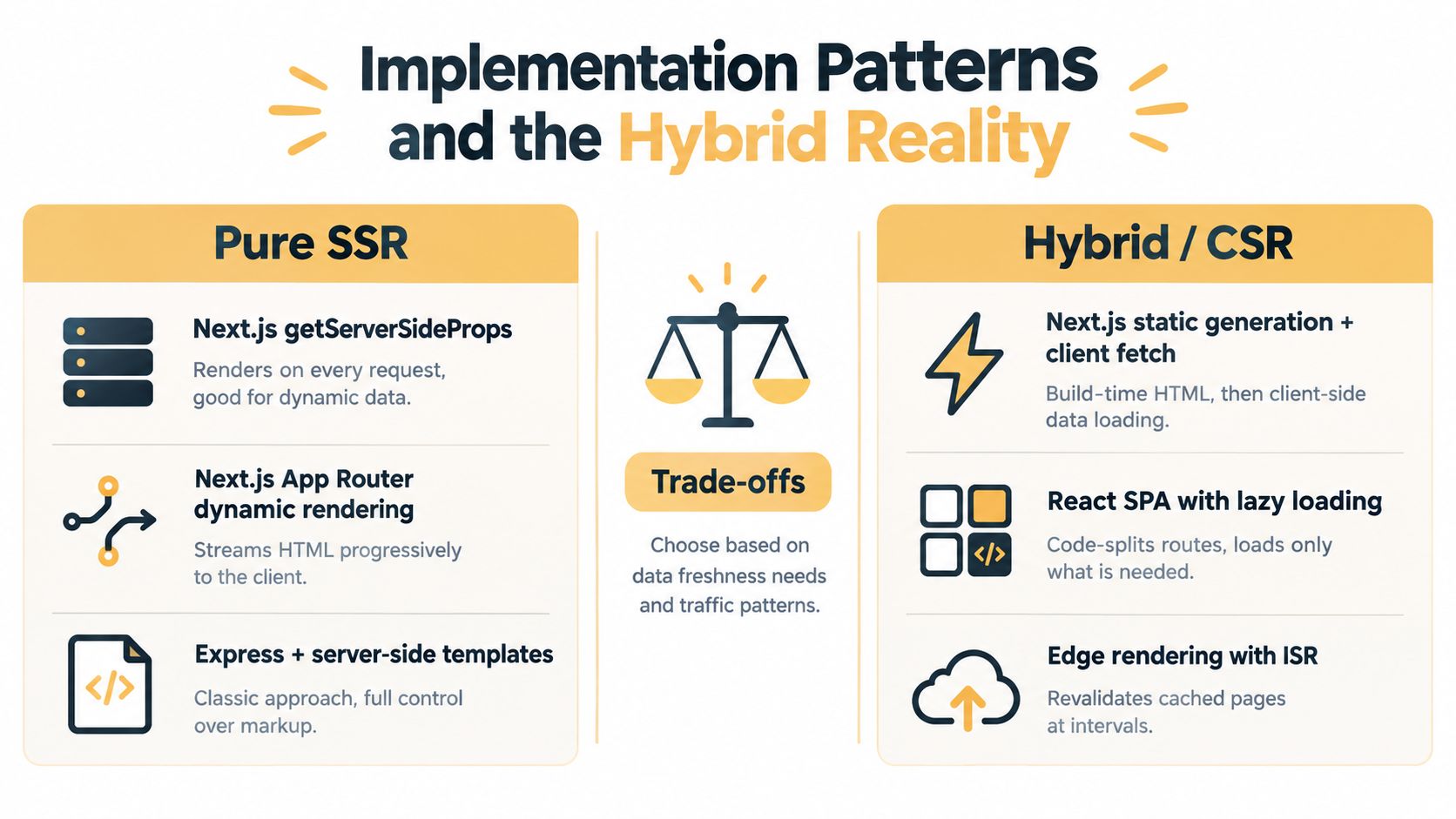
A 2025 study comparing hybrid rendering, streaming SSR, selective hydration, and edge-based rendering concluded that route-aware hybrid strategies are the most sustainable option for performance-critical, content-heavy systems. Read the study on hybrid rendering approaches.
Use the framework that supports the required route behavior, not the framework that makes the architecture diagram look simplest. This practical guide to web application development frameworks can help teams compare the implementation layer, but your route requirements should make the final call.
Matching Rendering to Omaha Business Scenarios
An Omaha service company, an e-commerce retailer, and a SaaS business shouldn't ship the same rendering strategy. Their customers arrive with different expectations, and each route carries a different commercial obligation.

Local service company
A plumber's service page, emergency repair page, or location page should use SSG, ISR, or SSR depending on how often content changes. The page should deliver its service explanation, local relevance, contact path, and internal links in initial HTML. There is little value in making a prospective customer wait for a client application to construct basic sales content.
Verdict: Pre-render stable pages. Use ISR or SSR where campaign, availability, or location data requires controlled freshness. Keep the booking widget interactive, but don't make the entire page depend on it.
E-commerce retailer
An e-commerce catalog needs a more careful split. Category and product pages are public, indexable, and often content-heavy, so SSR or ISR is usually the right starting point. The system must also keep prices, stock messaging, structured data, and visible product information aligned.
A product configurator, comparison drawer, cart, and checkout can use CSR after the initial product content arrives. That gives shoppers an HTML-first entry point without forcing every interaction through request-time page rendering.
Verdict: Use ISR for catalog routes when its freshness rules fit the business. Use SSR for data that must reflect the request immediately. Keep cart and configuration state client-driven where that reduces friction.
SaaS dashboard
A logged-in dashboard usually doesn't need search visibility. It benefits more from client-side state, responsive navigation, filters, charts, and sustained interaction. The initial shell can still be server-delivered for authentication and routing, but most dashboard data and controls can remain CSR.
Verdict: Use CSR for authenticated application screens unless measured startup costs create a real usability problem. Keep public documentation, pricing, comparison, and acquisition pages on an HTML-first path.
These scenarios demonstrate why a whole-site architecture verdict is too blunt. The route that wins a search impression isn't the route that manages an authenticated workflow.
The Route-Aware Recommendation and Your Next Step
Stop asking whether SSR beats CSR globally. Ask these questions for every important route:
- Is the route public and indexable? If yes, deliver its essential content in HTML.
- Does the content need request-time personalization or freshness? If yes, evaluate SSR and its cache strategy.
- Can the route be generated ahead of time? If yes, prefer SSG or ISR where the update path is reliable.
- Does the user spend a sustained session interacting with the interface? If yes, CSR may be the better fit after the entry response.
- What happens on a constrained device or network? Test it instead of assuming desktop averages represent customers.
When LCP regularly exceeds 2.5 seconds in real-world or throttled testing, SSR is the safer default for publishing, local-service landing pages, and e-commerce category and product pages. CSR remains appropriate for authenticated, app-like interfaces where search visibility is secondary. The 2025 research supports this route-level threshold.
The clear recommendation is hybrid and route-aware. Pre-render what earns attention, trust, and search traffic. Use client rendering where sustained interaction justifies the browser work. Measure LCP, TTI, JavaScript execution, cache behavior, and origin capacity before standardizing the pattern.
Up North Media helps Omaha businesses plan and build custom web applications, technical SEO strategies, and AI-enabled workflows around real route requirements. Visit Up North Media to request a consultation and turn your SSR, CSR, or hybrid rendering decision into an implementation plan.