

If you're still trying to answer site worth alexa by hunting for an old rank badge or a legacy valuation widget, you're starting from the wrong premise.
The popular advice used to be simple: find the rank, compare it to competitors, and treat that number like a shortcut to website value. That was convenient. It was also fragile. A business doesn't become valuable because a third-party score says it's popular. It becomes valuable when it attracts the right visitors, turns attention into revenue, and does that in a way that's defensible over time.
That change is good news for business owners.
The end of Alexa Rank forced a healthier conversation. Instead of asking, "What number am I?" smart owners now ask better questions. How much qualified traffic does the site attract? How dependent is revenue on one channel? Does the brand earn direct visits? Can the business convert traffic without burning margin? Those answers are harder to fake, more useful in a sale, and far more actionable in day-to-day marketing.
The End of an Era for Website Value
The death of Alexa Rank was good for serious business owners.
"Site worth alexa" still shows up in searches because the habit lasted for years. The metric itself is gone. Amazon shut down Alexa Internet in December 2022, and with it went one of the web's most overused shortcuts for judging a site's value.

That change exposed a problem that had been sitting in plain sight. Owners, buyers, and even agencies often treated one popularity score as if it reflected business strength. It never did that job well. It offered a fast signal, but fast and useful are not the same thing, especially if you're deciding how much a digital asset is worth.
For a long time, the appeal was obvious. One number made comparison easy. A seller could point to it in a pitch. A buyer could use it as a quick screen. A marketing team could show movement without explaining traffic quality, conversion rate, revenue mix, or retention. That convenience came with a cost. It pushed attention toward visibility and away from performance.
Its disappearance helps because it forces a better standard.
A modern website should be valued like an operating asset, not like a popularity contest. The questions that matter now are more demanding, but they lead to decisions you can use:
- Traffic quality: Are the visitors likely to buy, call, book, or become qualified leads?
- Revenue durability: Does the site produce dependable revenue, or does performance swing with one channel or campaign?
- Acquisition mix: Is growth spread across organic search, direct, email, paid media, referrals, and branded demand?
- Operational strength: Does the site have solid content, clean analytics, healthy technical performance, and systems that support scale?
At Up North Media, this is the shift we want owners to make. Stop asking for a single score that flatters the site. Start measuring the parts that affect sale value, cash flow, and future growth.
Practical rule: If a metric can't guide an investment decision next month, it should not shape your valuation this month.
That is the upside of Alexa's exit. Businesses have less reason to chase a dead benchmark and more reason to use numbers tied to ROI. True value is found there.
What Alexa Rank Was and Why It Mattered
Alexa Rank was a popularity score. For years, it gave owners, brokers, advertisers, and marketing teams a shared reference point for how large a site appeared relative to others on the web.
The system did not use your first-party analytics. It estimated traffic from Alexa's own data collection methods and rolled that into a comparative rank. Lower numbers suggested stronger relative traffic. Higher numbers suggested less reach.
That difference between measured performance and estimated popularity is the part many business owners missed.
Alexa worked well enough for fast comparisons. If you were reviewing a batch of publishing sites, affiliate projects, or ad-supported properties, the rank gave you a quick sense of which domains seemed to attract more attention. It reduced a messy question into a number people could reference in a call, a pitch deck, or a listing.
How the rank worked in practice
The rank became useful because it was public, simple, and widely recognized. You did not need backend access to a site's analytics account to form an opinion. You could look up the domain and get a rough benchmark.
Teams used it in a few common ways:
- Competitive scanning: A quick check on whether another site appeared larger in broad traffic terms.
- Ad sales: A supporting metric in conversations about audience size.
- Website sales: A shorthand signal buyers and brokers could use during early screening.
- SEO reporting: A loose indicator that a domain's visibility might be rising or falling over time.
None of that made Alexa precise. It made Alexa convenient.
Why business owners cared
Convenience has real market value. A buyer sorting through dozens of sites wants a filter. An advertiser wants an easy credibility check. A founder wants a signal that sounds objective without opening analytics, CRM reports, or revenue history.
Alexa served that purpose for a long time because the market accepted a single public score as a proxy for attention.
That mattered because attention often gets mistaken for value. A stronger rank could make a site look more important, more established, or more saleable, even if the underlying business was weak. In some cases, that shortcut helped people make faster decisions. In other cases, it let weak assets borrow credibility from a popularity metric that was never built to measure lead quality, revenue strength, or customer fit.
That is why Alexa Rank mattered. It shaped perception. And for a long stretch of internet history, perception influenced price.
Why Alexa-based valuations are a trap in 2026
Alexa did more than disappear. It left behind a bad habit. Business owners still ask for a single public score that turns a website into a price tag, and that shortcut creates bad decisions.
The problem is not nostalgia. The problem is using a popularity proxy as if it measures business strength.
The old shortcut was weak even before Alexa shut down
Alexa rank looked objective because it was public and easy to compare. In practice, it was still an estimate built from limited outside signals. As noted earlier, that approach carried sampling bias from the start, which means the score could drift away from the audience that buys from you.
That matters in valuation. A regional service company, a B2B manufacturer, and a content publisher can all have very different economics with similar-looking traffic patterns. One may have fewer visits and far stronger revenue per session. Another may pull in large traffic numbers that never turn into qualified leads.
A valuation method that ignores that difference is not conservative. It is careless.
Popularity does not equal asset value
Website value comes from cash flow potential, lead quality, channel durability, and how much of the audience the business controls. Rank does not tell you any of that.
A site can look busy and still be fragile. We see this often in audits. A business depends on one shaky traffic source, has poor conversion paths, and owns very little first-party data. On paper, the site looks active. In a sale or growth plan, it is worth less than the owner expects.
By contrast, a lower-traffic site with strong branded search, repeat customers, healthy margins, and reliable organic visibility is usually the better asset.
That is why modern valuation starts with business performance metrics, not vanity metrics. If your team needs a better framework, this guide to measuring digital marketing performance is a stronger starting point than any old rank-based estimate.
Rank-inspired valuation tools still cause confusion
A lot of "website worth" tools kept the Alexa mindset alive after Alexa itself went away. They swap in rough traffic estimates, domain-level authority metrics, or visibility snapshots, then output a dollar figure that looks precise enough to trust.
Treat those tools as screening tools, not valuation models.
They can be useful for quick market context. They can help with early competitor research. They can even flag whether a site is growing or fading in search, especially when paired with SERP tracking for digital marketers. What they cannot do is tell you what a buyer should pay, what an investor should believe, or which part of the site is creating enterprise value.
The wrong metric does not just misprice a site. It points the owner toward the wrong fixes.
Now, any valuation model that starts with one popularity proxy and ends with a dollar figure is too thin to trust. A useful valuation has to connect traffic quality, conversions, revenue, retention, and channel risk to the business goals behind the site. That is a better standard than Alexa ever gave the market, and business owners are better off because of it.
The New Playbook for Modern Website Analysis
A modern website analysis stack does what Alexa never could. It separates owned truth from market estimation.
Your own site should be measured with first-party data. Competitors should be evaluated with specialized third-party tools. Those are different jobs, and combining them into one score is what caused so much confusion in the first place.
Use the right tool for the right question
If you're valuing your own site, start with the systems that record actual business performance. If you're sizing up a competitor, use platforms that estimate visibility, backlinks, and market share from outside data.
After Alexa disappeared, the market moved toward tools with stronger alignment to modern search and traffic analysis. Historical comparisons noted that Semrush Traffic Analytics has up to a 90% correlation with Alexa's historical data, and that Ahrefs URL Rating above 40 often approximates a former Alexa rank below 100,000, based on the cited overview of post-Alexa alternatives.
That doesn't mean "replace Alexa with Semrush" and move on. It means use better instruments for distinct tasks.
Modern website analysis tools compared
| Tool | Primary Use Case | Data Source | Best For |
|---|---|---|---|
| Google Analytics | First-party performance measurement | Your site's actual user and conversion data | Revenue analysis, conversion behavior, channel contribution |
| Ahrefs | Search visibility and backlink analysis | External index of links and SEO signals | Evaluating authority, content opportunities, backlink risk |
| Semrush | Broad competitive marketing analysis | External clickstream and search datasets | Traffic estimation, keyword gaps, market visibility |
| SimilarWeb | Market-level traffic estimation | External panel and modeling data | Topline competitor traffic patterns and channel mix |
What works and what doesn't
What works is a blended view:
- Google Analytics for what your users do.
- Ahrefs for backlink profile and organic authority.
- Semrush for visibility trends and competitive keyword gaps.
- SimilarWeb for directional market traffic context.
What doesn't work is using any one of those as a standalone answer to value.
For businesses that care about organic growth, rank movement still matters, but it should be tracked where it connects to outcomes. If you want a clear primer on SERP tracking for digital marketers, that framework helps separate vanity rankings from rankings that influence pipeline and revenue.
A practical reporting setup should also connect traffic metrics to business metrics. That's where a disciplined performance framework matters more than a headline score. This guide on measuring digital marketing performance is a good model for building that kind of dashboard.
Better analysis doesn't give you one magic number. It gives you enough clarity to make better decisions.
How to Calculate Your Website's Real Worth
A website is worth what it can reliably produce for the business, not what an old public score once suggested.
That shift is useful. Once Alexa Rank stopped serving as a shortcut, owners had to ask better questions. How much profit does the site generate? How dependent is that profit on a few fragile inputs? How transferable is the system if someone else takes over? Those questions lead to a valuation you can defend in a sale, financing conversation, or budget review.
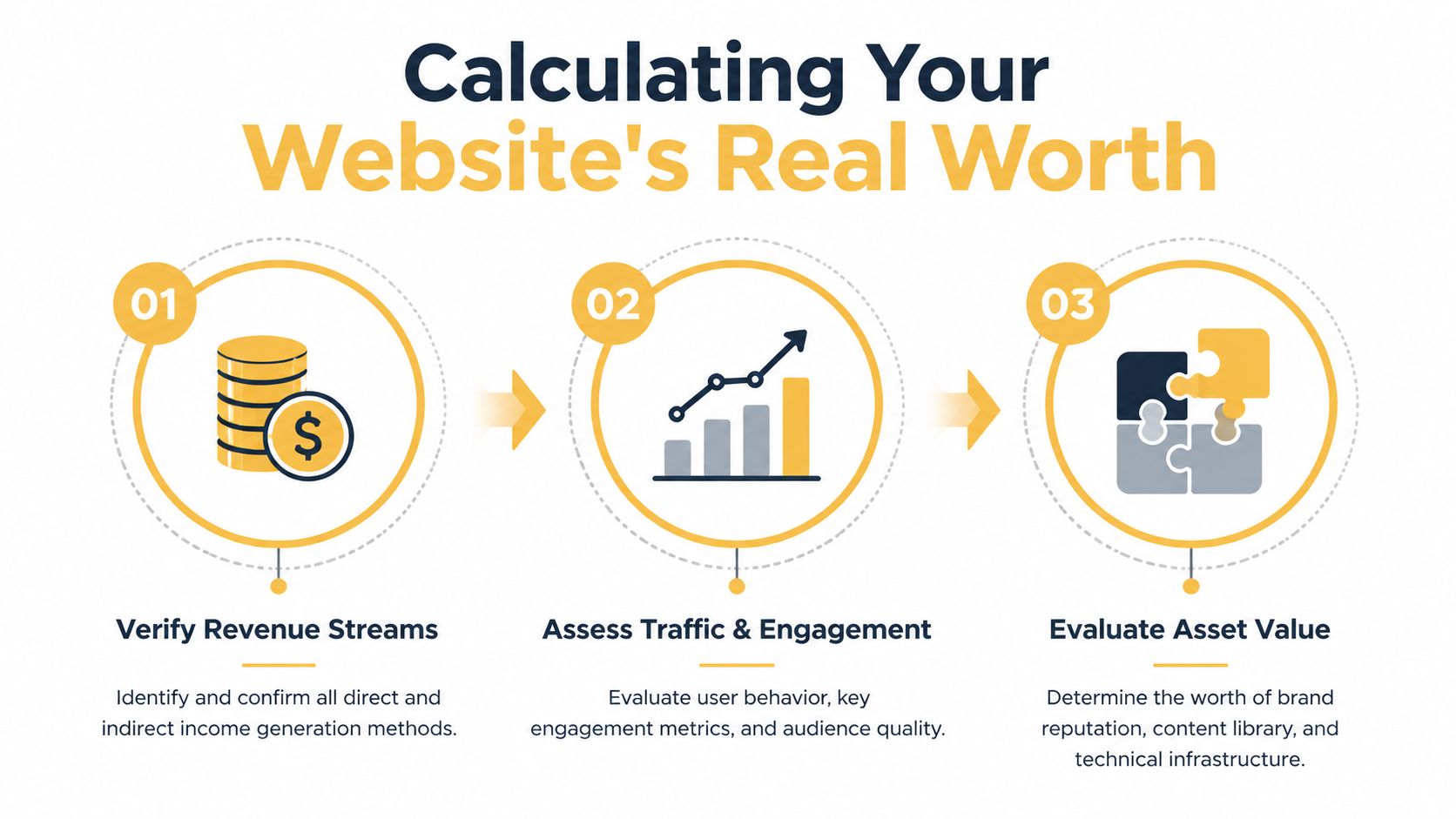
Start with verified earnings
Use monthly net profit tied to the website as the base. That means revenue minus actual costs required to keep the site performing.
For ecommerce, that usually includes fulfillment, software, merchant fees, content, and paid acquisition. For lead generation businesses, the work is harder because the website often influences sales that close offline. In those cases, use CRM data, call tracking, form attribution, and sales records together so the site gets credit for deals it helped create, not deals it happened to touch.
Clean numbers matter more than optimistic ones.
Judge how dependable those earnings are
Two sites can show the same monthly profit and deserve very different valuations because the risk profile is different.
Check what is holding the performance up:
- Traffic concentration: A site that depends on a narrow keyword set or one platform can lose value fast if rankings or policies shift.
- Revenue concentration: One top product, one affiliate relationship, or one major client can make earnings look stronger than they really are.
- Conversion efficiency: A site with steady lead quality, strong landing pages, and consistent close rates is easier to trust.
- Audience ownership: Email lists, repeat customers, branded search demand, and direct traffic usually make value more durable.
- Operational transferability: If results depend on one founder's relationships or manual work, buyers will discount the asset.
This is the part many owners skip. They focus on traffic and ignore fragility.
Apply a multiple that matches the risk
The multiple should reflect durability, not pride. Strong margins, diversified acquisition, repeatable conversion paths, and documented operations tend to justify a higher multiple. Heavy dependence on paid traffic, unstable rankings, or unclear attribution pushes that multiple down.
A practical process looks like this:
-
Confirm the profit base
Reconcile analytics, accounting, ecommerce data, and CRM reporting so the earnings number is real. -
Pressure-test the system
Review channel dependence, customer concentration, retention, seasonality, and how much manual effort is required each month. -
Choose the valuation method
A simple earnings multiple works for many small businesses. For larger or more predictable sites, future cash flow analysis can give a more grounded estimate.
If you want the finance side spelled out, this Excel-based DCF modeling guide is a useful reference for estimating future cash flow instead of relying only on a rule-of-thumb multiple.
For day-to-day operators, valuation also improves when marketing reporting is tied to return, not activity. Our guide on how to calculate marketing ROI for website-driven growth helps connect spend, leads, sales, and profit in a way that supports valuation work.
Reality check: Website value goes up when profit becomes easier to verify, easier to sustain, and easier to transfer.
That is the opportunity Alexa's disappearance created. Businesses are no longer stuck chasing a vanity benchmark. They can measure website value against what matters to an owner or buyer: cash flow, resilience, and return.
A Practical Checklist to Audit Your Site's Value
An honest valuation audit should feel a little uncomfortable. It should expose weak spots, not confirm your favorite assumptions.
Traffic quality and diversity
Start with where your visitors come from and whether those sources are dependable.
- Organic search resilience: If rankings slip in one cluster, does the business still attract demand elsewhere?
- Direct and branded traffic: Repeat visitors and brand searches usually indicate stronger market recognition.
- Referral quality: Some referral traffic drives demand. Some just inflates sessions.
- Paid dependence: If paid traffic stops tomorrow, does revenue collapse with it?
A site with broad, qualified acquisition channels is easier to defend and easier to sell.
Monetization and conversion strength
Traffic without a monetization engine doesn't deserve a premium.
Check whether the site has:
- Clear conversion paths that turn visits into leads or sales.
- More than one revenue stream, where appropriate.
- Healthy landing pages that match search intent to offers.
- Retention mechanisms such as email flows, repeat purchase patterns, or lead nurturing.
If you're unsure how to review the site from a buyer's perspective, watch this quick visual overview and then compare it to your own setup.
SEO, technical health, and operations
Many "good traffic" sites often lose value.
- Technical health: Slow pages, weak mobile UX, or indexing problems create avoidable risk.
- Backlink profile: Authority helps, but link quality matters more than raw volume.
- Content depth: A site with a documented, useful library is more durable than one built on a handful of lucky pages.
- Operational readiness: SOPs, documentation, content workflows, and clean analytics increase transferability.
Buyers pay more for systems they can understand, maintain, and grow.
The checklist isn't meant to produce one number. It's meant to reveal where your valuation multiple goes up and where it gets discounted.
Actionable Tactics to Increase Your Website's Value
If your site isn't worth what you want today, the answer usually isn't more traffic. It's better structure.
Most valuation gains come from reducing risk and improving monetization. That means making the business less dependent on one source of attention and better at converting the attention it already gets.
Prioritize the fixes that change valuation, not just visibility
A few upgrades consistently matter more than cosmetic wins:
- Build traffic diversity: Expand beyond a narrow keyword set. Publish around adjacent intent, strengthen branded search demand, and create referral partnerships that bring relevant users.
- Improve conversion paths: Rewrite weak service pages, simplify forms, tighten product page messaging, and remove friction between visit and inquiry.
- Strengthen technical performance: Faster pages, cleaner mobile UX, and stable site architecture reduce leakage and improve search durability. This guide on how to improve website loading speed is a good place to start.
- Create owned audience assets: Email lists, subscriber programs, customer communities, and repeat-visit habits make a site more defensible.
- Document operations: Clear publishing workflows, reporting standards, and maintenance processes make a business easier to transfer.
Use analysis to decide what to fix first
Before making changes, get clear on where demand and weakness sit. If you need a practical framework to analyze website traffic, use that kind of review to separate empty sessions from high-value behavior.
Then ask three direct questions:
- Which pages attract commercially relevant visitors?
- Which channels produce the best margin, not just the most volume?
- Which weak points would make a buyer nervous?
That sequence matters. Owners often spend months polishing blog traffic while their money pages underperform. Or they keep buying visits while ignoring the fact that the offer, page speed, or funnel logic is suppressing conversion.
The strongest sites don't just attract attention. They convert well, retain demand, and survive channel volatility. That's what increases website value in a way a buyer will respect.
If you're ready to replace outdated "site worth alexa" thinking with a valuation model tied to traffic quality, revenue, and ROI, Up North Media can help you audit your digital asset, identify what raises or lowers its value, and build a growth plan that improves the number that matters.