

If your Omaha website still looks polished, loads fine on your laptop, and the blog team keeps publishing, but organic traffic is slipping anyway, the problem probably isn't the content calendar. It's usually buried in the parts of the site search engines have to crawl, render, and trust before they'll send anyone your way. That's where technical SEO audit services earn their keep, because they expose the hidden blockers that a quick scan or a free report can't prioritize for a developer.

A good place to ground the basics is this primer on what is technical SEO, which helps separate infrastructure issues from content or link-building work. If you want the local version of that thinking, Up North Media also has a practical overview of technical SEO that fits the way many SMB sites are built and maintained.
What Technical SEO Audit Services Actually Are
A lot of business owners think they already have an audit because they ran a crawler and exported a spreadsheet. That's not the same thing. A true technical SEO audit service is a structured diagnosis of the systems that let search engines discover your pages, understand them, and decide whether they deserve to rank.
A local service business can feel this without knowing the terminology. The site may have strong reviews, fresh content, and a clean redesign, but one blocked section, one bad canonical setup, or one broken redirect pattern can keep Google from indexing the pages that matter. A 2026 guide says a professional audit typically examines 100 to 300 checkpoints depending on site size, and Semrush-based research cited in that same guide found 85% of 100,000 websites had at least one critical technical error that limited visibility, which is why these audits can't be treated like a light housekeeping task. Source guide on technical audit scope and error prevalence
A useful way to think about it is this. Free tools show symptoms, while professional audits connect those symptoms to business impact and implementation priority. That difference matters because the best audits don't just flag issues, they tell your developer what to fix first and why.
Practical rule: if the deliverable can't help a developer decide what goes into the next sprint, it's not really an audit, it's a crawl report.
If you're comparing services, look for wording that points to crawlability, indexation, Core Web Vitals, schema, mobile usability, redirects, and index coverage. Those are the layers that determine whether your content can win organic traffic, not just exist online. A technical audit service should surface the infrastructure problems that keep search engines from crawling, indexing, and ranking pages effectively, especially blocked pages and incorrect canonicals, then turn that into a fix list your team can act on. Technical audit service scope and prioritization
The Anatomy of a Technical SEO Audit
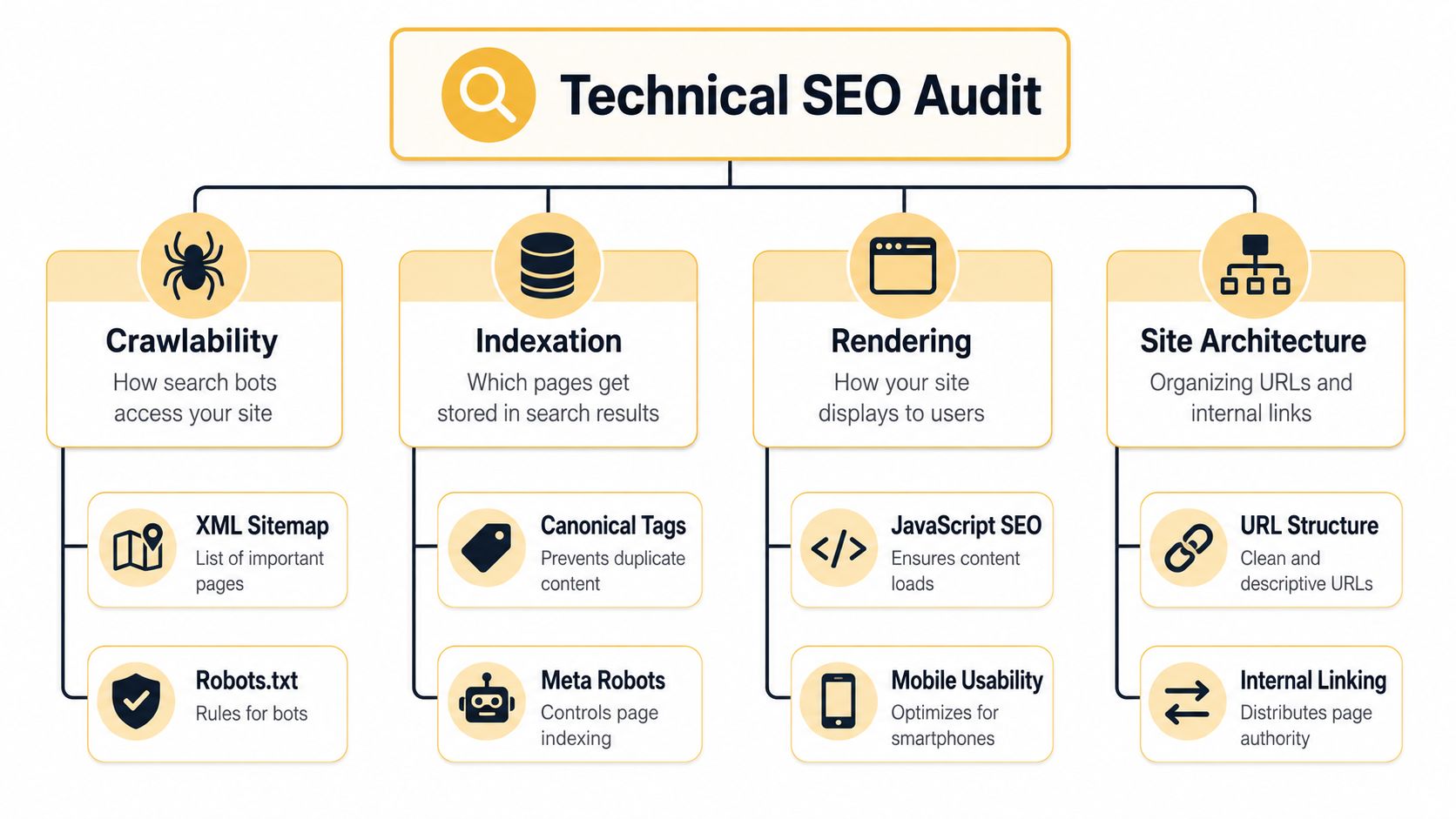
A professional audit usually starts with the basics, but it doesn't stop there. The strongest ones look at how each layer depends on the others, because a site can pass one test and still fail overall if the architecture is weak. That's why crawlability, indexation, rendering, and site architecture have to be reviewed together.
Crawlability and indexation
Crawlability is about whether search bots can reach your important URLs at all. That means checking XML sitemaps, robots.txt, blocked folders, and whether internal links point bots toward the right pages. Indexation comes next, because a page that's crawlable still may not be stored correctly if canonicals, noindex tags, or duplicate URL patterns confuse search engines.
Rendering and mobile usability
Rendering tells you whether search engines can see the content that users see. This becomes especially important on JavaScript-heavy sites where product details, navigation, or article text are loaded after the initial HTML. Mobile usability sits in the same layer of risk, because if layouts break on phones, search visibility and user behavior both suffer.
For a plain-English explainer on this performance side of the audit, what is Core Web Vitals is a helpful companion read for owners who need to understand why loading experience is part of SEO, not separate from it.
Site architecture and supporting signals
The audit gets practical. Internal linking, URL structure, duplicate content, redirects, metadata, and structured data all affect how easily search engines can understand your site's hierarchy. A weak internal architecture can bury your money pages, while sloppy redirects can pass users and bots into dead ends.
The more complete audit frameworks also look at LCP, INP, and CLS, plus canonicalization, sitemap directives, and robots rules, because those technical details affect indexation efficiency and user experience together. Core Web Vitals context and supporting technical review
Search engines don't rank a site in layers one at a time. They rank the version of your site they can crawl, render, and interpret without friction.
A brand or trust-focused site also needs reputation context. If you want a broader view of how technical issues can affect public perception, how a website audit supports brand reputation is a useful lens, especially when technical errors make a business look less reliable than it really is.
How Professional Audits Find What Free Tools Miss
Free crawlers are useful, but they're not enough when the problem is systemic. They'll tell you what exists on the site, yet they rarely tell you which defects are repeated across thousands of URLs or which ones are costing organic visibility. That's the gap between a scan and a real audit.
A professional review starts by asking where search engines spend their time, not just what they can technically see. Server-log analysis shows which URLs bots hit most often, where crawl budget gets wasted on parameterized or duplicate pages, and whether important pages are being ignored. That matters on large sites because the issue is often not a missing page, it's a pattern that keeps bots busy in the wrong places.
JavaScript-rendering checks are the next divider between surface-level and serious work. A page can look perfect in a browser and still hide content from search engines if the rendered HTML doesn't expose key text, links, or structured data. In practice, that means a site can appear healthy in a standard crawl report while still underperforming in search.
Why template-level defects matter
The hardest problems are usually repeated at the template level. One bad product template, one broken article template, or one flawed regional template can affect a huge share of the site while only showing a small number of visible errors. That's why the best providers look for repeat-pattern defects, not just low-severity issues.
Useful filter: ask whether the provider can show you the template, URL pattern, or deployment rule behind each issue. If they can't, you'll likely get a long list and very little progress.
A real audit also turns findings into a prioritization model. It should separate the issues that block indexing, the ones that slow rendering, and the ones that need engineering time but don't affect visibility right away. That's what makes the work developer-ready instead of report-heavy.
For site owners who want a broader content and implementation lens, tips for ranking content on Google is a useful complement because it reinforces that technical fixes and content clarity work together. Up North Media's own audit workflow for technical SEO on e-commerce sites follows the same practical pattern, using crawl data, template review, live URL checks, and Search Console to validate fixes rather than just listing issues.
Sample Deliverables and Real Audit Outcomes

A proper audit deliverable should feel like a handoff to a developer, not a homework assignment for marketing. The report usually includes a prioritized issue list, implementation notes, screenshots or code examples, and a roadmap that distinguishes quick fixes from heavier work. If it doesn't tell you what to do next, it's incomplete.
The strongest reports also quantify implementation effort. That doesn't mean a fake score or invented ROI math, it means a clear sense of what needs a template change, what needs a redirect mapping update, and what needs engineering time across multiple teams. That distinction matters because a long list of tiny errors can distract from the few defects that suppress organic performance.
A useful example is the kind of outcome seen in migration and launch work. In the research brief, one provider described a launch mistake where a site went live with a lingering noindex directive, which caused search engines to drop the domain from the index until the issue was removed and the site was recrawled. That's the kind of failure an audit is designed to catch before traffic disappears, not after.
The report format should also reflect how developers work. Clean handoffs often include:
- Executive summary: business risk, affected templates, and priority order.
- Technical findings: screenshots, URL samples, and the reason each issue exists.
- Implementation guidance: exact fixes, dependencies, and validation steps.
- QA checks: what to test after deployment so the fix sticks.
For content-heavy sites, technical and editorial work meet here. A page can be beautifully written and still fail to rank if the metadata is duplicated, the canonical points elsewhere, or JavaScript hides key content from crawlers. Technical SEO and loading speed guidance for implementation teams is a practical companion if your developers need to connect audit findings to page performance work.
An audit only matters when the recommendations survive contact with the development queue.
If you're comparing vendors, ask for a sample deliverable before you buy. A good one will show you how the provider separates the obvious crawl errors from the repeat-pattern defects that affect many URLs at once. It should also read like a prioritization document, not a diagnostics dump.
Pricing, Timelines, and Audit Frequency
Technical audit pricing should scale with site size, risk, and complexity. A small brochure site and a multi-template e-commerce catalog are not the same job, and the price should reflect that difference. Four Dots lists a Standard Technical Audit at $1,800 for sites up to 10,000 pages and an Enterprise Migration Audit at $3,900 for complex migrations with 50,000+ pages, which shows how the market prices audits by scale and risk. Audit service pricing and cadence guidance
| Audit tier | Site fit | Typical focus |
|---|---|---|
| Standard Technical Audit | Smaller to mid-sized sites | Crawlability, indexation, metadata, Core Web Vitals, and technical priorities |
| Enterprise Migration Audit | Large or complex sites | Redirects, template parity, crawl efficiency, and launch risk |
| Ongoing health checks | Active sites | Monitoring technical regressions and implementation changes |
Timeline expectations should be equally concrete. Standard audits are commonly delivered in about a week or a short two-week window, while enterprise migration work takes longer because redirect mapping, template validation, and stakeholder review add complexity. The important thing isn't speed alone, it's whether the provider has enough time to inspect the parts of the site that affect revenue.
Audit cadence depends on how often the site changes. A 2026 guide recommends quarterly audits for frequently updated sites and semi-annually for static sites, while Four Dots recommends weekly monitoring during implementation and monthly health checks afterward. That rhythm makes sense because technical regressions usually show up after launches, content pushes, or development changes, not in isolation.
If you're budgeting, think in two layers. First is the diagnostic audit. Second is the ongoing monitoring and implementation support that makes the audit useful. A cheaper report that sits untouched is more expensive in practice than a stronger audit that gets fixed and rechecked.
How to Choose the Right Audit Provider
The right provider should talk like a technologist and deliver like a project partner. You're not buying a keyword checklist, you're buying diagnosis, prioritization, and enough clarity for a developer to act without guessing. That's especially important for Omaha SMBs, where internal teams are often stretched across marketing, IT, and operations.
What to look for
A credible provider should show depth beyond surface crawling. That means they understand log-file analysis, JavaScript rendering, template-level defects, canonicalization, and structured data, not just page titles and broken links. Ask for a sample report, because the sample will tell you whether they produce real recommendations or just issue dumps.
Look for these signals when you compare agencies or consultants:
- Transparent pricing: you can see how scope changes with site size or complexity.
- Developer-ready output: findings include implementation notes, not only severity labels.
- Relevant experience: they've worked on a site type similar to yours, such as e-commerce, publishing, or multi-location service businesses.
- Ongoing support: they can stay involved while fixes are tested and deployed.
Why local fit matters for Omaha SMBs
Local knowledge helps more than people expect. An Omaha-based team can usually communicate faster, understand regional buying patterns, and avoid generic advice that was written for a different market and a different kind of business. That matters if your site supports local services, regional retail, or an SMB that needs fixes turned around without a long vendor chain.
If a provider can't explain the trade-off between quick wins and architectural work in plain English, they're probably not ready for a real implementation cycle.
Also watch for credibility gaps. Providers who promise a big list of findings but won't explain priority order, implementation effort, or how they validate fixes are usually handing you a diagnosis without a treatment plan. The better fit is the one that can point to outcomes, not just observations.
A final filter is whether the provider treats the audit as a one-off PDF or an operational process. Businesses that want sustained organic growth need a partner who can translate issues into a roadmap, not someone who just checks boxes.
Take the Next Step Toward Technical SEO Clarity
If your traffic has flattened, your pages are technically healthy on the surface but not in search, or your team keeps fixing symptoms without finding the root cause, a professional audit is the right first move. The cost of missed crawl paths, broken indexation, and avoidable implementation delays is usually higher than the cost of a thorough diagnosis. That's true for local Omaha businesses, regional brands, and e-commerce teams with a lot riding on organic visibility.
The best next step is a conversation, not a commitment. A good provider should be able to look at your site, explain where the technical risk sits, and tell you whether you need a focused audit, a migration review, or ongoing technical monitoring. If you want a local team that combines SEO, web development, and implementation support, Up North Media offers that kind of working relationship for businesses that need clear priorities and practical follow-through.
Up North Media can review your site's technical blockers, connect the findings to developer-ready priorities, and help you decide what deserves attention first. If you're ready to stop guessing and get a practical roadmap for your site, visit Up North Media and request a consultation.