
Your site is live. The design looks polished. The product pages are up. The contact form works. But sales or leads still feel softer than they should.
That's where many business owners get stuck. You start second-guessing everything. Is the headline too vague? Is the button buried? Are people hesitating at checkout because the page feels busy? You can keep making changes based on opinion, or you can let customer behavior tell you what's helping.
That's the value of A/B testing. It gives you a structured way to compare one version of a page or element against another, then make decisions based on what users do instead of what your team hopes will work. For small businesses, that matters because every design change, ad click, and product page visit has a cost attached to it.
If you're already trying to make better marketing decisions, this kind of thinking connects closely with broader data analytics for small business. A/B testing is one of the clearest examples of data guiding revenue decisions in plain English.
An Introduction to Data Driven Decisions
Most website decisions start as opinions.
A business owner wants a cleaner homepage. A marketer wants stronger calls to action. A designer wants less text above the fold. None of those ideas are bad. The problem is that people often confuse a reasonable idea with a proven improvement.
Data-driven decisions help you separate those two things.
If your Omaha service business gets traffic but not enough form submissions, or your online store gets product views but not enough checkouts, you don't need more internal debate. You need evidence. A/B testing gives you a way to create that evidence by comparing one version against another under controlled conditions.
A good test doesn't ask, "Which version do we like more?" It asks, "Which version helped more visitors take the action that matters?"
That action could be a purchase, a click, a registration, or a lead form completion. The key is that you define the goal before the test starts. Then you let users interact with each version and compare the outcome.
For many SMBs, this is the first shift that improves digital performance. Instead of redesigning a page because it feels outdated, you test a headline. Instead of rebuilding checkout because cart abandonment seems high, you test one friction point. Small changes become measurable decisions.
What Is A/B Testing at Its Core
At its simplest, A/B testing is a controlled experiment.
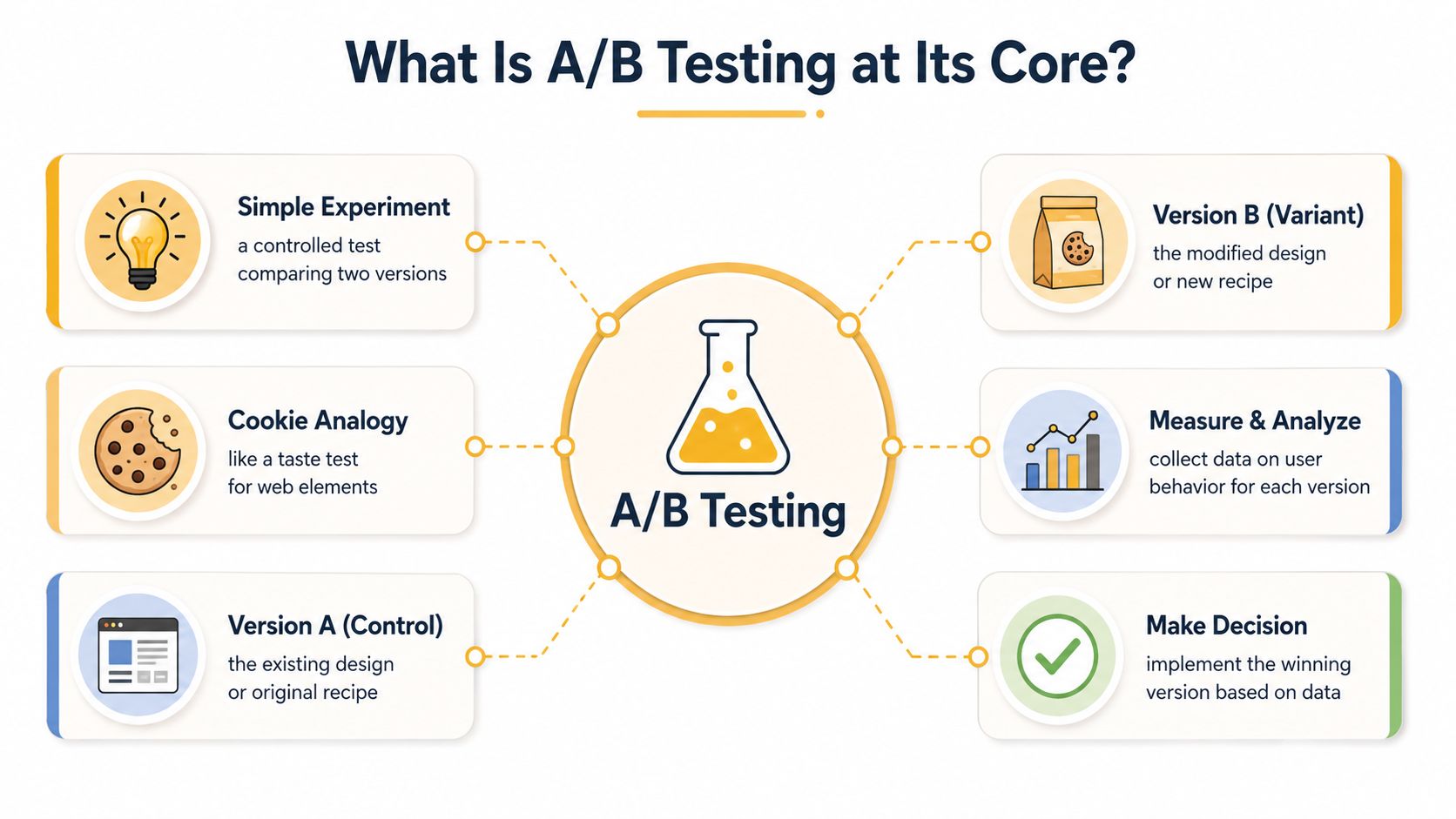
You have Version A, which is your current page, message, or design. You create Version B, which changes one thing you believe might improve performance. Then you divide visitors between those two versions and measure which one does better on a specific goal.
The bakery analogy that makes this easier
Think of a bakery testing two cookie recipes.
Recipe A is the original cookie. Recipe B adds chocolate chips. If the bakery gives both versions to similar customers and tracks which one gets chosen more often, it can make a smarter decision about what to sell. That's the same basic logic behind website testing.
On a website, the “cookie” might be:
- A headline that frames your offer differently
- A button label such as “Buy Now” versus “Get Started”
- A product image with a white background versus a lifestyle shot
- A form layout with fewer required fields
The point isn't to test everything at once. The point is to isolate one change and see whether that specific change improves the result you care about.
Why random assignment matters
The part that makes A/B testing more than casual comparison is random assignment.
A/B testing is a randomized controlled experiment that compares a control version and a modified variant. Its causal value depends on random assignment reducing selection bias, so outcome differences can be tied to the change rather than a different mix of users, as explained in Optimizely's A/B testing glossary.
That sounds technical, but the business meaning is simple. If similar visitors are randomly shown different versions, you can trust the result more. If all your repeat buyers saw one version and all your first-time visitors saw another, you wouldn't know whether the page caused the difference.
Practical rule: Change one meaningful thing, split traffic fairly, and measure one primary outcome.
Control, variant, and metric
Three terms confuse new clients more than they should:
| Term | Plain-English meaning |
|---|---|
| Control | Your current version |
| Variant | The new version with one change |
| Primary metric | The result you use to judge the winner |
If you want a broader plain-language reference, Tagada's guide to A/B testing is a useful companion because it frames the method clearly without overcomplicating it.
When people ask, “What is A/B testing?” the shortest honest answer is this: it's a way to test one idea against another so your customers, not internal opinions, decide what performs better.
Beyond the Basics Types of Website Tests
Once you understand classic A/B testing, the next question is usually which kind of test fits the problem in front of you. Not every change belongs in the same bucket.
Use classic A/B testing for focused questions
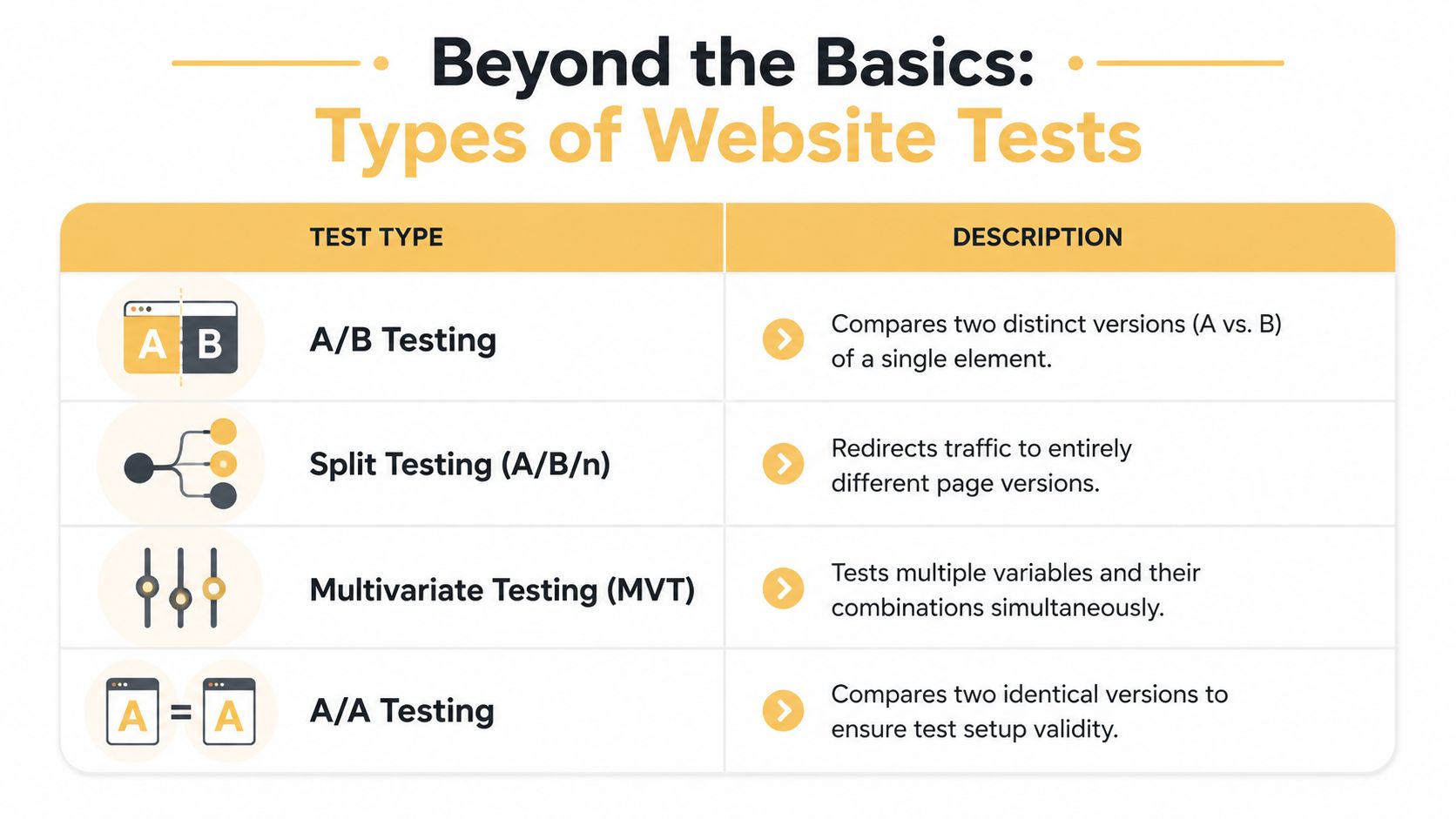
Classic A/B testing is best when you're changing one specific element inside the same experience.
Use it when you want to answer questions like:
- Headline choice because your landing page gets traffic but weak engagement
- Call-to-action wording because people are reading but not clicking
- Form design because visitors start but don't complete the submission
- Product page imagery because shoppers browse but hesitate to add to cart
This is the cleanest format for learning. It gives you a direct answer to a direct question.
Use split URL testing for bigger redesigns
Sometimes the change is too large for a simple element swap. Maybe your old category page is text-heavy and your new concept has a completely different layout, structure, and visual hierarchy.
That's when split URL testing makes more sense. Instead of swapping one element on the same page, you send users to separate page versions on different URLs and compare performance.
Here's one way to understand it:
| Test type | Best used when |
|---|---|
| A/B test | You want to isolate a single change |
| Split URL test | You want to compare substantially different page experiences |
If you're comparing these formats in more depth, this overview of what multivariate testing is helps clarify where split tests end and more complex experiment design begins.
Use multivariate testing when combinations matter
Multivariate testing is for situations where several page elements may interact with each other.
Instead of testing just one headline or one button, you test combinations. For example, one headline might work better only when paired with a certain image and a certain button style. That's useful insight, but it also makes the test more demanding.
For most SMBs, multivariate testing isn't the first place to start. It's better once you have stronger traffic, stable tracking, and a team that already knows how to run simpler experiments well.
Bigger test types aren't automatically better. The right test is the one that answers your question with the least confusion.
You may also hear about A/A testing, where two identical versions are compared to validate setup and tracking. That's less about optimization and more about checking whether the testing process itself is behaving as expected.
Understanding the Numbers Behind A/B Testing
This is the part that makes many people nervous. It sounds like a statistics class, but the practical version is manageable.
The numbers behind A/B testing exist for one reason. They help you avoid making business decisions based on noise.

What statistical significance means in real life
If one version of a page appears to be winning after a short period, that doesn't automatically mean the change worked. Random variation can make early results look stronger than they really are.
The threshold most commonly referenced in practice is a p-value below 0.05, which means there is less than a 5% probability that an observed difference would occur by random variation if there were no real effect, according to Wikipedia's overview of A/B testing. Many platforms also use 95% confidence as the standard benchmark in practice through that same reference.
For a business owner, the takeaway is straightforward. You're trying to avoid rolling out a change that looked good by accident.
Why sample size changes everything
A test needs enough visitors to say something useful.
Small samples can produce dramatic-looking swings that disappear later. Larger samples help you detect whether the difference is stable. That's why traffic volume matters so much. A homepage with steady visits can often support testing more easily than a niche product page or a low-volume local service page.
Here's the plain-English version:
- More traffic gives you a faster path to reliable results
- Less traffic means longer test windows or bigger visible changes
- Tiny differences are harder to trust unless enough users entered the test
One practical explanation from A Smart Bear's analysis of A/B testing statistics is that larger samples make smaller effects detectable, while small samples require much larger differences before you should feel confident about naming a winner. That same explanation also highlights how false-positive risk changes with confidence thresholds, which is why teams use stricter standards when the decision carries more business risk.
Test duration is not just a calendar choice
A/B tests should run long enough to capture normal customer behavior.
If you stop after a weekend spike, a holiday email blast, or a short sales push, you may be measuring a temporary pattern instead of a durable one. Good tests account for business rhythm, not just convenience.
Don't stop a test because the graph looks exciting. Stop when the result is mature enough to trust.
To see these concepts explained visually, this short video does a nice job breaking down the logic behind significance and test interpretation.
The metrics that matter most
The right metric depends on the page.
For an e-commerce product page, it might be add-to-cart actions or completed purchases. For a local service landing page, it might be form submissions or booked calls. What matters is choosing one primary metric before launch so you don't cherry-pick the result you like after the fact.
That's how testing stays honest. And honesty is what makes it useful.
Practical Use Cases for E-commerce and SMBs
A/B testing becomes easier to value when you connect it to everyday revenue questions. Most businesses aren't asking for a lesson in experimentation. They're asking why more visitors aren't buying, calling, or filling out the form.
An online store trying to improve product page performance
A small e-commerce brand has solid products and decent traffic from paid social, but shoppers browse without adding much to cart. The owner suspects the issue is price. The actual friction may be presentation.
A smart first test might compare the current product image setup against a version with clearer visuals, stronger image order, or more prominent trust cues near the buy area. Another test could compare existing button copy against a more direct purchasing prompt.
The lesson here isn't that every store should test the same thing. It's that small page elements often influence buying confidence more than owners expect.
A local service business trying to generate more leads
A home services company gets traffic from search, but too many visitors leave the landing page without contacting the business. The team starts by testing a new page headline that speaks more clearly to the customer problem. If that doesn't move the lead metric, the next test might reduce form friction by asking for less information upfront.
That's a much better sequence than redesigning the whole page at once. You learn where the friction lies.
Here are a few practical starting points for SMBs:
- Homepage messaging if people land on your site but don't move deeper
- Service page calls to action if visitors read but don't inquire
- Lead form length if submission rates feel weak
- Offer framing if traffic quality seems good but intent stalls
A checkout flow with hidden friction
Another common use case is checkout.
An online retailer may notice that customers add products to cart but abandon before finishing the purchase. Rather than assuming the payment system is broken, the team might test checkout layout, reassurance copy, or the order in which information is requested.
The key is to connect the test to a clear behavior in the funnel.
According to Fullstory's explanation of A/B testing, the statistical quality of a test is constrained by traffic volume, test duration, and the significance threshold you require. That same guidance notes that small uplifts can still matter at scale, but only when the experiment has enough sample size and clean tracking.
A page doesn't need to be “bad” to deserve testing. It only needs to be important enough that improvement would matter.
For e-commerce brands, that usually means product pages, cart, and checkout. For local SMBs, it usually means service pages, quote requests, and high-intent landing pages.
Common Pitfalls and Best Practices to Follow
Running a test is easy. Running one you can trust takes more discipline.
Most bad A/B tests fail for predictable reasons. The frustrating part is that smart teams make these mistakes all the time because the early data feels persuasive.
The traps that create misleading results
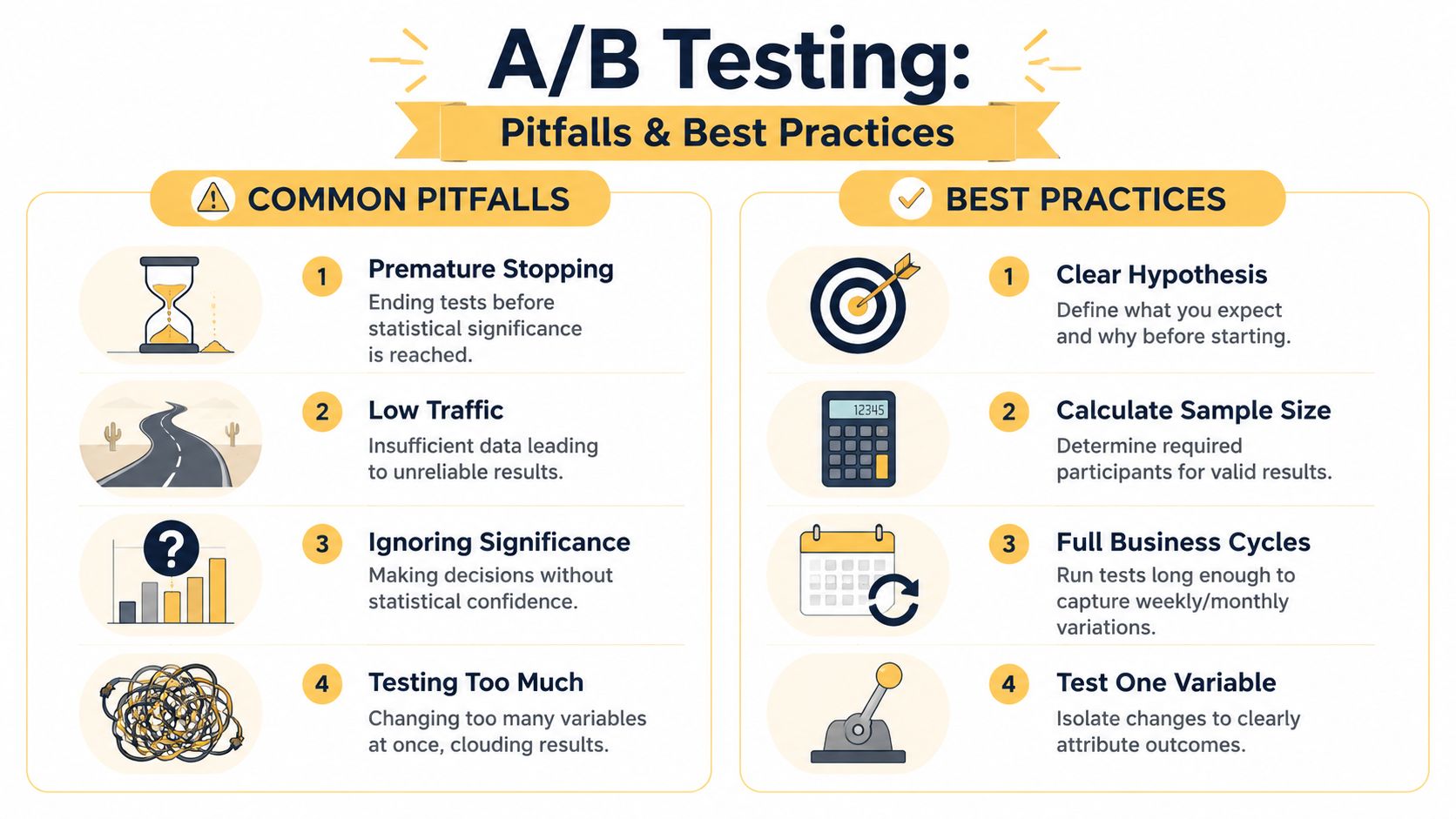
The first trap is ending the test too soon. A version jumps ahead early, everyone gets excited, and the business declares a winner before enough evidence exists.
The second trap is changing too many things in a simple A/B test. If you rewrite the headline, swap the hero image, shorten the form, and move the button, you may get a lift, but you won't know what caused it.
Another common problem is ignoring outside context. Promotions, email sends, seasonality, and traffic source changes can all distort results. If the test runs during an unusual period, your conclusion may not hold up later.
The low traffic question most SMBs actually care about
Now, the conversation gets real for smaller businesses.
A common underserved issue is whether A/B testing is worth it for low-traffic sites. A valid test needs enough traffic and a clear minimum detectable effect, which means many SMBs may wait too long or never reach useful confidence, as noted by Nielsen Norman Group's article on A/B testing.
That doesn't mean low-traffic businesses should give up on optimization. It means they should be selective.
If your site gets modest traffic, focus on:
- High-impact pages such as your core service landing page or checkout step
- Large, meaningful changes rather than tiny cosmetic tweaks
- Stronger qualitative input from recordings, customer calls, form feedback, and sales conversations
- Sequential learning where each test is informed by actual user friction
Best practices that keep testing useful
A reliable testing habit usually follows a few rules:
- Start with a hypothesis. Don't test random ideas. Tie the change to a reason.
- Pick one primary metric. Decide success before launch.
- Protect clean attribution. Keep the change isolated when possible.
- Run long enough to reflect normal business conditions.
- Document what you learned even when the variant loses.
If you want a practical companion checklist, A/B testing best practices from Figr is a helpful reference for teams tightening up their process.
For businesses that are serious about turning testing into ongoing improvement, this broader look at conversion rate optimization strategies adds useful context around where experimentation fits in the bigger picture.
A failed test isn't wasted work if it rules out a bad assumption before you roll it out sitewide.
Tools and Your First Steps into Testing
You don't need a giant optimization program to start. You need one important page, one clear business question, and a way to measure outcomes cleanly.
What to test first
Start where buyer intent is already strong.
For an e-commerce brand, that's often the product detail page, cart, or checkout. For a local business, it may be the main service page or a high-intent landing page tied to paid search. Don't begin on a low-priority blog page just because it feels safer. Test where a better result would matter.
A simple decision filter works well:
| Question | If yes |
|---|---|
| Does this page directly influence revenue or leads? | Prioritize it |
| Does the page get enough meaningful traffic? | Consider testing it |
| Can you identify one likely friction point? | Form a hypothesis |
| Can you measure a primary outcome cleanly? | Move forward |
Tools people commonly use
Many businesses begin with platforms such as Optimizely, VWO, Adobe Target, and product analytics tools that support experiment analysis alongside behavior tracking. The right choice depends less on brand name and more on your setup, traffic, technical resources, and reporting needs.
What matters most early on isn't having the fanciest tool. It's having a process your team will follow.
That usually means:
- Tracking is in place so you can trust your goal metric
- Variants can be launched cleanly without breaking the page
- Results are reviewed consistently instead of forgotten after launch
- Learnings are recorded so future tests build on past ones
Where AI fits now
The old mental model of A/B testing starts to feel incomplete at this point.
Many explainers still describe A/B testing as a static webpage exercise, but recent practice is moving toward continuous experimentation in which AI can dynamically allocate traffic and accelerate tests with machine-learning-based decisioning, according to Salesforce's overview of A/B testing.
For SMBs and e-commerce owners, the practical question isn't whether AI replaces experimentation. It's how AI changes the workflow.
In plain terms, AI-driven systems can help teams:
- Spot patterns faster in user behavior
- Route more traffic toward stronger-performing experiences over time
- Support personalization across web, email, and app touchpoints
- Reduce manual guesswork in larger testing programs
That said, the core discipline still matters. AI doesn't rescue a weak hypothesis, broken tracking, or a page with too little traffic to learn from. It works best when the basics are already solid.
If you're just starting, don't overcomplicate it. Pick one page. Pick one problem. Pick one metric. Run one clean test. Then build from there.
If you want help deciding whether A/B testing makes sense for your traffic level, revenue model, and site structure, Up North Media can help you sort through the strategy before you waste time testing the wrong things. Their team works with SMBs, e-commerce brands, and growing companies that want clearer conversion insights, stronger digital experiences, and practical ways to turn website traffic into more revenue.