
You're probably hearing the same thing I hear from business owners around Omaha. Everyone says AI matters. Every software company suddenly has an AI feature. Every consultant has a slide deck. And somewhere in the middle of all that noise, you're trying to answer a much simpler question.
What would this do for my business?
That's the right question. Not “How do I use AI?” Not “Should I buy the latest tool?” The useful question is whether AI can help your team save time, reduce mistakes, serve customers better, or open up a new source of revenue without creating a mess your staff has to clean up later.
For most small and mid-sized businesses, that's where AI consulting comes in. Done well, it turns a confusing technology trend into a practical business project with a clear goal, a working system, and a way to measure whether it paid off.
What AI Consulting Really Means for Your Business
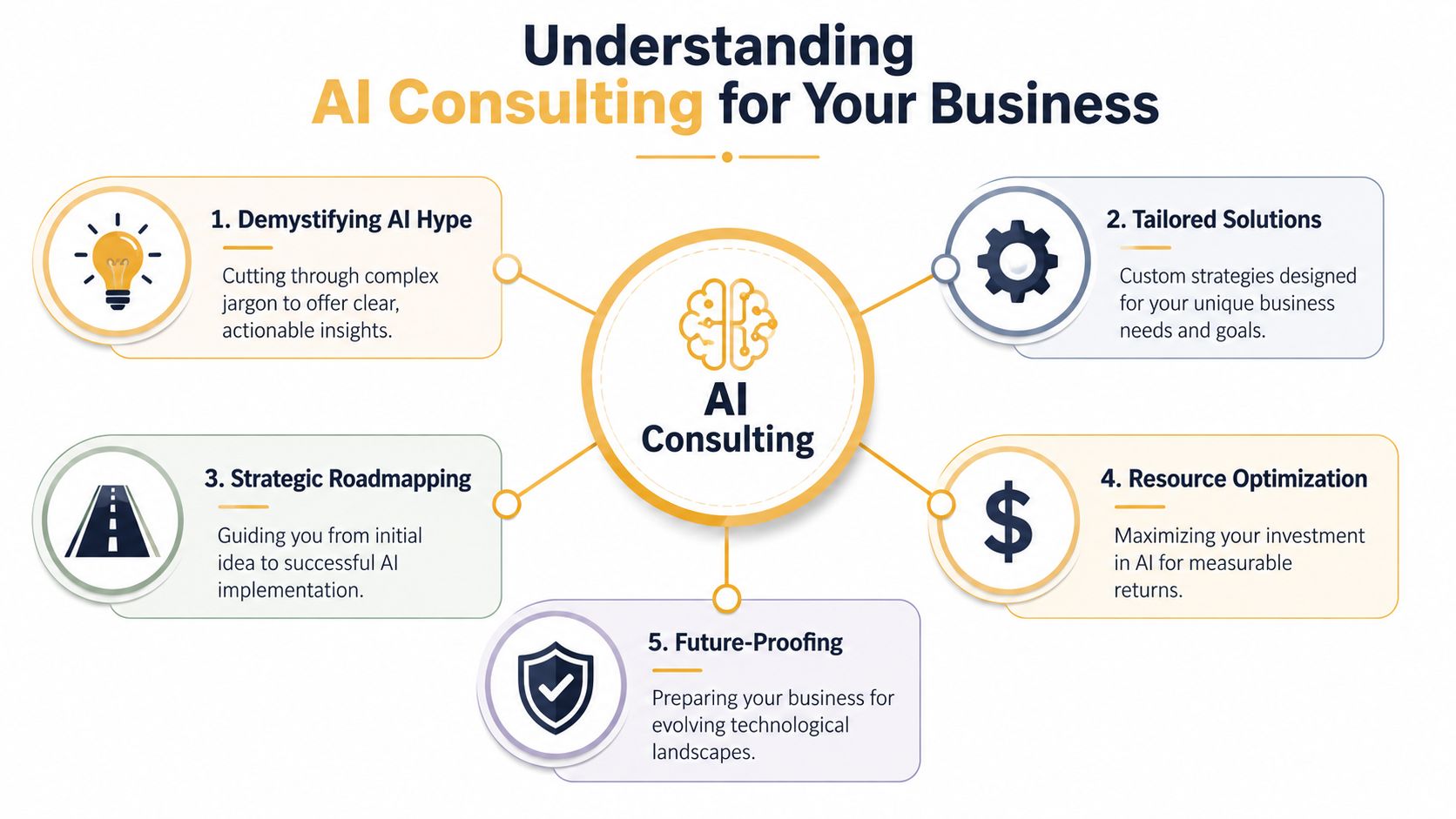
If you strip away the buzzwords, AI consulting means hiring a specialist to help your business decide where AI fits, how to apply it, and how to make it work practically.
That last part matters most.
A lot of owners think an AI consultant is someone who recommends ChatGPT, writes a roadmap, and leaves. Some do exactly that. The better version is closer to a general contractor on a renovation job. They don't just point at cabinets and flooring samples. They inspect the foundation, draw the plan, coordinate the trades, solve the surprises, and hand you something usable at the end.
That's the difference between AI advice and AI implementation.
Strategy-only consultants and build-capable consultants
Many SMBs misstep at this stage. One consultant helps you brainstorm use cases. Another can connect your data, build workflows, test outputs, train staff, and support the launch. Those are not the same service.
RAND estimates over 80% of AI projects fail due to poor problem clarity, data readiness, or lack of secure deployment, which is exactly why end-to-end execution matters for business owners who don't have a full internal AI team (Iternal.ai on AI consulting).
If I'm talking with a local owner over coffee, I usually put it this way:
Practical rule: If a consultant can't explain how the system will go live inside your actual workflow, you're not buying a solution. You're buying a presentation.
What business owners usually mean when they ask about AI
Most Omaha companies aren't looking for “AI transformation” in the abstract. They're asking questions like these:
- Can this reduce repetitive work so my staff stops spending hours on scheduling, data entry, document handling, or routine customer replies?
- Can this improve decision-making by spotting patterns in sales, operations, inventory, lead flow, or customer behavior?
- Can this fit our current systems like Shopify, QuickBooks, HubSpot, Google Workspace, Microsoft 365, or an internal database?
- Can we measure the payoff before we commit to a bigger rollout?
If you're not sure where to start, a simple AI readiness scan can help you spot whether your bottleneck is process, data, tools, or staffing.
The plain-English definition
A good answer to “what is AI consulting” is this:
It's the work of identifying a business problem, choosing the right AI approach, building or integrating the solution, and proving that it creates value.
That's why the best AI consultants for SMBs aren't just “AI people.” They're part business analyst, part systems builder, part translator between your operations and the technology.
The Core Services an AI Consultant Provides
When people hear “AI consulting,” they often picture one vague service. In practice, it usually breaks into a few distinct kinds of work. Good projects move through them in order, even if some parts are light and others are deep.
AI strategy and roadmapping
The consultant figures out what's worth doing and what isn't.
You don't start with a model. You start with a business issue. Maybe your sales team loses time answering the same pre-sale questions. Maybe your warehouse staff relies on manual spreadsheets. Maybe your customer service inbox never gets fully cleared.
A consultant should help you sort opportunities into three buckets:
- Quick wins that use existing tools and can be tested fast
- Workflow improvements that need some integration work
- Custom solutions that only make sense if the payoff is large enough
This part often produces a priority list, a phased plan, and a recommendation on whether you need off-the-shelf tools, custom automation, or both.
Data readiness and engineering
This is the least flashy part of AI consulting, and often the most important.
AI systems need clean, organized, relevant information. If your customer records live in one tool, order history in another, and support notes in a shared inbox, the consultant has to make sense of that before anything smart happens.
Here's what this can involve:
- Cleaning data so duplicate, missing, or outdated records don't poison the output
- Structuring information from documents, spreadsheets, forms, and apps
- Connecting systems so data can move between the tools your team already uses
A lot of small business owners think they have an AI problem when they have a data plumbing problem.
Custom solution development
This is the building phase. It can include chat assistants, internal knowledge tools, lead qualification systems, forecasting models, document review workflows, or content classification tools.
Some businesses need lightweight configuration inside platforms they already own. Others need a custom layer that sits between staff and their existing systems. One option among many is working with a provider that offers AI consulting services alongside implementation support, so the plan and the build stay connected.
The strongest projects don't start by asking, “What model should we use?” They start by asking, “What decision or task should this improve?”
If you're exploring multi-step automation, this guide on how to get AI agent orchestration right is useful because it shows why chaining AI actions together takes more design discipline than expected.
Process automation and optimization
After the first version works, the next question is whether it fits daily operations.
That means things like:
- Reducing handoffs between departments
- Flagging exceptions that still need a human review
- Improving prompts and rules based on real usage
- Training staff so they know when to trust the system and when to step in
In this stage, a consultant moves from “we built a thing” to “your team uses it.”
A Typical AI Project from Idea to ROI
For most SMBs, the process feels intimidating because they can't see the path. In reality, a solid AI project tends to follow a fairly understandable rhythm.
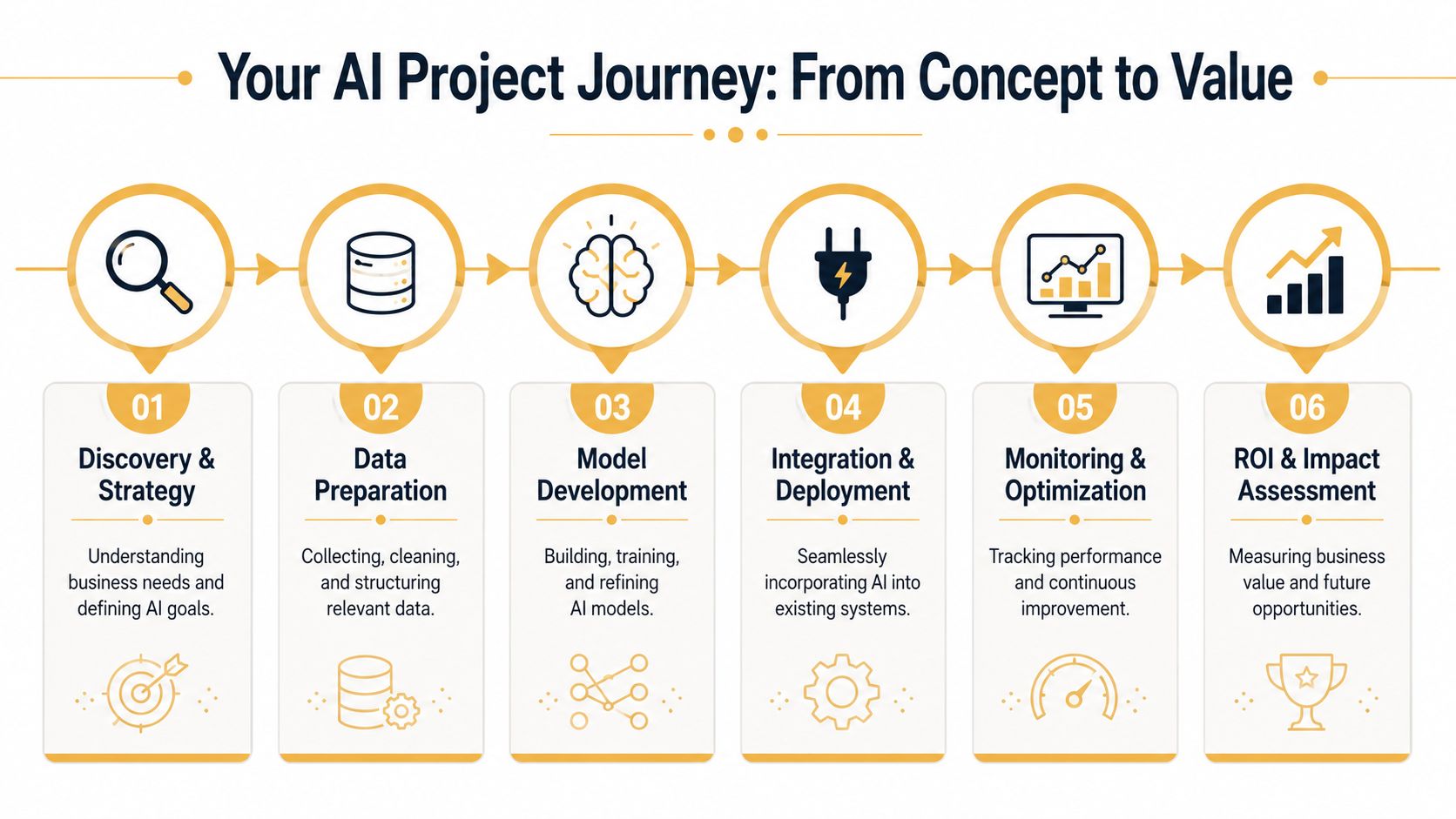
Phase one builds clarity
The project usually starts with discovery and strategy. For a small or mid-sized business, that often takes 1 to 2 weeks. The goal is to understand the workflow, define the problem, identify available data, and decide what success should look like.
That sounds simple, but it's where bad projects usually reveal themselves. If the problem statement is fuzzy, the rest of the project gets expensive fast.
A consultant might ask questions like:
- Which task eats up the most staff time each week?
- What decision is slow because information is scattered?
- Where do customers experience delays or inconsistency?
- What systems already hold the data needed to improve this?
Phase two proves the idea before a full build
The next step is often a proof of concept. For many SMB projects, that can take 4 to 6 weeks.
This is the low-risk stage. Instead of rebuilding half your business, the consultant creates a focused test. Maybe it's an internal search assistant trained on your SOPs. Maybe it's a support-ticket triage workflow. Maybe it's a draft-generation tool for proposals or product descriptions.
The point is to answer one question: does this work well enough to justify deeper investment?
If you want a practical look at what the rollout process can involve inside a company, this overview of how to implement AI in business is a helpful companion.
Phase three makes it operational
Once the concept proves itself, implementation starts. For a typical SMB build, this often runs 8 to 12 weeks depending on the systems involved.
At this point, the consultant is doing real production work:
- Connecting the solution to your tools
- Setting user permissions
- Creating fallback rules
- Testing edge cases
- Training the staff who will use it
A proof of concept answers “Can this work?” A production system answers “Can this survive Monday morning?”
Phase four tracks value after launch
After launch, the work doesn't stop. Monitoring and optimization continue on an ongoing basis.
That's because real businesses change. New customer questions appear. Staff use the system in unexpected ways. Some outputs need tuning. Some automations need guardrails.
A mature consultant watches for those issues, compares results against the baseline from before AI was introduced, and improves performance over time. That's how a project moves from novelty to ROI.
Measuring the Real-World Impact and ROI
This is the question every owner should ask early. Not “Is AI powerful?” but “How will we know if this investment worked?”
For SMBs, ROI gets fuzzy when people treat AI as a broad innovation project instead of a specific business improvement. The cleaner approach is to measure it the same way you'd measure a new hire, a software subscription, or a process change. Start with a baseline. Decide what KPI should move. Track that KPI after launch.
According to industry analysis, two-thirds of companies report that AI adoption increased their operational efficiency by 10-20%, while 40% achieved a revenue uplift exceeding 5% (Technavio AI consulting market analysis). That doesn't mean your company should expect the same result automatically. It does mean measurable payoff is a reasonable standard, not a fantasy.
The three buckets that matter most
Most AI ROI falls into one of these categories:
- Cost savings from reducing manual work, rework, or avoidable delays
- Revenue growth from better lead handling, conversion support, upsells, or customer retention
- Risk reduction from catching errors, enforcing consistency, or reviewing sensitive outputs before they go out
A lot of businesses should track all three, but one usually drives the project.
Measuring AI consulting ROI key performance indicators
| AI Application Area | Example KPI to Track | Business Impact |
|---|---|---|
| Customer service assistant | Average response time, number of tickets handled before human escalation | Faster service and lower workload for staff |
| Sales lead qualification | Qualified leads passed to sales, speed of first follow-up | Better use of sales time and stronger pipeline management |
| Document review workflow | Time spent per document, review backlog | Lower admin burden and quicker turnaround |
| Scheduling and intake automation | Appointments booked, missed appointments, staff time spent on scheduling | Smoother operations and less front-desk friction |
| E-commerce personalization | Conversion rate, average order value, repeat purchase behavior | Stronger revenue from existing traffic |
| Internal knowledge assistant | Time to find answers, repeated internal questions | Less interruption and quicker staff onboarding |
A simple SMB ROI method
If you don't have a data team, keep it plain.
First, document how the process works today. How long it takes, who touches it, where errors happen, and what the delay costs you operationally. Next, define one or two success metrics for the AI system. After launch, compare the before and after.
Owner's checklist: pick one process, capture the current baseline, choose the KPI, and review it on a set schedule instead of relying on gut feel.
That turns AI from a trendy purchase into a managed business investment.
AI in Action Real Examples for Omaha Businesses
The easiest way to understand AI consulting is to see how it fits ordinary business problems. Not moonshot ideas. Daily friction.

Logistics on the I-80 corridor
A local logistics company has dispatchers juggling route changes, delivery windows, and driver updates. The problem isn't a lack of effort. It's that too much decision-making depends on scattered information and manual judgment.
An AI consultant might build a workflow that pulls historical route patterns, customer timing preferences, and shipment notes into one recommendation layer. Dispatch still makes the final call, but the system surfaces likely delays, likely conflicts, and better order sequencing.
The result is a calmer morning dispatch process, fewer avoidable scrambles, and more consistency across shifts.
Specialty clinics trying to smooth scheduling
A group of clinics doesn't need a robot doctor. It needs fewer scheduling headaches.
An AI consultant could help implement an intake and scheduling assistant that handles routine questions, routes patients to the right appointment type, and flags edge cases for staff review. Add document summarization and internal search for policy questions, and the front office gets breathing room.
The value shows up in fewer phone bottlenecks, cleaner handoffs, and staff who can spend more time helping patients instead of chasing admin tasks.
An e-commerce retailer with solid traffic but messy conversion flow
This one is common. The store gets visits, but shoppers drop off because product discovery is weak, customer questions go unanswered, or merchandising takes too long to update.
The consultant might recommend a product recommendation layer, AI-assisted product copy workflow, and a support assistant trained on shipping, returns, and product details. That's not “AI for AI's sake.” It's better merchandising and faster customer guidance.
For an Omaha retailer competing with larger brands, that can mean a sharper buying experience without hiring a huge team.
A law office buried in document review
Legal work is a strong example of where people get confused about AI capability. A flashy model leaderboard may look impressive, but the benchmark has to match the actual task. For contract-heavy use cases, consultants need domain-aligned evaluation, not generic scores, or they risk buying a system that performs well on paper and fails in production.
That's why model selection needs to map to the client's real use cases and the right benchmarks for those tasks, rather than broad leaderboard hype (SVA on reading AI benchmarks before choosing a model).
A practical build here might summarize documents, identify clauses for attorney review, and sort files by issue type. The lawyers still make legal judgments. The AI shortens the path to them.
How to Choose the Right AI Consultant in Omaha
Hiring the wrong AI consultant costs more than the invoice. It burns team trust, drags out timelines, and leaves you with another abandoned tool.
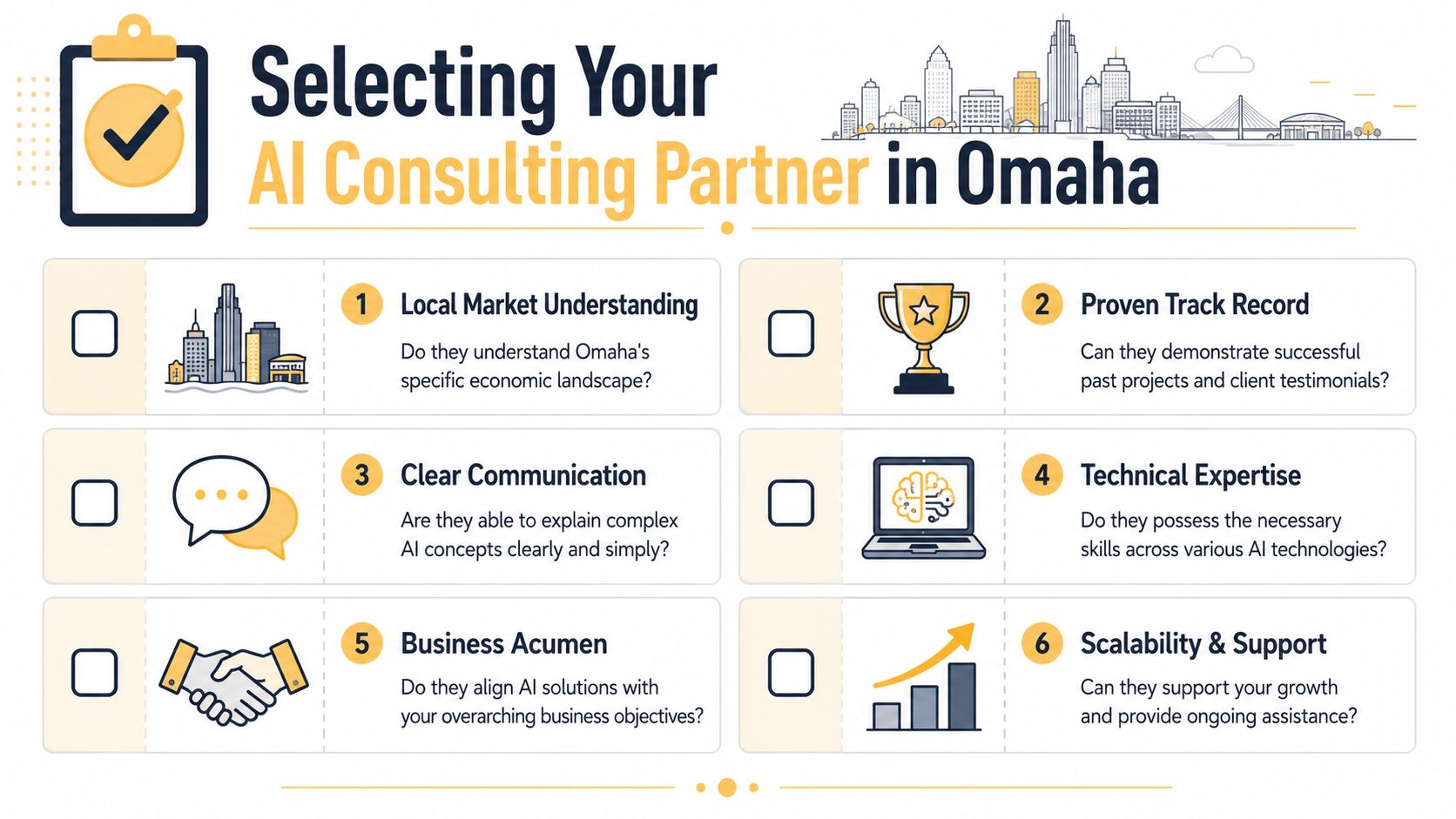
So when you evaluate firms or freelancers, don't start with who talks most confidently about AI. Start with who can connect business goals to an operational system.
Understand the common pricing models
Most consultants price their work in one of three ways:
- Project-based pricing works best when the scope is defined, such as a pilot, workflow automation build, or internal assistant launch.
- Retainer pricing fits ongoing advisory, optimization, governance support, or phased rollout work.
- Hourly pricing can make sense for short discovery work, troubleshooting, or second-opinion reviews.
The model matters less than whether the scope, deliverables, and success criteria are clear.
Ask questions that expose real capability
These questions usually tell you more than a polished pitch deck:
- What have you built and deployed? Ask for examples of working systems, not just strategy documents.
- How do you decide whether a problem needs AI at all? A good consultant should be willing to say no.
- What systems will you need access to? This reveals whether they understand integration reality.
- How will you measure success? If they can't define KPIs, the engagement is still too vague.
- Who handles security, permissions, and human review steps? Important for any tool touching customer or operational data.
- What happens after launch? You want a plan for monitoring, tuning, and staff adoption.
Put performance expectations in writing
This is one of the biggest upgrades happening in the field. Expert consultants are now embedding AI Performance Benchmarking clauses into contracts, defining success criteria such as maximum hallucination rates and minimum task accuracy so the results are measurable and enforceable (Shumaker on AI performance benchmarking clauses).
That matters because “industry standard” is too vague to protect you.
If a consultant promises outcomes, ask how those outcomes will be tested, documented, and tied to the agreement.
If you want more context on how buyers compare providers, this AI consulting buyer's guide can help you frame your shortlist. You can also review practical hiring considerations in this guide on how to hire an AI consultant.
The Omaha filter
Local context still matters. A consultant doesn't need to be born in Nebraska, but they should understand how SMBs here operate. Lean teams. Tight margins. Existing software that can't just be ripped out. Owners who need plain English and visible payoff.
That tends to favor consultants who can both advise and execute, because small businesses rarely have separate in-house teams to fill the gaps between strategy, data work, and deployment.
Your Next Step to AI Powered Growth
The AI consulting market is projected to grow from approximately USD 11.07 billion in 2025 to USD 90.99 billion by 2035, according to Future Market Insights on AI consulting services. That's a projection, but the signal is clear. Businesses aren't treating AI as a side experiment anymore.
Your next move doesn't need to be big.
Start with one repetitive task that slows your team down. Pick the thing people complain about most. Maybe it's intake, scheduling, product copy, proposal drafting, document sorting, or customer support triage.
Then talk with a consultant about that one process only. Ask how they'd evaluate it, what data they'd need, how they'd test a small version first, and what KPI would prove it worked.
Finally, use the screening questions from this guide. Don't buy slides. Don't buy hype. Buy clarity, implementation, and a way to measure results.
If you want a practical conversation about where AI could fit in your business, Up North Media offers Omaha-based support across AI consulting, web development, and digital growth strategy. A good first discussion should stay focused on one business problem, one realistic use case, and one measurable outcome.