
You're already paying to bring visitors to your website, but do you know how many leave without taking the action your business needs? More traffic can hide a weak buying journey. Conversion rate optimization, or CRO, starts by measuring where visitors hesitate, abandon, or lose confidence, then uses evidence to improve those moments.
For a small business, that distinction matters. A redesign may look polished while leaving the checkout, lead form, offer, or mobile experience just as difficult to use. CRO treats the website as a system that can be observed, tested, and improved, so each marketing dollar has a better chance of producing revenue.
The Plain-English Definition of Conversion Rate Optimization
Traffic that doesn't convert still consumes acquisition budget, staff time, and attention. If a visitor clicks an ad, reads a product page, and leaves without buying, the business paid for the visit but didn't receive the intended outcome. CRO addresses that gap by improving the percentage of visitors who complete a defined action.
The basic calculation is straightforward:
Conversion rate = conversions ÷ visitors × 100
If 100 visitors produce 3 purchases, the conversion rate is 3%. A conversion might be a completed purchase, a qualified form submission, a booked call, a trial signup, an email subscription, or a download. The important point is to define the action before measuring performance.
A useful analogy is a physical store. Buying more advertising may bring more people through the door, but it won't help much if shoppers can't find the products, understand the prices, trust the staff, or complete checkout. CRO is the work of repairing that leaky store from the entrance to the register.
CRO isn't the same as traffic generation
SEO, paid search, social campaigns, and email marketing help attract visitors. CRO works with the traffic you already earn. The two disciplines support each other, but they answer different questions. Acquisition asks, “How do we bring in more relevant people?” CRO asks, “Why aren't more of the right people taking action?”
CRO also isn't just a visual redesign. A redesign can be part of an experiment, but CRO is a measurement-first discipline. Teams review funnel data, observe behavior, gather customer feedback, write a testable hypothesis, and measure the result. They don't assume a new layout will work because it looks cleaner.
Small improvements can compound across several steps. Clearer product messaging may help visitors reach the cart, better payment information may reduce checkout hesitation, and a simpler form may increase completed leads. If you're auditing purchase friction, this guide to removing purchase friction offers a useful complement to analytics and testing.
Why CRO Matters for SMBs and E-Commerce Brands
CRO gives small and mid-sized businesses a way to grow without making traffic the only answer. Consider a simple e-commerce scenario: 50,000 monthly visitors, a $60 average order value, and a conversion rate that rises from 2% to 3%. At 2%, the store produces 1,000 orders and $60,000 in monthly revenue. At 3%, it produces 1,500 orders and $90,000. That's roughly $30,000 in additional monthly revenue from the same traffic, before accounting for costs, refunds, or margin.
| Scenario | Monthly Visitors | Avg Order Value | Conversion Rate | Monthly Revenue |
|---|---|---|---|---|
| Baseline | 50,000 | $60 | 2% | $60,000 |
| Improved | 50,000 | $60 | 3% | $90,000 |
The example uses deliberately simple math, but it shows the advantage clearly. Industry benchmarks commonly place average website conversion rates around 2.35% to 2.9%, while top-performing sites reach roughly 11.45% or higher, according to conversion rate optimization benchmarks and statistics. The gap doesn't mean every business can reach the top benchmark. It means there may be meaningful room to improve before buying more traffic.
For lead-generation companies, the conversion isn't a purchase. It may be a consultation request, quote form, or phone call. A software company may optimize trial starts or demo requests, then connect those events to CRM outcomes and customer value. A local service business can learn whether visitors abandon because the service area is unclear, the form asks for too much information, or the next step feels risky.
The economics are stronger than a redesign argument
A higher conversion rate can lower effective customer acquisition cost because the same acquisition spend produces more customers. It can also improve return on ad spend and create more room to compete for valuable traffic. Those outcomes depend on lead quality, order value, margins, and retention, so CRO teams should measure business results rather than celebrate a page metric in isolation.
Small teams also face a practical constraint: engineering and design capacity is limited. A focused test on a high-traffic product page or checkout step may be more useful than a broad rebuild that takes months and changes everything at once. The best starting point is usually a measurable bottleneck, not a subjective complaint that the site “feels dated.”
For an e-commerce-specific view of the workflow, review conversion rate optimization for e-commerce, especially if your main opportunity sits between product discovery and completed purchase.
The Core KPIs and Data Sources Behind CRO
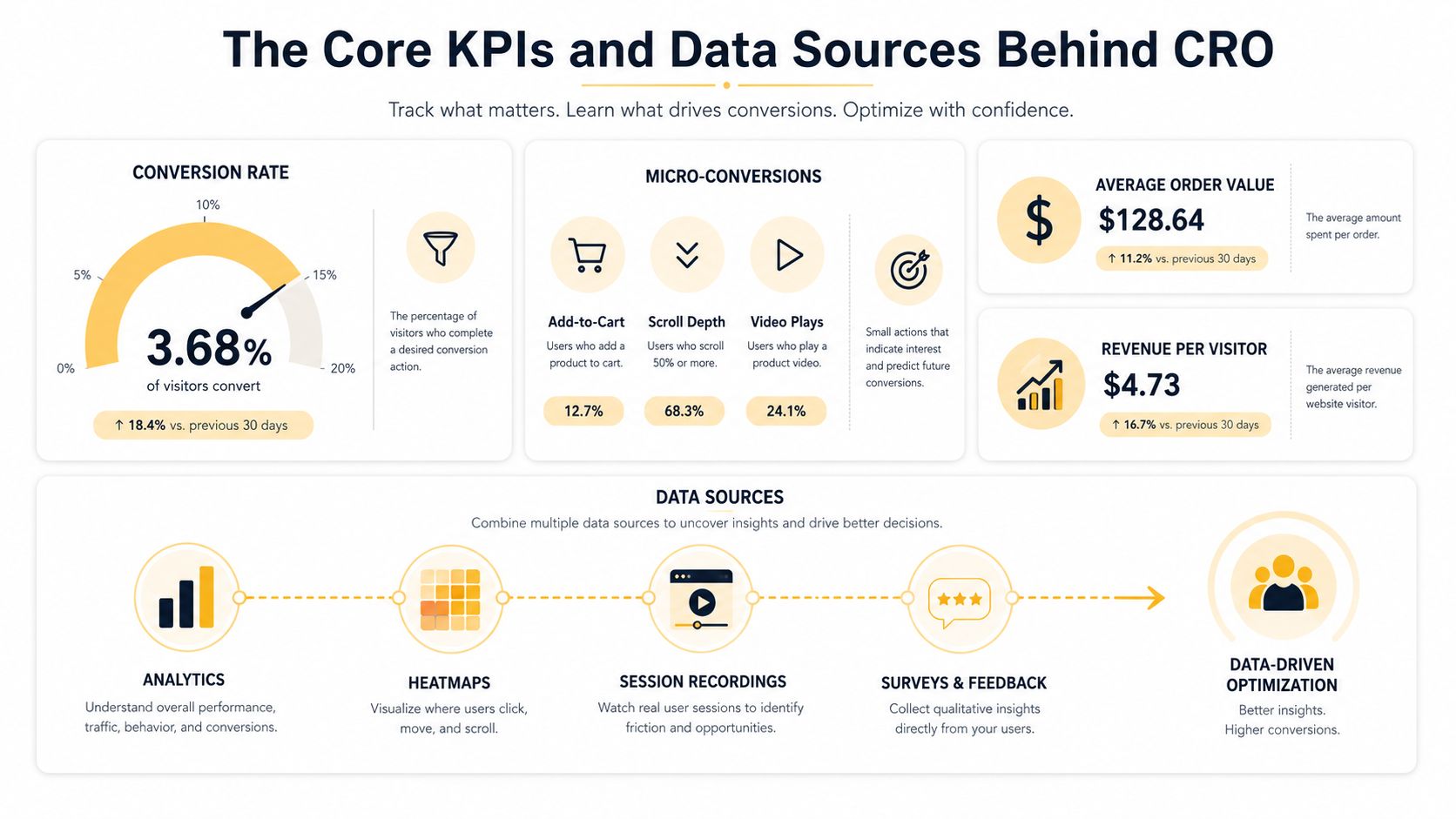
A CRO dashboard should help someone make a decision. Conversion rate tells you how often the primary action occurs, but it doesn't explain the whole journey. Pair it with metrics that reveal where intent builds, where users hesitate, and whether the resulting conversions create commercial value.
Match each metric to a question
- Conversion rate: Are visitors completing the main action, such as purchase, signup, or inquiry?
- Micro-conversions: Are visitors adding products to cart, reaching important content, playing videos, or starting forms?
- Average order value: Does a change increase completed purchases while changing basket size?
- Revenue per visitor: How much commercial value does each visitor generate?
- Segmented bounce rate: Do mobile visitors, paid visitors, returning users, or specific campaigns leave at different points?
- Lead quality: Do submitted forms become qualified opportunities, or are they only filling the top of the CRM?
Google Analytics 4 can answer questions about traffic sources, funnel progression, events, devices, and audiences. Shopify, WooCommerce, HubSpot, and payment-platform reporting provide closer views of transactions, checkout outcomes, revenue, and downstream lead activity. The analytics platform should agree with the system that records money or sales pipeline. If those systems disagree, investigate the tracking before changing the page.
Heatmaps and session recordings add the qualitative layer. They can show visitors clicking non-clickable elements, missing a primary call to action, struggling with a form field, or repeatedly returning to shipping information. A recording doesn't prove that every visitor has the same problem, but repeated patterns can turn a vague suspicion into a specific hypothesis.
Measurement rule: Quantitative data shows where performance changes. Qualitative evidence helps explain why.
Fix the data before trusting the conclusion
Misfiring events, duplicate purchase events, missing cross-domain tracking, and untracked phone conversions can distort the baseline. A form may appear to have a low completion rate because the success event never fires. A checkout may look strong because refunds or payment failures aren't connected to the revenue view.
Use a documented event plan and test important actions yourself. The analytics implementation guide can help establish the tracking foundation before you invest in experimentation.
A Practical Five-Phase CRO Framework You Can Run
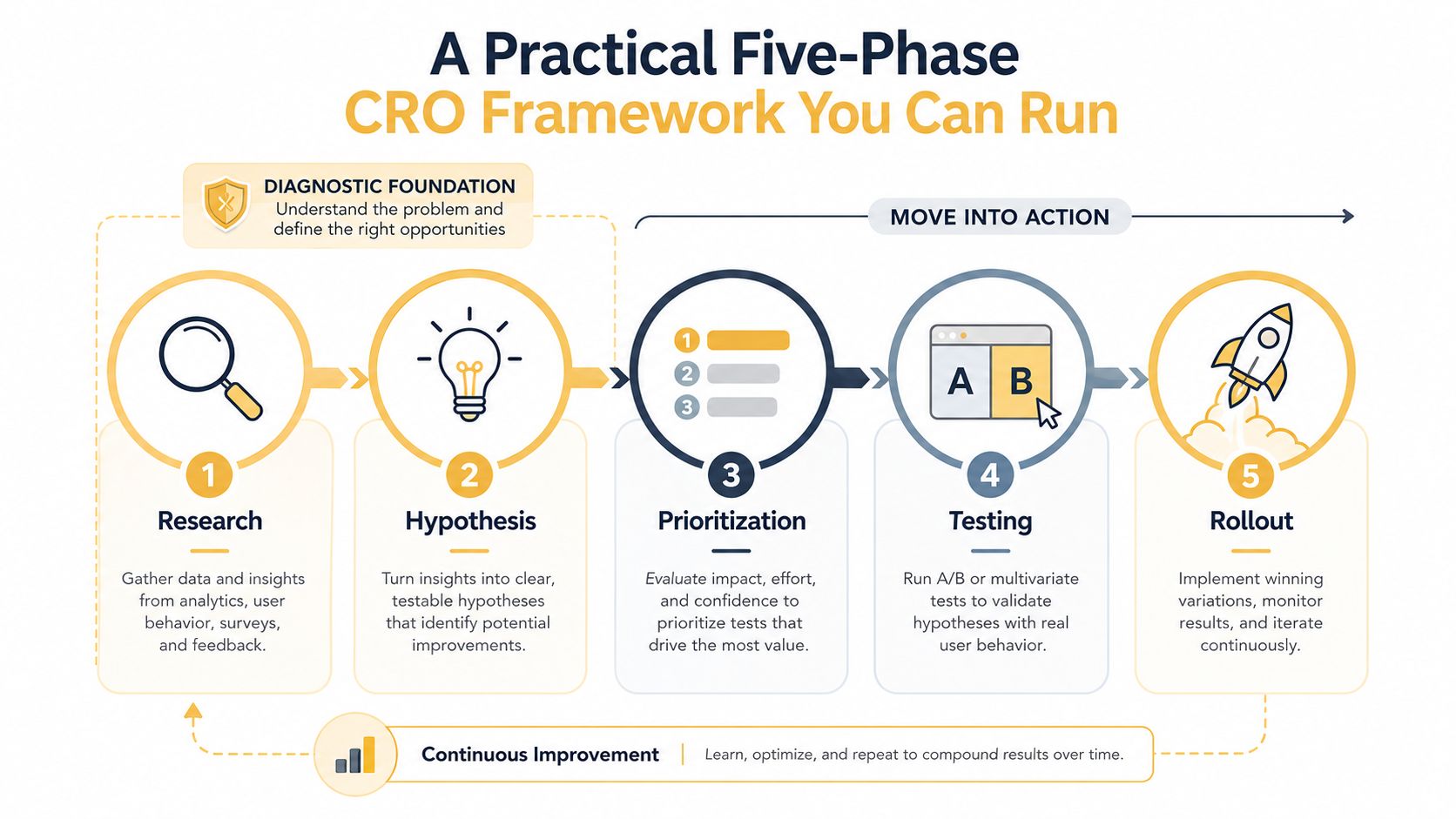
A useful CRO program moves from observation to action in a controlled sequence. The five phases below aren't separate checklists. Each phase produces the input needed for the next one.
1. Research
Start with funnel analytics, segmented performance, heatmaps, session recordings, customer-service conversations, sales objections, and interviews. Look for a specific failure pattern. “The homepage needs work” isn't a research finding. “Mobile visitors reach the shipping section, open the delivery details, and leave before payment” gives a team something testable.
2. Hypothesis
Turn the observation into a statement with a change, expected behavior, and primary metric. For example: “If we show delivery timing beside the add-to-cart button, more qualified visitors will begin checkout because uncertainty about arrival is reduced.” Keep the hypothesis narrow enough that the result can teach you something.
3. Prioritization
Rank ideas by likely impact, confidence in the diagnosis, audience exposure, and implementation effort. A high-traffic checkout problem supported by recordings should usually outrank a low-traffic color preference. Small teams can use a simple effort-versus-impact grid, provided they record why each idea received its score.
4. Testing
A controlled experiment splits traffic between a control and a variant. The result should be judged with hypothesis testing rather than an early numerical swing. Standard practice commonly uses a 95% confidence threshold, meaning the observed difference must have less than a 5% probability of occurring by chance, as described in this research on controlled A/B testing.
Set one primary conversion metric and define guardrails before launch. Check sample requirements, traffic quality, device mix, and test duration. Don't stop a test because a variant wins briefly, and don't change the audience or page midway unless the experiment plan allows it.
5. Rollout
A winning variant still needs monitoring after implementation. Confirm that the tracking event remains accurate, revenue and lead quality hold up, and no important segment suffers. Document the result, including inconclusive tests, because a test that fails can prevent your team from repeating the same assumption.
For additional examples of how content formats can affect performance, Landra's listicle performance statistics provide useful context, but your own audience data should decide what belongs in the next experiment.
Common CRO Tactics and the AI Testing Shift
Traditional CRO tactics still matter because visitors abandon for familiar reasons. They can't tell what the offer is, don't trust the business, encounter unexpected costs, struggle with a form, or find the page difficult to use on a phone.
A practical audit might examine:
- Landing page hierarchy: Does the headline match the visitor's intent, and does the page make one primary action obvious?
- Checkout friction: Can shoppers understand shipping, returns, taxes, payment methods, and account requirements before they commit?
- Trust signals: Are reviews, guarantees, security information, credentials, or contact details visible where hesitation occurs?
- Pricing presentation: Does the price make the value and commitment clear, or force visitors to search for basic information?
- Form design: Are fields necessary, labels clear, errors understandable, and autofill supported?
- Mobile behavior: Do buttons, menus, product images, and payment steps work comfortably on a small screen?
A team should test the highest-impact uncertainty first. A headline test may be appropriate when message clarity is the issue. A checkout-flow experiment is more relevant when users reach payment but fail to complete the order.
AI changes the workflow, not the need for judgment
AI-assisted tools can help draft copy variants, identify behavior patterns, predict promising layouts, and personalize page elements for different visitor groups. They can also reduce the manual work required to review recordings and generate ideas. They don't remove the need to define the conversion, protect data quality, or judge whether a result matters commercially.
| Dimension | Manual A/B Testing | AI-Assisted Testing |
|---|---|---|
| Variant creation | Marketers and designers write and build alternatives | AI can help draft copy, layouts, and audience-specific versions |
| Test structure | Usually focused on a clear control-versus-variant comparison | Can support broader experimentation and automated allocation |
| Sample requirements | Needs enough traffic for a reliable comparison | May help learn across variants, but still requires valid measurement |
| Learning velocity | Dependent on analyst review and test cadence | Can accelerate pattern detection and iteration |
| Strategic judgment | Human-led | Still human-led, especially for offer, brand, and guardrail decisions |
A 2025 study reported average conversion-rate improvements of 22.8% from automated recognition and enhancement of conversion elements, with 27.4% gains in e-commerce, as summarized in the study on automated conversion-element optimization. Treat those figures as evidence of a developing direction, not a guaranteed result for your site.
The same principle applies to behavioral signals. A 2026 paper reported eye-tracking-driven UI improvements ranging from 17% to 400%, while companies using eye-tracking tools reported 23% to 28% higher engagement than conventional A/B testing methods, according to this eye-tracking research on UI optimization. For most SMBs, the practical lesson is to improve observation and hypothesis quality before adding complexity. A grounded CartBoss guide to CRO success can provide more tactic ideas, but tactics still need validation.
For a focused explanation of experiment mechanics, see what is A/B testing.
A Mini Case Study That Makes the Gains Real
How can a checkout redesign show whether CRO created business value, rather than merely a higher completion rate? The accompanying illustration contrasts a complex multi-step checkout with a simplified flow that reduces friction and clarifies payment options. It presents a reported change from 2.1% to 4.8%, or a 128% lift, as a hypothetical example rather than a verified business result. Your own analytics and test record must support any figures used in a real case study.
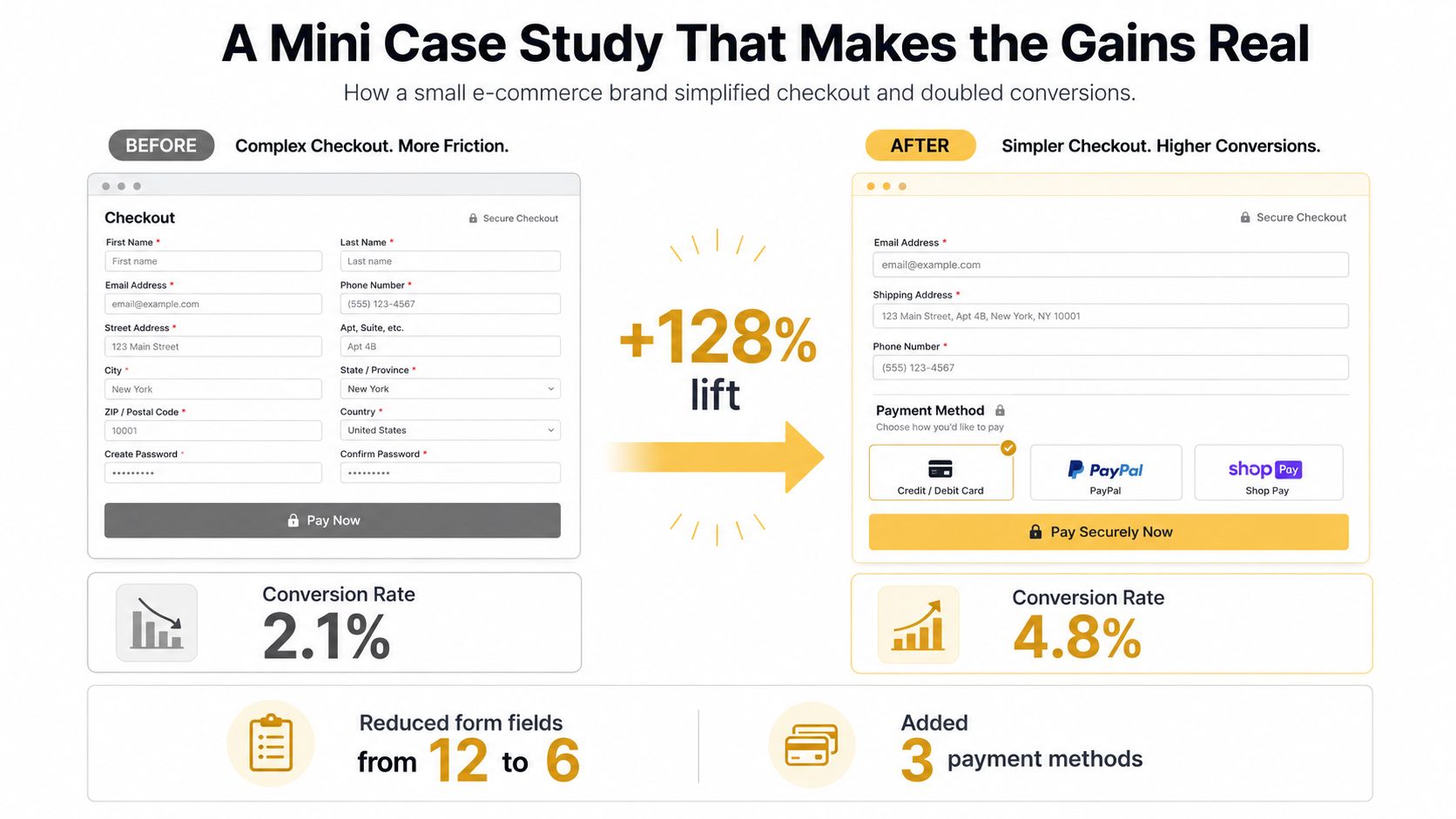
The hypothesis is straightforward: fewer form fields and familiar payment options may remove friction for some shoppers. A sound test records the baseline, defines the audience, lists each form and payment change, selects checkout completion as the primary metric, and sets the testing rules before launch. It also monitors revenue, refunds, payment failures, average order value, and support issues. A higher completion rate is not a win if it produces lower-quality orders or more payment problems.
What a real SMB test record should contain
A credible case study requires more than a before-and-after screenshot:
- Baseline: Record the original checkout conversion rate, order value, revenue, and relevant segments.
- Diagnosis: Use funnel data, recordings, form analytics, and customer feedback to locate friction.
- Hypothesis: Explain why the proposed change should affect the primary metric.
- Implementation: List every shipped change, including fields, payment methods, copy, and technical conditions.
- Test rules: Document audience allocation, duration, sample requirements, confidence threshold, and guardrails.
- Business outcome: Report completed orders, revenue, margin, refunds, and downstream customer quality.
This record prevents a common CRO error: assigning the result of several changes to one idea. Cutting fields, changing copy, adding payment methods, and redesigning the page at once may produce movement, but the team cannot identify which decision caused it. Audit friction first, isolate the highest-priority change, then test follow-up ideas, such as post-purchase offers, separately.
Open your checkout analytics and find where intent disappears. Compare devices, traffic sources, payment failures, field errors, and support questions. That evidence gives a small team a stronger starting point than copying a generic best practice.
Tools, When to Hire an Agency, and Your Next-Step Checklist
A workable CRO stack supports four jobs: measure behavior, identify friction, test changes, and document learning. Start with the tools you already use before buying a large suite.
Google Analytics 4 and platform reports can show acquisition, events, funnels, and revenue. Microsoft Clarity and Hotjar can add heatmaps, session recordings, and frustration signals. Google Tag Manager can help organize event tracking. Shopify, WooCommerce, HubSpot, and payment dashboards remain important because they hold transaction and pipeline truth. Tools such as Optimizely, Vibe, or Convert can support structured experiments.
Practical rule: Buy the smallest stack that can answer your next business question.
DIY CRO is reasonable when traffic is modest, tracking is dependable, someone can write a clear hypothesis, and a team member can review results without changing the experiment halfway through. An agency becomes more useful when tracking is unreliable, meaningful traffic is available, experiments need faster learning, or leadership wants an independent roadmap.
Choose a partner that connects recommendations to revenue and can explain inconclusive results. Be cautious with anyone who guarantees an arbitrary lift before reviewing your data, funnel, offer, traffic mix, and technical constraints. Up North Media is one option for businesses that need strategic research, Shopify expertise, design, development, testing, and implementation support.
A five-point launch checklist
- Define the primary conversion: Choose one main action for the experiment, then list relevant micro-conversions and guardrails.
- Verify tracking: Test page views, form events, purchases, revenue, device segmentation, and any off-site conversion path.
- Capture a baseline: Record current conversion rate, traffic mix, order value or lead quality, and the period used for comparison.
- Choose one high-impact hypothesis: Select a page with meaningful exposure and state the specific change and expected behavior.
- Set the rules before launch: Decide success criteria, guardrails, duration, sample requirements, and the confidence threshold.
After the test, review the primary result alongside revenue and quality metrics. Roll out only validated changes, document what happened, and place the next hypothesis in the queue. That operating rhythm turns CRO from occasional website tinkering into a repeatable growth capability.
Up North Media helps businesses connect analytics, e-commerce experience, SEO, AI consulting, and conversion-focused web development into a practical growth plan. Visit Up North Media to discuss your funnel, tracking setup, and highest-priority CRO opportunity.