

The popular advice is to benchmark a few models, pick the one with the highest accuracy, and move on. That approach works for a classroom exercise. It breaks down in production, where latency, feature costs, interpretability, maintenance, changing data, and operational risk often matter as much as predictive quality.
Algorithm selection is a system decision, not a model popularity contest. The useful question isn't “Which algorithm is best?” It's “Which selection method can keep choosing appropriately as the data, workload, and business objective change?” That shift matters for an e-commerce team protecting checkout speed, a publisher managing recommendation quality, and a local operator trying to schedule work without adding operational complexity.
Why There Is No Single Best Algorithm
The idea of one best algorithm collapses as soon as the operating context changes. Data structure, business objective, infrastructure, risk tolerance, and response requirements all shape the decision. A model that performs well on structured tabular data may fail on unstructured inputs, miss a strict latency target, or create unacceptable review work for a team that must explain each decision.
Benchmark rankings can create false confidence. Recent analysis found that even non-informative features and meta-models can appear highly accurate when the evaluation protocol is flawed, which makes headline accuracy unreliable (benchmark analysis on evaluation leakage). Weak splits, unrepresentative instances, and limited testing allow a selector to learn quirks of the benchmark rather than patterns that persist in production.

Accuracy is only one operating signal
A model can win an offline metric and still lose commercially. Expensive feature computation, slow responses, difficult retraining, or unstable behavior under distribution change can outweigh a modest gain in predictive quality. A less fashionable method may deliver more value because it costs less to run, is easier to inspect, and remains stable under realistic workloads.
The selector needs the same scrutiny as the models it chooses. A meta-model that maps problem characteristics to algorithms should be tested on held-out problems, not only on instances resembling its training data. ASlib's algorithm-selection guidance describes a practical setup: split problems for training and testing, calculate meta-features, rank candidate algorithms on training problems, and evaluate selection quality while accounting for feature-computation overhead.
Selection continues after launch
Static model choice assumes that customer behavior, traffic, inputs, and priorities remain stable. Production systems rarely get that guarantee. Data pipelines develop new failure modes, workloads shift, and a business may later favor lower cost or faster responses over a small quality improvement. Recent NeurIPS material presents online algorithm selection as an ongoing decision process, including approaches with no-regret guarantees (NeurIPS 2025 material on online algorithm selection).
The useful standard is reliability after deployment. Build benchmarking, resource-aware evaluation, monitoring, fallback behavior, and re-selection triggers into the design. A selection method earns its place by adapting to the conditions the system faces, not by winning a static leaderboard.
The Four-Phase Algorithm Selection Workflow
The reliable algorithm is rarely the one that wins a clean benchmark. It is the method that still makes sensible choices after data shifts, feature costs rise, and production constraints take effect. A practical workflow exposes those conditions before experimentation turns into an expensive search.
Phase one defines the decision
Start by specifying the decision the system must support, the action that follows, and the cost of a wrong or late result. Record acceptable latency, interpretability requirements, retraining expectations, infrastructure limits, and the budget for feature generation and inference.
A recommendation system may favor response time and graceful fallbacks. A risk workflow may require traceability and calibrated uncertainty. A scheduling system may value constraint satisfaction and operational stability more than a small gain in predictive score.
Phase two audits the data
Inspect the data before selecting candidate algorithms. Check example volume and freshness, missing values, label quality, feature types, class balance, duplicate records, and whether production inputs resemble historical training data.
Measure feature production cost at the same stage. A feature that depends on a slow external lookup may improve offline results while making the chosen algorithm unsuitable for a live request path. Record which features are available at decision time, rather than only which features exist in the warehouse.
Phase three establishes a floor
Create a baseline that every more complex approach must beat. Depending on the task, it could be a business rule, recent-value heuristic, majority class, linear model, or existing solver. The baseline makes added complexity accountable.
Use a split that matches the deployment unit. For solver selection, leave-one-instance-out or leave-one-problem-out evaluation trains the selector on all available problems except one, then tests its choice on the held-out problem. Stochastic algorithms require repeated runs and variability reporting, since one favorable result is weak evidence. The benchmark guidance cited earlier emphasizes representative instances, repeated stochastic runs, and cross-validation or independent holdout testing.
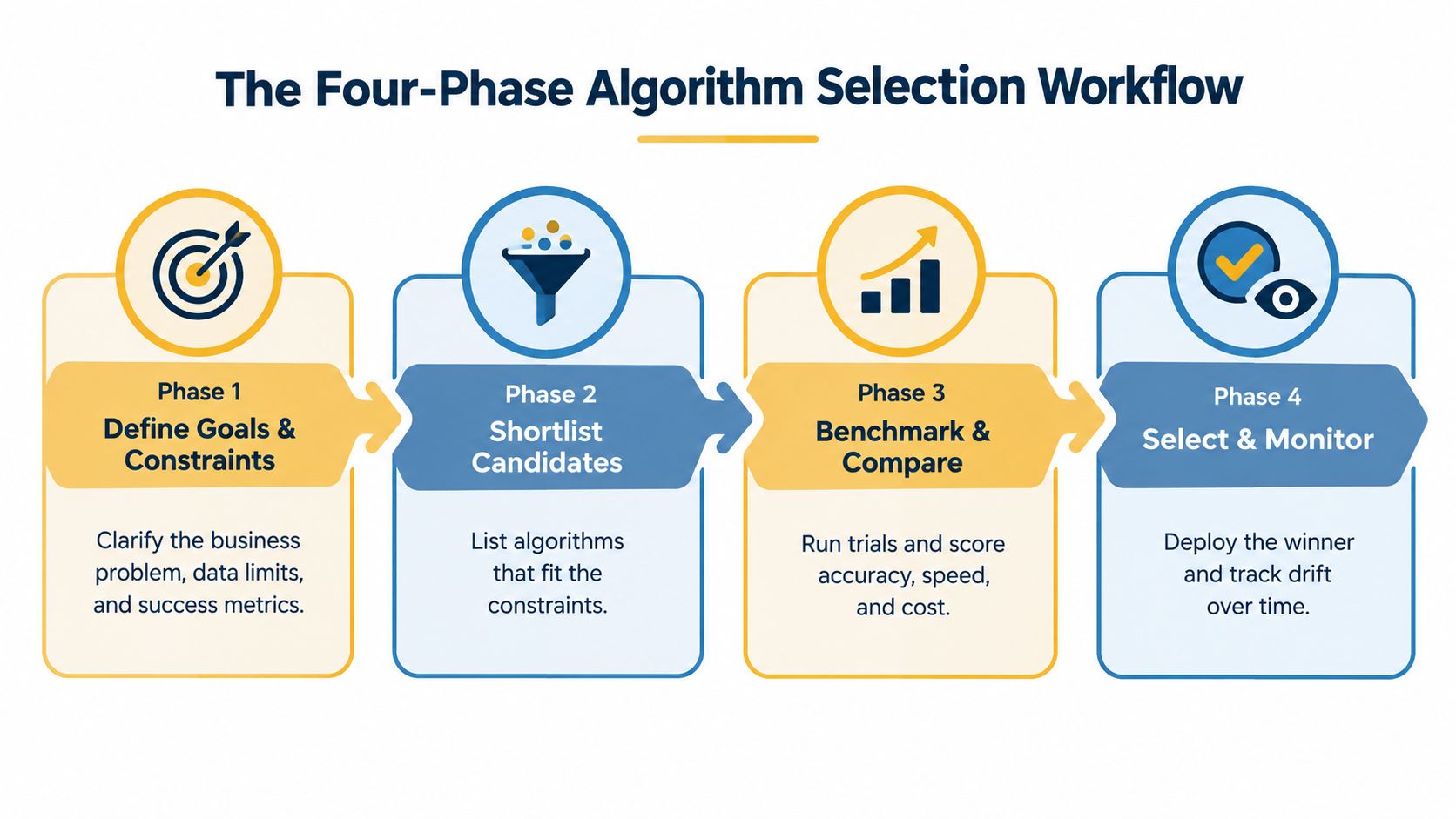
Phase four compares candidates with their real cost
Compare predictive or objective quality with inference time, feature computation, memory use, retraining effort, and failure behavior. For solver portfolios, nPAR10 helps express selection quality: 0 represents oracle performance, 1 represents the single-best solver baseline, and values above 1 indicate performance worse than that baseline. The measure matters because it includes the cost of choosing, not just the result produced afterward.
Keep an experiment log with the problem signature, selected candidate, objective result, feature cost, runtime, resource use, and fallback outcome. That record supports monitoring and later re-selection. It also makes the method auditable when operating conditions change.
Selection quality should therefore be judged over time. A method that wins offline but ignores feature latency, fallback behavior, or changing priorities is not a production solution. The workflow should make those costs visible before deployment and leave clear evidence for deciding when to adapt.
Comparing Classical ML, Machine Learning, and Deep Learning
“Classical ML” and “machine learning” are often used inconsistently, so the useful distinction here is between statistical or low-complexity methods, traditional supervised learning on engineered features, and deep learning for high-dimensional or unstructured inputs. The right category depends less on prestige than on the shape of the data and the team's ability to run the system.
| Category | Best For | When to Avoid | Typical Latency |
|---|---|---|---|
| Classical statistical methods | Small or structured datasets, transparent relationships, forecasting, scoring, and strong domain rules | Highly nonlinear relationships, raw media, or complex representation learning | Often low, depending on feature preparation |
| Traditional machine learning | Tabular data, mixed features, ranking, classification, and regression with engineered inputs | Inputs need learned representations, or manual feature work has become the main bottleneck | Often low to moderate, depending on model and feature pipeline |
| Deep learning | Images, audio, text, sequences, embeddings, and complex interactions | Limited data, strict interpretability, small teams, or infrastructure that can't support the lifecycle | Ranges from low to high, depending on architecture and serving setup |
Start with the simplest credible candidate
Linear models, generalized linear models, decision trees, and regularized statistical methods are strong starting points when the data is structured and stakeholders need an explanation. They also give you a diagnostic baseline. If a complex system barely outperforms a transparent model, the extra maintenance may not be justified.
Traditional machine learning often provides the best middle ground for business data. Gradient boosting, random forests, and carefully designed ranking models can handle nonlinear interactions without requiring a full deep learning platform. They still depend on feature quality, but the engineering loop is usually easier to inspect and retrain.
Deep learning earns its place when representation learning is central to the task. A vision system working directly with images or a language system processing raw text may need it. A small business predicting repeat purchases from a clean table of customer, product, and transaction fields often doesn't.
Automation needs a business case
Meta-learning and automated selection can help when the team repeatedly solves related problems and has enough historical benchmark information to learn from. A 2025 survey review describes a benchmark base of 4 million previously learned models and testing across 400 datasets, while also noting a lack of comparative evaluations (survey review of meta-learning for automated algorithm selection). That finding supports caution, not blind automation. The field is still looking for dependable decision rules, rather than a universal winner.
Evaluating Trade-offs That Actually Matter
The best offline score can be the wrong business choice. A checkout recommendation must return quickly enough to preserve the user experience. A publisher may accept more computation if the system provides an editorial explanation. A dispatch operator may prefer a stable, understandable method over a marginally stronger but fragile alternative.

Three trade-offs deserve explicit decisions
Accuracy versus latency is a product decision, not just an engineering measurement. An e-commerce retailer might accept a simpler recommender if it responds consistently during high-demand periods. A publisher with asynchronous article recommendations can evaluate a broader candidate set because the user doesn't wait for every score.
Interpretability versus performance depends on who must trust the output. A customer support team may need feature-level reasons for a routing decision. A fraud or eligibility workflow may need an audit trail. If stakeholders can't act on an explanation, adding interpretability theater won't solve the underlying governance problem.
Upfront cost versus maintenance appears after launch. A model may be inexpensive to prototype but costly to monitor because it depends on fragile features or specialized serving infrastructure. A simpler candidate may require more manual feature design yet remain easier for a small team to own.
A weighted scorecard makes these preferences visible. Assign each criterion a business weight, score every candidate against the same definitions, and document where a score comes from. Keep raw measurements beside the summary so nobody mistakes a subjective preference for an observed result.
Practical rule: A candidate shouldn't win because it has the highest score. It should win because its score remains acceptable after latency, feature cost, maintenance, and failure behavior are included.
For a local service provider scheduling dispatches, I'd score constraint satisfaction and operational stability heavily. For a content publisher, I'd add editorial control and explanation quality. For an online retailer, I'd give response time and fallback behavior a prominent place beside ranking quality.
Use a video walkthrough only as a supplement to the written decision record. The record should still identify the objective, measurement protocol, constraints, and deployment owner.
Real-World Case Studies from Up North Media
I can't substantiate the three named portfolio stories in the brief as verified case studies, so they shouldn't be presented as documented outcomes. The practical scenarios are still useful, provided they're treated as decision patterns rather than claims about measured client results.

The retailer with a strict response budget
A retailer serving recommendations during a live shopping session should begin by measuring the complete request path, not just model inference. Candidate algorithms need to be tested with feature retrieval, filtering, ranking, and fallback behavior included.
Collaborative filtering can be a sensible first candidate when interaction history is the strongest signal and the serving path is well understood. A deep model may become appropriate if the system must learn complex representations from text, images, or sequences, but that choice brings extra deployment and monitoring work. The selection method should therefore compare quality under realistic traffic conditions and retain a simple fallback for new products or sparse user history.
The publisher that needs editorial trust
A digital publisher may care about more than engagement. Editors may need to understand why an article was promoted, which audience signals influenced distribution, and how to intervene when a recommendation conflicts with editorial standards.
A gradient boosting model can be attractive in that setting because its structured features and post hoc diagnostics fit an explainable workflow. The selector shouldn't optimize a single ranking metric in isolation. It should include explanation quality, editorial controls, freshness, and the cost of reviewing unexpected recommendations.
For broader context on designing AI capabilities around business operations, see AI solutions for businesses. The useful lesson is to define the operating workflow before selecting the model.
The startup using automation for discovery
A fitness tracking startup may use automated machine learning to explore feature transformations and candidate families during prototyping. That can shorten the search process, but automation doesn't remove the need to define leakage controls, serving constraints, retraining ownership, and monitoring signals.
A custom neural architecture might eventually make for sensor sequences or multimodal inputs. It shouldn't become the default just because the prototype platform surfaced it. The production choice must survive a review of data availability, inference cost, debugging capability, and the consequences of drift.
Deployment and Monitoring Best Practices
A model that passes offline evaluation still needs a controlled release. Start with shadow traffic or a limited rollout, compare the incumbent and challenger on the same eligible inputs, and keep a deterministic fallback for missing features, service failures, and unfamiliar input patterns.
A/B testing can measure business impact, but it must respect the decision's unit and feedback loop. For recommendations, exposure changes future clicks and training data. For dispatching, a short-term outcome may hide operational effects that appear later. Log the candidate selected, the input signature, the decision, the outcome, and the resources consumed.
Monitor the input, decision, and outcome
A useful dashboard includes:
- Input health: Missingness, schema changes, freshness, and distribution shifts by important segment.
- Selection behavior: Which candidate wins, how often fallbacks occur, and whether the selector concentrates on one option unexpectedly.
- Operational cost: Feature computation time, inference latency, memory use, queueing, and failed requests.
- Outcome quality: The business objective, calibration where relevant, constraint violations, and delayed labels when they arrive.
- Data and concept drift: Changes in inputs and changes in the relationship between inputs and outcomes.
Don't set arbitrary alerts just to produce a green dashboard. Establish thresholds from baseline behavior, business tolerances, and the cost of investigation. Trigger a re-evaluation when the input distribution moves materially, labels show sustained degradation, a new data source changes the feature space, infrastructure costs rise, or the business objective changes.
Selection should have an exit plan. If the system can't explain when it will reconsider its choice, it isn't fully operationalized.
A cost-aware feedback loop stores both the selected algorithm and the alternatives' observed results when they can be measured safely. That record lets the team improve the selector instead of retraining it on a biased history containing only winners. The implementation plan should document ownership, rollback, and review cadence. A structured AI implementation roadmap can help teams place those controls before production launch.
Your Algorithm Selection Decision Toolkit
Use this decision tree before opening a model leaderboard:
- Is the input structured and the relationship reasonably transparent? Start with statistical or traditional machine learning candidates.
- Does the task depend on raw text, images, audio, or complex sequences? Add deep learning candidates, but price the serving and monitoring requirements.
- Are latency, interpretability, or infrastructure constraints strict? Eliminate candidates that fail them before comparing quality.
- Do you solve related problems repeatedly? Consider meta-learning or automated selection only after you have reliable benchmark records.
- Can the selector adapt after launch? Define drift signals, fallbacks, and re-selection triggers before deployment.
Your one-page review should include the business objective, eligible data, leakage controls, baseline, candidate list, evaluation split, feature cost, latency, interpretability, maintenance owner, rollback path, and monitoring signals. For teams building technical hiring capability alongside these systems, this practical guide to prepare for technical interviews offers useful preparation context.
The central principle behind AI consulting for businesses is also the right principle here: match the method to the operating problem. Don't select a model until you know how you'll judge it, serve it, monitor it, and replace it.
Up North Media helps businesses assess AI opportunities, design practical machine learning solutions, and connect algorithm choices to web applications and operating workflows. Visit Up North Media to discuss an algorithm selection project built around your data, latency, cost, and maintenance constraints.