
Your first compliance audit usually doesn't arrive as a neat project plan. It shows up as a customer data request, a security questionnaire from a buying committee, or a contract that won't move until someone can prove the controls are real. For an Omaha e-commerce team, that's when the spreadsheet system starts to crack, because the evidence lives in email threads, shared drives, and one person's memory.
That's why compliance management solutions have moved from nice-to-have software to core operating infrastructure. Market estimates now place the category in strong double-digit growth, with a global compliance software market projected at $35.37 billion in 2025 and $74.12 billion by 2031, and an enterprise compliance management market projected at $5.32 billion in 2025 and $16.52 billion by 2033. Both reports point to North America as the largest regional market, which lines up with what growing U.S. teams already feel in practice, compliance is no longer a back-office checkbox, it's part of how deals get signed and how customer trust gets earned. Mordor Intelligence's market outlook shows the category's scale, but the operational change matters just as much, because the best platforms don't just store documents, they connect policies, controls, evidence, issues, and audits into one working system.
If you've ever needed a practical starting point for people-related risk, contract risk alerts for HR is a useful example of how compliance work is moving closer to daily operations instead of sitting in a binder.
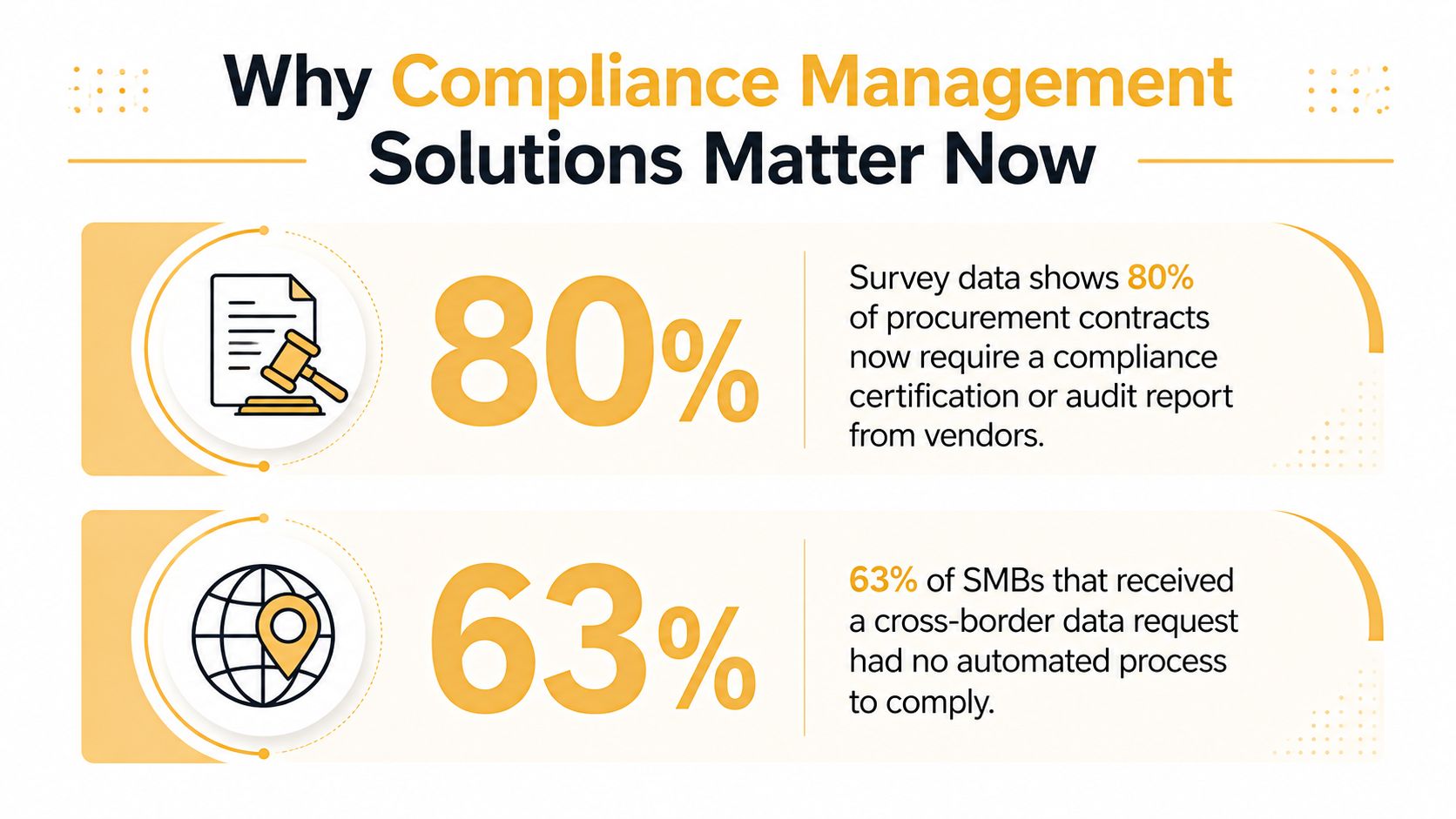
Why Compliance Management Solutions Matter Now
An Omaha founder can keep a store running on instinct, shared folders, and one careful operations lead for a long time. Then a European customer asks how GDPR requests are handled, or a larger retailer asks for SOC 2 before renewing a contract, and the team starts hunting for proof that was never assembled in one place. That is usually the point where it becomes clear the business does not have a compliance program, it has scattered artifacts.
From document storage to an operating system
The old model treated compliance as a filing problem. Policies were written once, evidence was exported at the end of the quarter, and audits turned into a scramble to reconstruct what happened after the fact. That approach holds up only until the business starts moving faster than the spreadsheet can keep up.
Modern compliance management solutions act more like an operating layer. They connect the requirement, the control, the evidence, the exception, and the audit trail so the team can see what is current without rebuilding the story every time a reviewer asks a question. For SMBs and e-commerce teams, that shift matters because the cost of being unprepared is not just stress during audit season, it is delayed deals, slower customer onboarding, and more internal time spent proving what should already be clear.
Practical rule: If your compliance evidence can only be assembled by one person in a panic, you do not have an auditable system yet.
The win is continuity. Teams stop treating compliance like a quarterly project and start treating it like an always-on business process, which fits privacy requests, vendor reviews, and certification cycles that come up throughout the year.
What the new expectation looks like
Growing U.S. teams already feel this shift. Compliance sits inside deal reviews, renewal cycles, and customer trust conversations, which is why the old “we will clean it up before the audit” approach creates real friction. For Omaha teams, that pressure often shows up first in contract review, especially when a procurement team wants proof that controls are documented and current.
A practical starting point for people-related risk is contract risk alerts for HR, which shows how compliance work is moving closer to daily operations instead of sitting in a binder.
The business case is stronger than the old “we should probably do this” argument. SecurityScorecard notes that organizations without proper IT compliance management face much higher costs than organizations with stronger programs, and that compliance automation is already widely deployed, which helps explain why the category has moved into mainstream enterprise spend. SecurityScorecard's compliance management overview makes the same broader point from a risk and operations angle, compliance work pays off when it is built into the way the company runs, not bolted on after the fact.
For Omaha teams, the takeaway is straightforward. The right platform does not make the audit disappear, but it changes the work from scattered reconstruction to managed operations. That is the difference between hoping your records hold up and knowing your controls can be shown, traced, and defended.
How Modern Compliance Platforms Actually Work
A strong platform is less like a document library and more like a control hub. It ties together regulations, policies, controls, evidence, issues, and audits so the compliance team can manage one operating model instead of five disconnected trackers. In practice, that means the software becomes the place where control ownership, evidence freshness, and remediation live together.
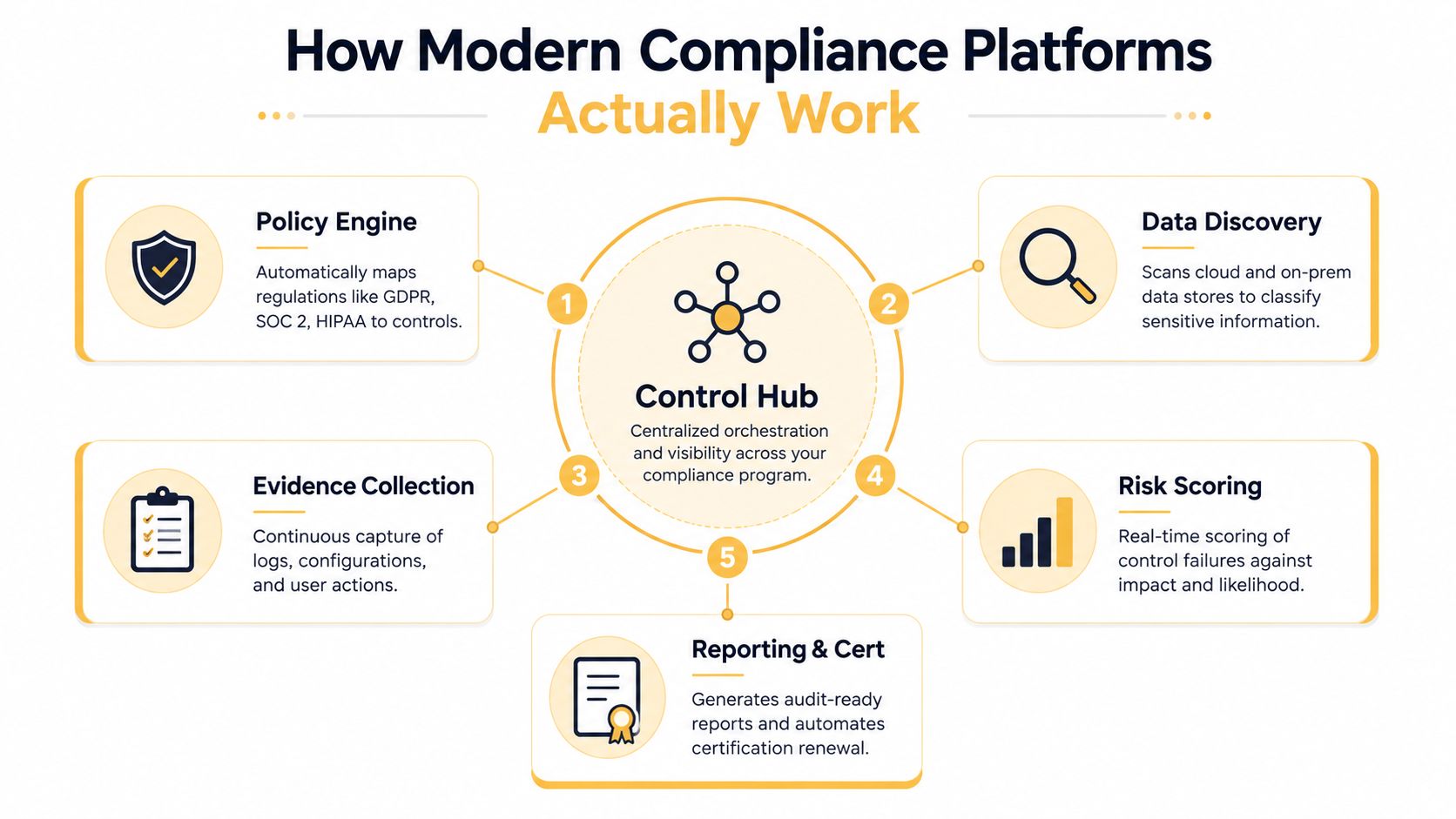
The control hub model
The most mature systems continuously, or on a schedule, pull evidence from systems of record such as SIEM, XDR, cloud security, IAM, EDR, and ITSM. They evaluate whether the control is working against the current state, then attach that result to one or more frameworks. UTMStack's compliance architecture overview describes this style of architecture clearly, and the important operational point is that one tested control can satisfy several frameworks at once.
That reuse matters. If your team has to prove the same underlying behavior separately for SOC 2, ISO 27001, and privacy obligations, the work multiplies fast. A well-built platform reduces duplicate testing, standardizes the control language, and keeps the audit trail tied to actual telemetry instead of spreadsheet exports.
Why evidence freshness changes the game
Traditional audit prep relies on sampling. Someone exports a report, takes screenshots, stores them in a folder, and hopes the evidence still reflects reality by the time the auditor reviews it. Continuous monitoring changes the timing. The platform can flag missing, stale, or failed evidence as soon as it appears, then auto-open a remediation task before the problem becomes a finding.
The platform senses, evaluates, and triggers a response. The business doesn't need more folders, it needs faster feedback loops.
Live evidence beats retrospective cleanup, because a control failure caught early is easier to fix, explain, and document.
That's also why the best implementations don't treat compliance as a bolt-on workflow. They connect to the systems already running the business, so controls stay grounded in real operational data rather than in manually maintained narratives.
Key Features to Evaluate in Compliance Software
Vendors talk about “automation” a lot, but that word hides very different capabilities. Some tools are little more than form builders with a nicer dashboard. Others can support a real compliance operating model, where evidence refresh, framework mapping, and remediation all happen with minimal manual chasing.
Foundational versus advanced capabilities
At a minimum, a platform should handle policy management, control libraries, evidence collection, and audit trails. If it can't do those four things cleanly, it's not ready for a serious SOC 2 or GDPR program. That said, basic capability isn't enough once the business starts growing or the framework count rises.
Advanced platforms add automated evidence refresh, multi-framework mapping, continuous monitoring dashboards, and integration APIs. Those features matter when controls need to reflect changing infrastructure, user access, and cloud configuration without waiting for someone to refresh a file. They're especially useful for e-commerce teams where infrastructure and customer data flows shift often, because the control environment needs to keep pace.
What to look for by business stage
| Feature Tier | Key Capabilities | Best For |
|---|---|---|
| Foundational | Policy storage, control lists, evidence folders, audit logs | Early-stage teams building their first formal program |
| Operational | Automated reminders, workflow approvals, version control, system integrations | SMBs moving from spreadsheet prep to repeatable audits |
| Mature | Continuous evidence refresh, cross-framework mapping, dashboard monitoring, remediation orchestration | Teams managing multiple audits or multi-region obligations |
A useful check is whether the tool fits your current operating model or forces you to redesign everything before you can get value. If you're still organizing your controls by hand, too much automation can be hard to adopt all at once. If you already have cloud, identity, and ticketing systems in place, a platform that can connect to them directly is usually the smarter move.
For teams trying to decide where automation fits alongside broader operations, business automation guidance can help frame the difference between task automation and process-level control.
Emerging capabilities that matter
AI features are only useful when they shorten a real workflow. Intelligent gap analysis can help spot missing evidence, and automated remediation routing can keep issues from getting lost. But avoid buying AI for its own sake.
The same caution applies to adjacent people-risk workflows. If your organization also needs a better framework for HR-related exposures, employment risk reduction strategies can show how compliance thinking extends beyond cybersecurity and into operational governance. The core lesson is the same, tools are only valuable when they reduce the number of manual decisions your team has to make.
The Cost of Ignoring Compliance Automation
Manual compliance doesn't just burn time. It adds cost to every audit, every customer review, and every contract negotiation. When evidence sits in inboxes and shared drives, each request turns into a mini project, and each project pulls attention away from work that moves the business forward.
The hard cost gap
The clearest financial case comes from the gap between organizations with stronger controls and those that still rely on manual cleanup. SecurityScorecard's compliance benchmark reports that the noncompliant group pays about 2.71 times more each year, with annual costs of $14.82 million versus $5.47 million, a spread of $9.35 million. That is not a small process improvement. It changes how leadership treats compliance spend.
For smaller organizations, the absolute numbers will not line up with enterprise scale, but the pattern does. Manual prep consumes skilled labor, slows responses, and increases the odds that a customer-facing deadline slips because the compliance record is not ready. Omaha SMBs and e-commerce teams feel that pressure quickly, especially when payment, privacy, and vendor reviews all depend on the same small operations team.
Where the waste shows up
A team without automation usually pays in four places. Audit preparation takes too long because evidence has to be assembled by hand. Remediation drags because the issue is not visible until someone notices it during review. Sales cycles stall when prospects ask for proof the team cannot produce quickly. Senior staff get pulled into low-value collection work instead of policy work, control design, or process improvement.
The productivity case is just as clear. SecurityScorecard's data says 68% of enterprise organizations have implemented compliance automation tools, 45% of mid-market companies plan to adopt them by 2025, and 70% of tools now use robotic process automation for repetitive compliance tasks. The same source says enterprises using automation report an average 40% reduction in manual compliance tasks and an average annual ROI of 225%. Those figures explain why teams keep funding automation. They want less chasing and more control, especially when multiple frameworks and data residency rules are in play.
Automation creates a compliance process the business can sustain. Speed is one benefit, but the larger value is steady evidence collection, faster issue tracking, and fewer last-minute scrambles.
If you are making the budget case, keep the focus on avoided rework, faster evidence production, and fewer deal delays. That is how compliance stops looking like overhead and starts looking like an operational safeguard.
Building Your Implementation Roadmap
Implementation fails when teams try to automate a process they haven't mapped. The better approach is to start with the business services, the systems that support them, and the specific controls that need reliable evidence. That sequence keeps the platform aligned with reality instead of with a wish list.
Start with architecture, not documents
The strongest programs are built around auditability, traceability, and data lineage. Research on compliance-focused data architecture highlights lineage and provenance as the basis for defensible reporting, because they document where regulated data came from, how it moved, and what changed along the way. This compliance architecture paper also supports a practical habit I've seen work repeatedly, model controls against underlying business services and technical dependencies, then review architecture changes before they reach production.
That matters because many compliance failures are architectural failures first. A new API, cloud service, or data flow can break a control dependency if no one checks the impact ahead of time.
A workable rollout sequence
- Discovery first. Inventory systems, data flows, policies, and current controls. Don't start by buying software before you know what it has to connect to.
- Map the frameworks. Choose the first compliance target, then connect its requirements to your actual control set.
- Connect systems. Tie the platform to cloud, identity, logging, and ticketing tools so evidence can flow automatically.
- Automate the workflow. Set approval chains, remediation steps, and reminders so issues don't disappear into email.
- Shift to continuous monitoring. Move from periodic evidence collection to live or scheduled refresh once the basics are stable.
For teams that want a parallel lens on sequencing digital projects, AI implementation roadmap guidance is a helpful reminder that even the smartest tooling still needs a disciplined rollout.
A practical shortcut is to pilot with one framework and a narrow control set. That gives you a real test of integrations, evidence freshness, and user adoption before you expand. It's far easier to tune one lane well than to automate five at once and discover the data model is wrong.
Navigating Data Residency and Jurisdictional Complexity
Vendor demos typically present compliance as a single centralized dashboard, which rarely reflects how multi-region teams operate. Real businesses are messier, especially if they sell into Europe, store customer data in the U.S., or run systems across several cloud regions. Beyond tracking controls, the harder question is whether the platform respects where data lives and how it moves.
The questions vendors need to answer
Buyers should ask where data is stored, where it is processed, and where it is backed up. They should also ask whether those choices fit security and privacy expectations in every market they serve. Independent buyer guidance from Cynomi's comparison of compliance management software makes the same practical point: a platform is only useful if it can show how its architecture matches the rules you face.
GDPR can collide with U.S. retention needs. One set of obligations pushes toward minimization, another can require retention for legal or operational reasons. A compliant program needs a documented answer for both, not a hand-wave.
Shared core, local variation
The strongest design pattern I've seen is a shared control core with regional overlays. The organization keeps one central way of mapping controls and evidence, while local rules adjust retention, hosting, access, or processing requirements. That avoids the chaos of building separate programs for each market, which usually creates duplication and inconsistent control language.
Server-side data practices also deserve attention in privacy planning. If customer data is routed through too many hidden steps, it becomes harder to explain lineage, retention, and access boundaries. Server-side tracking guidance is useful here because it reinforces a broader governance point, technical design choices shape compliance outcomes long before auditors show up.
For Omaha businesses expanding beyond local markets, the risk is assuming one clean policy can cover every jurisdiction. It usually cannot. The right platform helps you keep the core stable while layering regional requirements on top, which is far easier than rebuilding the control framework every time the business enters a new market.
Practical Checklists and Real-World Scenarios
Three scenarios come up again and again in SMB and e-commerce work. The first is a local company preparing for its first SOC 2 Type II audit. The second is a retailer balancing PCI DSS with GDPR for European customers. The third is a growing tech team adopting AI tools that create new data governance questions.
Quick scenario checklists
Omaha SMB first audit
- Inventory systems early. Identify where logs, access records, and policy documents live.
- Choose one control owner per area. Ambiguity turns into delays fast.
- Test evidence collection before the audit. Don't wait until the reviewer asks.
- Avoid overbuilding. A lean, accurate control set is better than a bloated one nobody maintains.
E-commerce team with PCI DSS and GDPR
- Separate payment and privacy evidence. Don't force one control trail to do everything.
- Review data residency questions with hosting and backups. Cross-border issues show up quickly in retail.
- Tie remediation to ticketing. Findings should become tasks, not notes.
- Avoid storing more customer data than the process needs. Extra data creates extra governance burden.
Tech company adopting AI tools
- Map where AI tools touch customer or employee data. Shadow workflows create hidden risk.
- Update policies before broad rollout. The rules should exist before the use case scales.
- Ask how evidence will be produced later. AI governance needs traceability, not just enthusiasm.
- Avoid approving tools without ownership. If nobody owns the data path, nobody owns the risk.
Vendor evaluation checklist
- Integration depth
- Framework coverage
- Automation quality
- Evidence lineage
- Workflow flexibility
- Support responsiveness
- Pricing clarity
The industry keeps moving toward continuous monitoring and automated evidence refresh, and that changes auditor expectations. Teams are no longer being rewarded for heroic last-minute cleanup. They're being judged on whether controls are visible, current, and traceable all year long.
If your team is replacing spreadsheet-based audit prep or trying to connect compliance work across privacy, security, and operations, Up North Media can help you think through the right digital foundation. Visit Up North Media to explore web app development, SEO, and AI consulting support that fits the way modern compliance teams work.